


Pahela Baishakh sales bounce back after two lean years

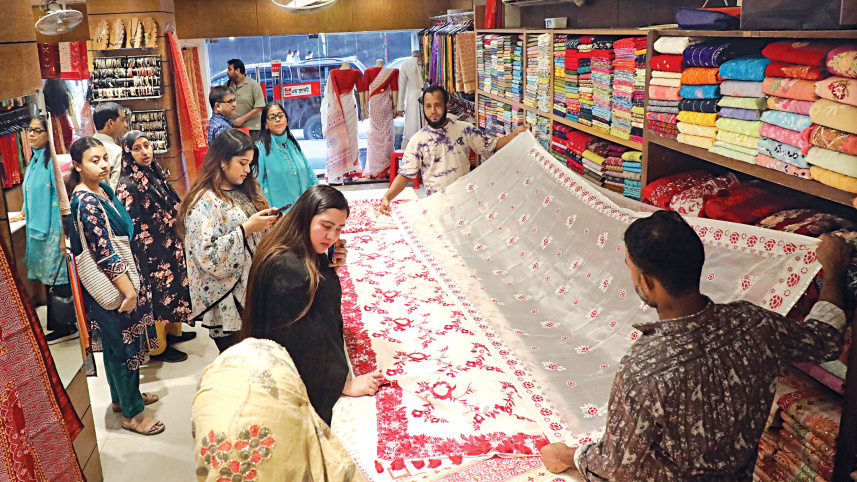
Sales of clothing items ahead of Pahela Baishakh, the first day of the Bengali new year and the second largest annual shopping season after Eid, have rebounded this year after two subdued seasons marked by overlapping festivities and political uncertainty.
Aside from clothing, sweetmeat and footwear traders are reporting improved sales centring the festival this year, though sales fell short of expectations.

Retailers from about half a dozen fashion brands said that business has picked up, as greater political stability has helped restore consumer confidence and improved footfalls. As Eid-ul-Fitr holidays fell in the third week of March, retailers as well as traditional clothmakers and weavers had at least two weeks to restock and organise collections for Baishakh.
Soumik Das, chief executive officer of Rang Bangladesh, said this year’s sales performance reflects a noticeable improvement compared to the immediate past two seasons.
The gap between Eid-ul-Fitr and Pahela Baishakh was somewhat short, so the fashion house made relatively moderate preparations. However, customer turnout has been encouraging, he said.
“When compared to recent years marked by political unrest, uncertainty, and shrunken consumer spending, this year shows a return toward normal retail behaviour.”
Khalid Mahmood Khan, co-founder of Kay Kraft, a retailer of clothing, accessories, home textiles, handicrafts, and handloom-based products, said this year’s sales have seen encouraging customer turnout, with noticeably higher interest compared to last year.
However, limited shop hours remain a key constraint, he said.
Across the market, wholesalers and saree distributors are reporting an upward trend in sales. At the production level, weavers and artisans are also seeing positive responses from designers and retailers, indicating strong demand for Baishakh clothing, Khan added.
Shaheen Ahmed, owner of Anjan’s, one of the leading fashion brands, said this year’s Pahela Baishakh sales have shown improvement, particularly in terms of customer turnout.
“After a long gap, we have produced Baishakh-specific products again, and the response has been encouraging, especially in major markets where customer flow has increased,” he said.
However, sales are still not at pre-2020 levels, and production volumes have also been limited compared to that period, Ahmed added.
Kamruzzaman Kamal, marketing director of PRAN-RFL Group, which operates Mithai, a sweetmeat and bakery chain, said this year’s sales are comparatively better than last year, mainly because last year the festival coincided with Ramadan.
Year-on-year growth in pre-orders, especially from corporate and organisational clients, has increased by 30 percent so far, he said.
On the other hand, Mahbubur Rahman Bokul, head of Bangladesh operations at Premium Sweets, said compared to a typical year, footfall is significantly lower, and demand remains subdued.
Global uncertainties, including the Middle East war and international political developments, appear to be affecting consumer confidence and spending behaviour, contributing to a slowdown in the retail environment, he said.
Md Jashim Uddin, manager for brand and marketing at Apex Footwear Limited, said this year’s sales have been relatively low in terms of consumer enthusiasm and customer footfall.
Since the festival comes immediately after Eid, when consumers have already completed a large round of purchases, the overall response for Pahela Baishakh is low, he said.
Apex is also being affected by shorter shopping hours, he said, adding that because of the restriction, the footwear brand is losing a significant portion of the expected daily sales potential, around 60 percent to 65 percent.
Sharifun Nesa Reba, director at SaRa Lifestyle Limited, said sales this season have grown modestly, with steady consumer enthusiasm around Pahela Baishakh.
 For all latest news, follow The Daily Star's Google News channel.
 Demand for traditional attire, lifestyle products, and festive essentials continues to support purchases, reflecting positive market sentiment despite economic adjustments, although growth remains limited compared to a typical season, she added.
Reba attributed the subdued performance to the recent oil and diesel crisis, which disrupted transport and reduced consumer mobility, making it difficult for many shoppers to reach major retail hubs and resulting in lower-than-expected turnout.
She added that mandatory shop closures after 7pm have further hurt business, causing potential sales losses of up to 50 percent.
RETAILERS RUE SHORTER SHOPPING HOURS
Retailers of footwear and sweetmeats say sales could have been stronger had shopping hours not been cut to 7pm. Many public and private sector employees prefer to shop after office hours, they said.
But shopping centres across the country now close in the evening because of an energy crunch linked to the Middle East war, which has disrupted global supply chains.
Soumik Das also said that operational restrictions, especially the enforced 7pm closing time, are significantly limiting potential revenue. Peak shopping hours naturally occur later in the evening.
Based on observed patterns, extending business hours even to 8pm could increase sales by 10 percent, while further extensions to 9pm could drive increases to 20 percent, or more in some cases, he said.
Extending operating time until 10pm, or allowing more flexibility from the 11th to the 14th, would significantly improve sales outcomes, said Kay Kraft’s Khalid Mahmood Khan.
Shopping during Pahela Baishakh is not only about purchasing products but also a social and lifestyle activity, where families and friends go out together, he added.
Mahbubur Rahman Bokul said that with most retail outlets closing early, overall street activity declines, affecting even businesses permitted to operate later. As a result, customer flow to Premium Sweets has reduced substantially, leading to an estimated 50 percent drop in sales.
Kamruzzaman Kamal said overall, Mithai is facing an estimated 20 percent loss due to early closures.
Comments