


BTRC sets base price for lower-band spectrum
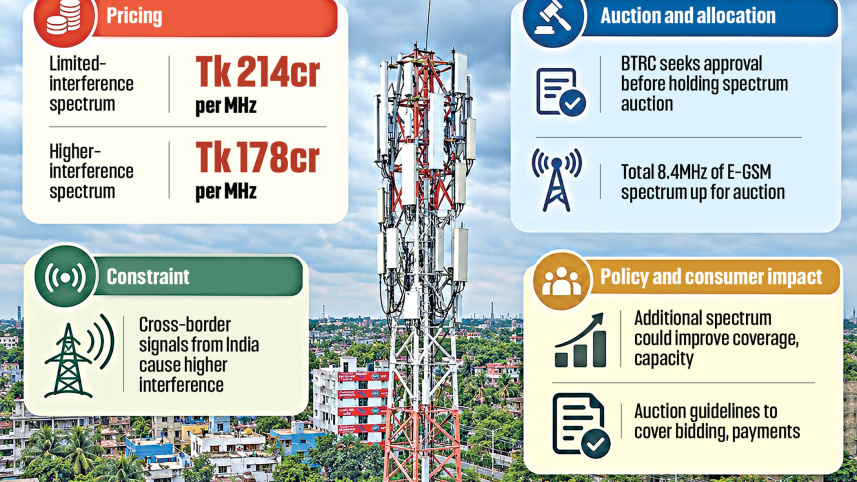
The Bangladesh Telecommunication Regulatory Commission (BTRC) has proposed a base price of Tk 214 crore per MHz for a block of E-GSM spectrum with limited interference, a lower-frequency band that helps mobile operators extend network coverage and improve indoor connectivity.
It has also proposed a price of Tk 178 crore per MHz for another block with higher interference.

The telecom regulator has decided to seek government approval for the proposed prices before holding the auction, which it intends to conduct this year.
For customers, the additional spectrum could improve network coverage and capacity, particularly in areas where mobile networks face congestion or coverage gaps. It could also support more reliable mobile internet services as operators deploy additional capacity.
A total of 8.4MHz of E-GSM spectrum will be up for auction.
According to BTRC documents, the 3.4MHz block with limited interference has a proposed base price of Tk 214 crore per MHz for 15 years, down 10 per cent from the benchmark price of Tk 237 crore.
The other 5MHz block, which faces higher interference from neighbouring India, has been priced at Tk 178 crore per MHz, a 25 per cent reduction from the same benchmark.
The commission has also formed a committee to prepare auction guidelines covering the bidding process, bid increments, spectrum tenure, payment arrangements, application processing fees, bid earnest money and annual spectrum charges.
The pricing decision comes as the telecom regulator seeks to make additional lower-band spectrum available to mobile operators to improve network quality and expand coverage, particularly in remote areas.
The proposed rates reflect differences in interference levels and the limited period for which the spectrum would be available. Both blocks are expected to be allocated only until 2030.
After 2030, spectrum allocation from this band would shift to the 850MHz band in coordination with neighbouring countries to achieve a lasting resolution.
The 3.4MHz block covers the paired frequency ranges of 885–888.4MHz and 930–933.4MHz. The 5MHz block covers 880–885MHz and 925–930MHz.
According to the BTRC, the latter block experiences significantly higher interference across substantial parts of the country because of cross-border signals from India. As a result, it cannot be used as effectively nationwide as the other block.
The regulator believes the proposed discounts would account for these technical limitations and the short allocation period while ensuring that the spectrum benefits consumers and generates revenue for the government.
The pricing proposal follows consultations among the BTRC, the Posts and Telecommunications Division and the Finance Division of the Ministry of Finance.
In a letter dated September 7, the Posts and Telecommunications Division asked the BTRC to proceed with the auction in line with the Finance Division’s opinion, as well as recommendations from the Spectrum Management Committee and applicable laws, regulations and guidelines. The division also instructed the regulator to obtain government approval wherever required.
The Finance Division said determining the base price of spectrum for auction falls within the BTRC’s statutory management process under the Bangladesh Telecommunication Regulation Act, 2001, and does not constitute the fixing of rates, charges, tariffs or fees that would require its consent on that basis.
Since the actual spectrum price would be determined through competitive bidding, the Finance Division had no objection to the BTRC addressing technical interference issues in accordance with applicable standards recommended by the International Telecommunication Union.
“The Finance Division and the Posts and Telecommunications Ministry have already opined that setting spectrum prices falls within BTRC’s jurisdiction. Despite that, we have decided to seek government approval, specifying the proposed price for the spectrum,” said BTRC Chairman Major General (retd) Md Emdad Ul Bari.
Of the 10MHz E-GSM band under consideration, 1.6MHz has already been allocated to Robi Axiata PLC, according to BTRC documents. The regulator is now preparing to auction the remaining 8.4MHz.
 For all latest news, follow The Daily Star's Google News channel.
 The Spectrum Management Committee recommended auctioning the available spectrum after finding that multiple operators had expressed interest in the same blocks.
The BTRC has argued that additional lower-band spectrum is urgently needed to improve mobile network quality and expand coverage.
The commission has also formed a committee comprising officials from its spectrum management, legal, engineering and finance-related departments to prepare the auction guidelines.
Comments