


Is Bangladesh’s low-cost garment model running out of steam?

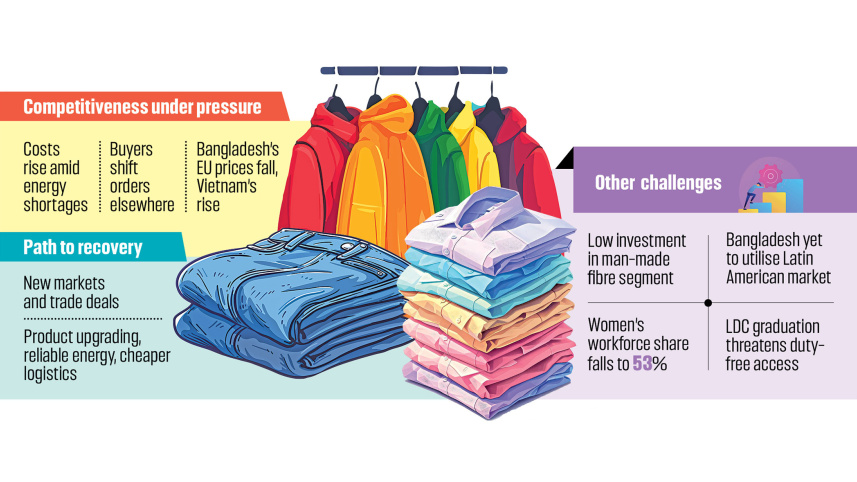
Bangladesh’s readymade garment (RMG) sector is facing mounting challenges as international clothing retailers and brands diversify their sourcing destinations. Rising production costs, energy shortages, geopolitical tensions and uncertainty over preferential market access after the country’s graduation from the least developed country (LDC) category are putting pressure on exporters.
The challenges are exposing the limits of a business model built on low production costs and competitive prices. Although many manufacturers have started moving towards higher-value products, the transition remains gradual.

The situation has raised questions about how well Bangladesh can compete as costs rise and trade preferences come under pressure.
At a recent press conference, Mahmud Hasan Khan, president of the Bangladesh Garment Manufacturers and Exporters Association (BGMEA), said several major international retailers and brands that had sourced garments from Bangladesh for years were shifting some work orders to other destinations for strategic reasons.
The prolonged energy crisis has further weakened buyers’ confidence, as some suppliers have struggled to meet shipment deadlines.
Meanwhile, geopolitical conflicts and Houthi attacks on commercial vessels in the Red Sea have disrupted shipping routes connecting Asia with Europe and North America.
With vessels increasingly rerouting around the Cape of Good Hope instead of travelling through the traditional Suez Canal, shipping journeys have become longer and more expensive.
These disruptions have also encouraged buyers to consider sourcing from countries closer to European markets, including Egypt and Ethiopia, to reduce logistical complications and shipping risks.
THE LIMITS OF A LOW-COST MODEL
Bangladesh established itself as a major global manufacturing hub for basic garments from the early 1980s, capitalising on an abundant labour force and low production costs.
That model helped the country become a leading apparel exporter in the world. But rising production expenses, combined with continued pressure on garment prices, are making it increasingly difficult to sustain the same competitive advantage.
In the European Union, Bangladesh’s garment export unit price is less than half that of Vietnam, reflecting, in part, the limited share of higher-value products in the country’s export basket.
Eurostat data show that the average unit price of garments exported from Bangladesh to the EU fell to €13.80 per kilogramme in January-June this year, from €15.07 in the same period of 2025.
By contrast, Vietnam’s average unit price rose to €29 per kg from €25.95 over the same period. China’s garment export unit price to the EU fell by 2.18 percent.
Among major garment suppliers to the EU, Bangladesh remains one of the cheapest, with only one supplier recording a lower average unit price.
Although many Bangladeshi manufacturers have started exporting higher-value products, the transition remains gradual. According to industry estimates, high-end garments account for 30 to 40 percent of the sector’s output, suggesting considerable scope for upgrading.
The government has been considering a gradual phase-out of export cash incentives, which supported exporters during the sector’s development, ahead of Bangladesh’s graduation from the LDC category.
On top of that, following LDC graduation, Bangladesh will face growing pressure to compete without relying on existing preferential trade arrangements.
The possible loss of duty-free market access is a particular concern. Unless Bangladesh secures the European Union’s GSP+ facility or negotiates a free trade agreement (FTA), exporters could face higher tariffs in a market that absorbs nearly 60 percent of the country’s garment exports, worth more than $25 billion annually.
Average duties on RMG products could approach 12 percent, further eroding the price advantage of Bangladeshi suppliers.
 For all latest news, follow The Daily Star's Google News channel.
 LABOUR AND INVESTMENT PRESSURES
The challenges extend beyond production costs and trade policy. After nearly five decades of growth, the first generation of garment entrepreneurs is ageing, while some second- and third-generation successors are struggling to sustain the traditional business model.
Several older factories are closing, and fresh investment in the sector is gradually slowing.
The workforce is also shrinking, particularly among women. Long working hours, demanding workloads and relatively low wages have discouraged younger workers from entering the industry.
According to the BGMEA, women made up roughly 80 percent of Bangladesh’s garment workforce between 1980 and 1994. The figure fell to 70 percent by 2005 and to around 53 percent in both 2021 and 2023, according to studies by the Ethical Trading Initiative, GIZ, BRAC University and the Bangladesh Institute of Development Studies (BIDS).
Industry insiders say younger workers increasingly prefer occupations such as driving auto-rickshaws or operating small shops, which they perceive as offering “greater flexibility and a more comfortable lifestyle”.
Automation and artificial intelligence are adding another dimension to the challenge, as factory owners adopt new technologies to reduce costs and remain competitive.
Meanwhile, some female garment workers have moved to countries such as Jordan, attracted by higher salaries, greater dignity and better employment benefits.
Despite these difficulties, Bangladesh has made significant progress in workplace safety and compliance. Inspections and remediation initiatives under the Accord and Alliance have improved factory safety standards, helping strengthen the country’s international reputation.
However, improved compliance alone will not guarantee continued competitiveness. Exporters must also contend with rising costs, supply-chain disruptions and the risk of losing preferential access to major markets.
THE WAY FORWARD
Bangladesh retains important advantages, including substantial installed production capacity and a large, experienced workforce capable of serving international retailers and brands.
The challenge is to build on these strengths while reducing dependence on price competition in basic garments.
One option is to diversify export destinations. Markets such as India, Japan, South Korea, Malaysia, Brazil and Argentina could help reduce dependence on traditional Western markets.
Bangladesh has been pursuing trade agreements to preserve preferential access after LDC graduation. These initiatives include an Economic Partnership Agreement with Japan and a Comprehensive Economic Partnership Agreement with South Korea, alongside negotiations with other countries.
According to BGMEA’s Mahmud, international buyers had become concerned about concentrating too much of their sourcing in Bangladesh, prompting them to diversify their supply chains.
Nevertheless, Bangladeshi exporters are increasingly targeting Asian markets, particularly Japan, India and South Korea.
He added that the BGMEA had lobbied the Ministry of Commerce to negotiate FTAs with countries such as Brazil and South Africa, where Bangladeshi exports face tariffs exceeding 25 percent. Such agreements could help exporters secure zero-duty access.
The association has also urged the government to negotiate with the United States to waive the 10 percent duty on garments using US cotton and man-made fibres. Expanding exports of higher-value man-made fibre products could further improve the sector’s prospects.
However, market diversification and trade agreements will need to be accompanied by improvements in domestic production conditions.
Mohammad Abdur Razzaque, chairman of Research and Policy Integration for Development (RAPID), said the garment industry was confronting numerous domestic and international challenges, with rising business costs being a central concern.
He emphasised that Bangladesh must strengthen its competitiveness by reducing production expenses, increasing prices per unit through value addition, ensuring adequate energy supplies and lowering logistics costs.
The sector’s long-term sustainability will ultimately depend on whether Bangladesh can move beyond its traditional reliance on low-cost production, according to the economist.
Modernising factories, upgrading products, diversifying markets and securing favourable trade arrangements will be crucial as the country navigates the post-LDC era, he said.
Comments