


Adaptation as misrecognition: ‘Siddhartha’ between text, philosophy, and stage

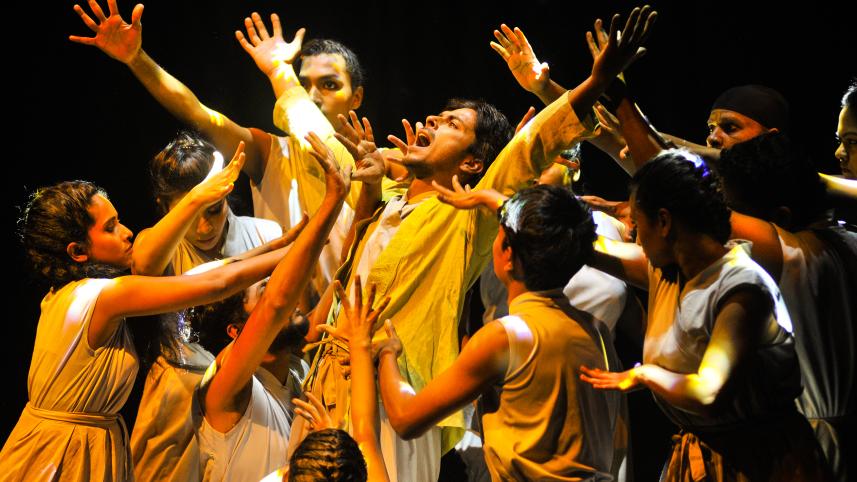
There is always a subtle tension when a story migrates across cultures. Some narratives travel with the lightness of wind, reshaping themselves almost effortlessly inside new imaginations, while others arrive heavy with the weight of the worlds that first produced them. Hermann Hesse's Siddhartha (S. Fischer Verlag, 1922) belongs to this latter category. It carries within it the long shadow of a Western gaze pondering the East, a fascination that blends desire, distance, and misrecognition. Before the curtain rose at the Experimental Theatre Hall of Bangladesh Shilpakala Academy and before I could surrender to Reza Arif's theatrical adaptation, I found myself returning again and again to this lingering tension. I had come to watch a play named "Siddhartha", but I was acutely aware that the Siddhartha on stage would not be the historical Buddha. Instead, this Siddhartha would be the child of a European novel shaped by a specific spiritual hunger of the West.
In Hesse's hands, Siddhartha is a symbolic seeker, a lone wanderer who believes that truth has to be tasted personally rather than received from teachers or traditions. That idea may feel intuitive to a contemporary western reader, but it stands in subtle tension with the historical reality of Buddhist enlightenment, which is steeped in communal practice, lineage, doctrine, meditation techniques refined over centuries, and an explicit rejection of the ego.

This is where the western gaze quietly narrows the terrain of Eastern spiritual biography. In classical Buddhist philosophy, enlightenment is not a poetic softening of the self but a profound dissolution of the illusion of selfhood. It is not the discovery of a truer inner self but the recognition that no self exists at all in the permanent sense. Hesse's novel, however, turns this metaphysical demandingness into an introspective psychological awakening. The Buddha becomes less a teacher of rigorous doctrine and more an emblem of serene authenticity. The journey becomes less about liberation from the cycle of suffering and more about the cultivation of an inward wholeness. Such a transformation is not insignificant. It shapes the very way audiences imagine Eastern spirituality: as something gentle, aesthetic, universal, floating free of its philosophical architecture. And such a reframing inevitably ripples into any adaptation that draws from Hesse.
The novel itself does not make the work easy for the theatre. It is episodic and contemplative. It moves like a river, looping from youth to asceticism to sensuality to despair and then returning to renewal. Siddhartha leaves home to seek the life of the Samanas, encounters the Buddha, yet chooses to forge his own path, learns the pleasures of love with Kamala, and accumulates wealth under the guidance of Kamaswami, sinks into spiritual fatigue and moral numbness, and then walks away once more to the river where he nearly chooses death. When he awakens, saved by the resonance of Om, he settles beside the ferryman Vasudeva and learns to listen to the many voices of the river. The river becomes the last teacher, revealing unity, cyclicity, and timelessness. The novel concludes with the return of the old Govinda, Siddhartha's lifelong friend, who, upon touching Siddhartha's forehead, experiences a vision of totality and recognises the depth of his enlightenment. This moment of recognition functions as both emotional closure and philosophical culmination. The theatrical adaptation, however, chooses to end earlier. Instead of returning to the friendship between Siddhartha and Govinda, it closes with the moment where Vasudeva guides Siddhartha into the river's layered voice. It ends on awakening rather than transmission.

As I took my seat inside the dimming hall and allowed myself a moment of anticipation, I felt the novel's philosophical compressions echoing in the background. Hesse's text is generous in imagery and introspection but austere in dialogue. The language is shaped by inner monologue, silence and symbolic encounters. Drama, in the classic sense of tension and relational friction, is sparse. A theatrical adaptation would therefore need to invent where the novel holds back. It would need to turn inward revelation into external gesture, stillness into movement, reflection into dramaturgy. The task was demanding. I was curious to see how Reza Arif would navigate these absences.
The opening moments surprised me. The decision to cast a female performer, Qazi Nawshaba Ahmed, as the young Siddhartha was immediately captivating. Her presence held a luminous fluidity. It offered a version of Siddhartha that felt unbound by gender, almost androgynous in essence, reminiscent of the idea that enlightenment is a state beyond identity. For a moment, the performance hinted at a particularly powerful reading: Siddhartha as a notion rather than a man, a seeker with a soul that transcends gender. This gesture resonated deeply with me, because it aligned with a philosophical intuition that certain spiritual itineraries dissolve categories rather than reinforce them. However, this interpretation did not carry forward into the rest of the play. As the narrative progressed, the production returned to a more conventional representation of Siddhartha's identity, leaving that initial experiment feeling like a brilliant but isolated spark. It raised a question in me about the courage and continuity required to sustain radical theatrical choices. The early gesture had immense promise but was not given space to mature into a structural idea.
The challenge of adapting a novel written in contemplative chapters was already evident by then. Theatre demands dramaturgy, and dramaturgy demands shape, pacing, tension and rhythm. The early dialogues, however, felt flat and overly declarative. They carried a tone of explanation, as if sacred truths were being announced rather than discovered. Many lines sounded preachy in a way the novel never intended. Hesse's prose breathes through silence and rhythm. It creates an atmosphere more through suggestion than through exposition. The production could have embraced a more poetic vocabulary, allowing the dialogue to be porous, metaphorical, rhythmic, and responsive to the shifting emotional terrain. Instead, the scenes moved through statements rather than revelations. This made the opening arc feel somewhat rigid.
The blocking in these early movements also felt constrained. There were moments that called for illusion, ambiguity, and choreographic abstraction, but remained static instead. This was striking because the director later embraced symbolic choreographies with confidence, and those later sequences were some of the most arresting parts of the play. The shift between early stiffness and later fluidity made me feel that the production carried two different selves: one cautious and literal, the other daring and imagistic.
Given that many performers appeared to be new to the stage, a few lighting cues and musical transitions slipped. These may seem minor, but in a production as spiritual and atmospheric as "Siddhartha", rhythm is integral. Missed cues can elongate scenes that should feel sharp or contemplative, pulling the audience out of the spell. The pace became stretched at times, especially in the first half. The script also glossed over the dramatic beats that could have lifted the early scenes toward their emotional peaks. Siddhartha's spiritual thresholds in the novel are quiet, but they are charged with interior turbulence. Representing that on stage requires a dramaturgical sensitivity to tension building. Without that, the first part of the performance struggled to find its pulse.
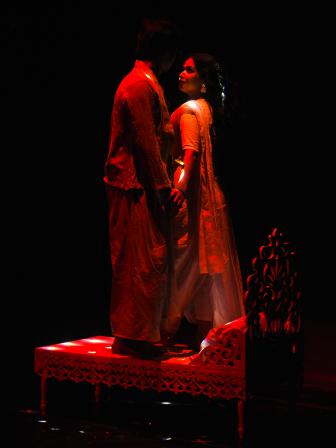
Yet in the midst of these challenges, there were performances that grounded the production. The scenes with Kamala were beautifully realised. The performer, Jeenat Jahan Nisha, carried her scenes with a compelling mixture of sensuality, precision, and emotional intelligence. Her presence seemed to open up the stage in a way that allowed Siddhartha's transformation to feel lived rather than narrated. The set design also contributed immensely to the sense of journey. It was visually imaginative, creating symbolic landscapes that echoed the emotional shifts in Siddhartha's arc. As the production moved toward the later chapters, it found a steadier rhythm. The portrayals of the older Siddhartha, performed by Maeen Hasan and the older Vasudeva, performed by Refat Hasan Saykat, were sincere and layered. Ariful Islam Neel who played Siddhartha's son offered a surprising depth, bringing forth the stubbornness, longing, and vulnerability of a child navigating abandonment and expectation.
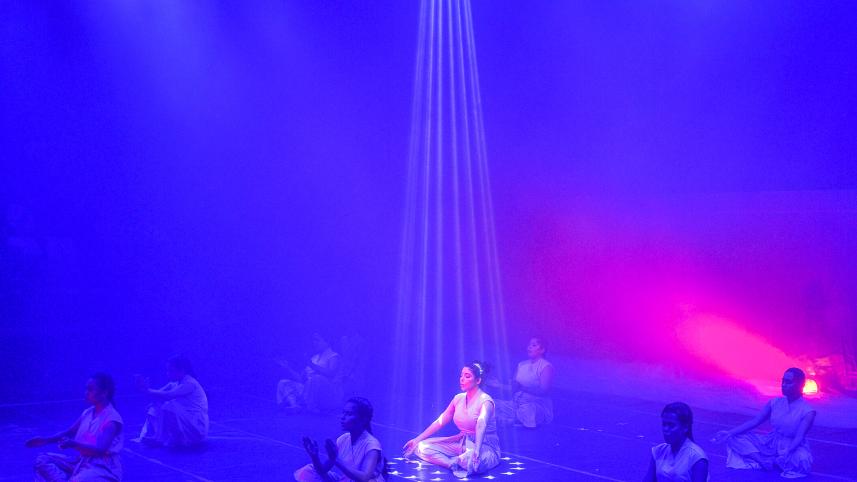
The more I watched, the more I realised that the strengths of the production lay in its visual and choreographic language. The play was at its most powerful when it embraced movement, imagery, and symbolic representation. These moments allowed the philosophical dimensions of the story to breathe in nonverbal ways. The river sequences, the choreographed transitions, and the contemplative stillness of Vasudeva's presence created a space where meaning felt embodied rather than explained.
But Siddhartha is a work that also demands intellectual architecture. Without a grounded understanding of Buddhist philosophy and the dramaturgical craft necessary to shape internal transformation into external drama, an adaptation can inherit limitations from the original novel without interrogating them. Hesse simplifies the doctrines of impermanence, suffering, and non-self into poetic metaphors. A theatrical adaptation that does not return to the philosophical roots risks reproducing that simplification. What is required is a director who sees dramaturgy and philosophy as intertwined. Siddhartha's journey is not only about movement across space but about movement across consciousness. That journey has its own dramatic structure, which must be rendered with care.
The production had immense poetic potential, and it often reached toward it. The design instincts were strong, the performers sincere, and the choreography evocative. But without a more cohesive dramaturgical vision, the experience remained beautiful yet incomplete. It touched the surface of spiritual transformation but did not always descend into its depths. The materials were present, the ambition clear, and the sincerity palpable. What remains is the need to harmonise all these elements so that design, text, philosophy, and movement exist not as fragments but as one flowing current. In that sense, the play is much like the river at the heart of Siddhartha's story. Many voices, many textures, many possibilities. What it seeks is a unity that can hold them all together.
Naseef Faruque Amin is a writer, screenwriter, and creative professional.
 For all latest news, follow The Daily Star's Google News channel.
Comments