


Putin critic Navalny was poisoned with Novichok, Germany says
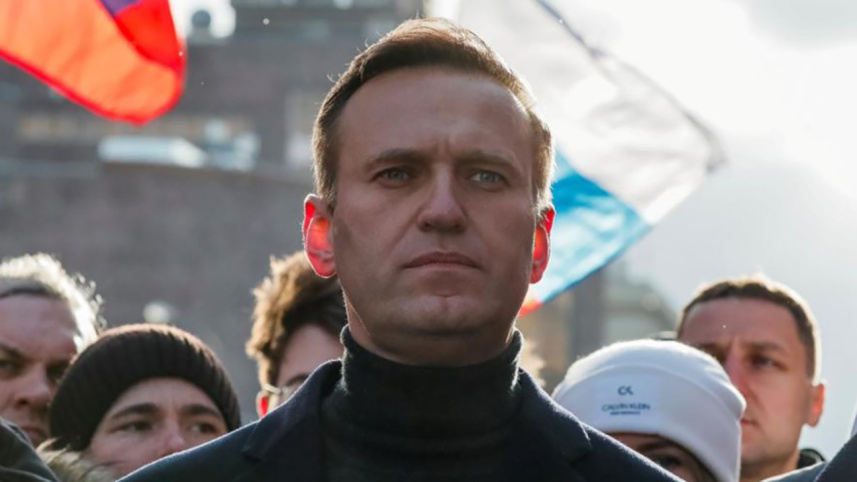
A critic of President Vladimir Putin who fell into a coma in Russia and is being treated in Berlin was attacked with a Soviet-style Novichok nerve agent, a German government spokesman said on Wednesday.
Tests conducted at a German military laboratory produced "unequivocal evidence" that Alexei Navalny, Russia's most prominent opposition figure, had been poisoned with Novichok, Steffen Seibert said in an emailed statement.

An agent of the same family was used two years ago to poison a Russian defector living in Britain.
"The federal government will inform its partners in the EU and NATO of the results of the investigation," Seibert added. "It will discuss an appropriate joint response with the partners in the light of the Russian response."
Russia is already under Western sanctions after its annexation of Crimea from Ukraine six years ago, and another stand-off with European nations or the United States may hurt its economy further.
Russian prosecutors said last Thursday they saw no need for a criminal investigation as they had found no sign that any crime had been committed.
The Russian rouble extended losses against the euro after the German government statement.
Navalny, 44, was airlifted to Germany late last month after collapsing on a flight from the Siberian city of Tomsk to Moscow, which had to make an emergency landing in Omsk.
Alexei Navalny is the victim of a murder attempt with the nerve agent Novichok, German Chancellor Angela Merkel said on Wednesday, adding that Russia must answer "difficult questions" related to the attack against President Vladimir Putin's critic.
"This is disturbing information about the attemped murder through poisoning against a leading Russian opposition figure," Merkel said.
"Alexei Navalny was the victim of an attack with a chemical nerve agent of the Novichok group. This poison could be identified unequivocally in tests."
German Foreign Minister Heiko Maas urged Russia to investigate Navalny's poisoning now that clinical tests had shown he had been attacked with a chemical nerve agent.
"This makes it all the more urgent that those responsible in Russia be identified and held accountable," Maas told reporters. "We condemn this attack in the strongest terms."
A Kremlin spokesman said Germany had not informed it that it believed Navalny had been poisoned with Novichok, according to the RIA news agency.
Novichok is a deadly group of nerve agents developed by the Soviet military in the 1970s and 1980s.
Britain says Russia used Novichok to poison former spy Sergei Skripal and his daughter in the British city of Salisbury in 2018. Russia has repeatedly denied any involvement in the attack, which the Skripals survived. A member of the public, 44-year-old Dawn Sturgess, was killed.
What is Novichok, the poison Germany says was used on Alexei Navalny?
Novichok, the nerve agent that Germany says was used to poison Alexei Navalny, a critic of Russian President Vladimir Putin who is in a coma in a Berlin hospital, was developed in the Soviet Union in the 1970s and 1980s.
-- The name Novichok means "newcomer". It is used for a family of highly toxic nerve agents with a composition slightly different from the better known poison gases VX and sarin.
-- Novichok agents are believed to be five to 10 times more lethal than those substances, although there are no known uses before 2018, when Novichok was deployed in Britain on a former Russian spy and his daughter.
-- Moscow is not believed ever to have declared Novichok or its ingredients to the Hague-based Organisation for the Prohibition of Chemical Weapons (OPCW), which oversees a treaty banning their use.
 For all latest news, follow The Daily Star's Google News channel.
 -- The weaponisation of any chemical is banned under the 1997 Chemical Weapons Convention, of which Moscow is a signatory.
-- In November 2019, members of the OPCW agreed to expand its list of banned "Schedule 1" chemicals to include Novichok agents. That ban went into effect on June 7, 2020.
-- Novichok was made with agrochemicals so that its production could more readily be hidden within a legitimate commercial industry, according to U.S. chemical weapons expert Amy Smithson.
-- Russia and the United States once ran two of the largest chemical weapons programs in the world. Russia completed the destruction of a stockpile declared to the OPCW last year. The United States is in the final stages of destroying its own stockpile.
-- However, publications about development and testing of Novichok in the 1990s raised U.S. suspicions that the Soviet Union had a secret weapons program, and did not declare its full stockpile when it joined the OPCW.
-- Russia was once believed to possess thousands of tonnes of weaponised Novichok varieties and their precursors, according to a 2014 report by the US-based Nuclear Threat Initiative, a non-partisan group working to reduce the threat of weapons of mass destruction.
-- The chemical "causes a slowing of the heart and restriction of the airways, leading to death by asphyxiation", according to Professor Gary Stephens, a pharmacology expert at the University of Reading. "One of the main reasons these agents are developed is because their component parts are not on the banned list."
-- Britain says Russia used Novichok to poison former spy Sergei Skripal and his daughter Yulia in the British city of Salisbury two years ago. Russia has repeatedly denied any involvement in the attack, which the Skripals survived. One member of the public, Dawn Sturgess, was killed. Decontamination and recovery measures in the city cost millions of pounds.
Comments