


Lost warship dents Russian pride, capability
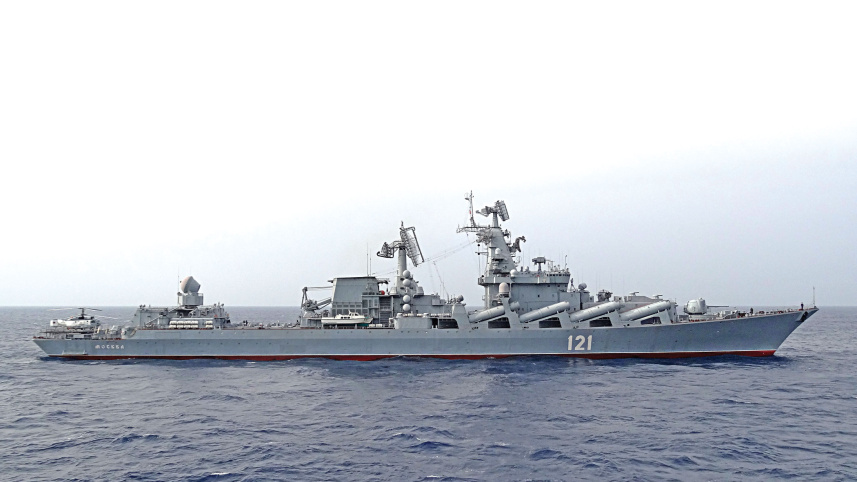
Russia's loss of its flagship cruiser Moskva represents a dent in the operational capabilities of the Russian navy and a severe wound to Russian pride at the height of the war against Ukraine, analysts say.
The Moskva sank on Thursday after an explosion and fire that Ukraine claimed was a successful missile strike and Russia said was the result of exploding ammunition.

Until the sinking of the Moskva, nobody had good reason to doubt Russia's supremacy in the Black Sea during the conflict with Ukraine but these calculations have now changed.
"In symbolic terms this is a great loss," said ex-admiral Pascal Ausseur, director general of the Toulon-based Mediterranean Foundation of Strategic Studies (FMES).
The 12,000-ton ship should have been able to withstand one missile impact or more and get a fire under control, but instead went under in just 12 hours, he told AFP.
"That was not part of the plan," Ausseur said, adding that the Moskva probably housed the command post for the naval group which now will have to find a new home.
Coming after successive setbacks for President Vladimir Putin in the 52-day-old war -- including an unexpectedly weak air and land combat record -- the loss of the Moskva will also have a real impact on the Russian navy's ability to attack Ukrainian targets and keep its fellow fighters safe.
The 186-metre- (610-foot-) long cruiser was equipped with 16 surface-to-surface Bazalt/Vulcan missiles used against ships as well as Fort missiles, which are navy-adapted versions of long-range S-300s, and short-range Ossa missiles.
Able to carry a crew of 680, its role was to give air cover to other ships during their operations, especially during the bombing of targets on the coast and landings, according to a Telegram post by Sergei Brachuk, a spokesman for the Odessa regional military administration.
But beyond representing a body blow to Russian military prestige, the Moskva's loss is probably not a game changer for the Russian campaign, Western analysts said.
"The rest of the Black Sea Fleet remains a puissant force," said Nick Brown at British intelligence analysis firm Janes.
The remaining force is all the more crucial for Russian capabilities as Moscow cannot dispatch a replacement for the Moskva while Turkey keeps the Bosphorus and Dardanelles straits closed to warships.
This, some analysts say, may not make a huge difference to the current phase of the war which has seen the Russian navy play a limited role.
But the ship's loss could force Moscow to revise any plans to give the navy a bigger role in the future, said Maia Otarashvili at the Foreign Policy Research Institute.
The full story of what caused the Moskva's demise are unlikely to be known soon, as experts will need to examine its hull which is now somewhere in the depths of the Black Sea.
But it's already clear that the disappearance of the Moskva "reveals a real vulnerability" of the Russian navy, Ausseur said.
 For all latest news, follow The Daily Star's Google News channel.
Comments