


Financing the dream of owning a home
For many Bangladeshis, buying a first home is less a question of whether they want to own one and more a question of whether they can afford it. With land, apartment and construction costs rising steadily, paying the full price upfront is beyond the reach of most middle-income households. A home loan can make ownership possible by spreading the cost over years, but getting one approved is not as simple as finding a property and filling out a loan form. Banks and housing-finance institutions scrutinise the borrower’s income, repayment capacity, existing liabilities and, perhaps most importantly, the legal status of the property.
A growing housing-finance market

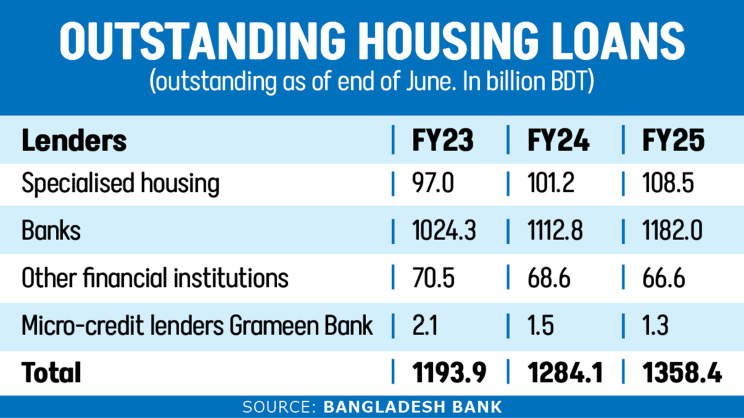
Bangladesh’s housing-finance market continued to expand in FY2024-25. According to Bangladesh Bank, outstanding housing loans of banks and financial companies stood at Tk 1,358.4 billion at the end of June 2025, equivalent to 7.8 per cent of total private-sector credit. Private commercial banks remained the dominant lenders, with outstanding housing loans of Tk 780.9 billion. State-owned commercial banks followed with Tk 340.2 billion, while other banks accounted for Tk 60.9 billion. Specialised housing-finance companies also held a significant Tk 108.5 billion in outstanding housing credit.
The Bangladesh House Building Finance Corporation (BHBFC), the country’s only state-owned specialised housing-loan lender, had Tk 53.9 billion in outstanding credit in FY2024-25. During the year, it disbursed Tk 9.2 billion against recoveries of Tk 7.1 billion. Bangladesh Bank also reported that the government-managed Grihayan Tahobil released Tk 6.9 billion among enlisted NGOs by the end of June 2025, with a recovery rate of 95 per cent. Through this fund, 106,261 houses were built in FY2024-25, highlighting the broader role of institutional finance in expanding access to housing.
What lenders look for
The documentation requirements can also be demanding. Banks generally divide applicants into categories such as salaried employees, businesspeople, self-employed professionals and property-income earners. For salaried applicants, lenders commonly ask for a national identity card, photographs, salary certificate or employer’s introduction letter, bank statements and evidence of existing loans. IFIC Bank’s current home-loan requirements, for example, include a 12-month bank statement, loan statements, credit-card statements where applicable, salary certificate or other proof of income, TIN certificate, utility bill and NID. Dhaka Bank asks business applicants for documents including a valid trade licence, partnership or company documents where applicable, company bank statements and information on existing company loans. City Bank’s Islamic home-finance requirements similarly ask self-employed professionals for income declarations, bank statements showing professional income and professional qualification or membership documents.
When the property becomes the problem
For many applicants, proving income is only half the battle. The property itself must pass the lender’s legal and technical scrutiny. Depending on whether the loan is being used to buy an apartment, purchase land or construct a house, lenders may require ownership deeds, previous deeds establishing the chain of ownership, mutation records, land-tax receipts, approved building plans, developer documents and other legal papers. BHBFC’s own loan process includes a site visit, legal ownership report, cost-estimation report, viability assessment and final approval before disbursement.
This is where many prospective homeowners encounter their biggest obstacles. A borrower may have a stable salary but still fail to qualify because existing personal loans, credit-card balances or other liabilities leave insufficient repayment capacity. Self-employed applicants can face another problem: irregular or poorly documented income. Cash-based earnings may be real but difficult to demonstrate through conventional banking records. Incomplete tax records, inconsistent bank statements and insufficient employment or business history can also weaken an application.
Property-related complications are equally common. Disputed ownership, incomplete mutation, discrepancies between deeds and land records, unapproved construction or problems with a developer can delay or derail financing. Banks must protect themselves against the possibility that the property offered as collateral has a legal defect, so a borrower may find that a seemingly straightforward purchase takes weeks or months to clear the lender’s verification process.
The rising cost of borrowing
The cost of borrowing has also become a major concern. Bangladesh Bank data showed housing-loan rates rising sharply in recent years, with the maximum rate reaching as high as 17 per cent in January 2024, compared with 9 per cent in January 2022. Rates remained elevated through January 2026, putting additional pressure on borrowers who depend heavily on bank financing.
Preparing before taking the loan
That makes preparation crucial for a first-time buyer. Before applying, prospective borrowers should calculate an EMI they can comfortably afford rather than borrowing the maximum amount available. They should maintain an emergency fund separately from their down payment, organise tax and banking records, disclose existing liabilities and verify the property’s legal status before committing a large advance.
Choosing a loan you can live with
A home loan can turn the aspiration of owning a first home into a realistic possibility. But the key is not simply getting a bank to say yes. It is ensuring that the monthly repayment remains manageable long after the excitement of buying the home has faded. For a first-time homeowner, the safest loan is therefore not the biggest one a lender is willing to provide, but the one that can be repaid without putting the rest of the household’s finances at risk.
 For all latest news, follow The Daily Star's Google News channel.
Comments