


The making of Bangladesh’s leather industry
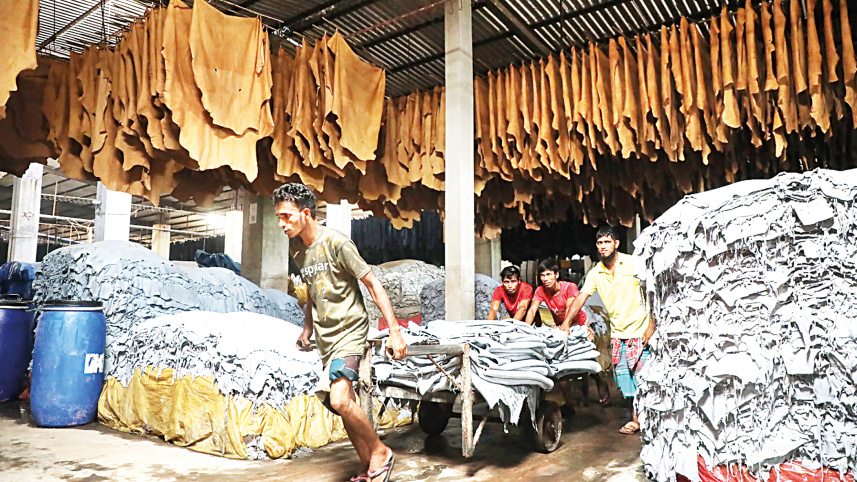
Long before Hazaribagh became synonymous with tanneries, and decades before Bangladeshi factories began shipping shoes to Europe, Japan and North America, the leather economy of this region largely ended at the edge of an animal hide.
East Bengal had cattle, goats and a steady supply of hides and skins. What it largely lacked was the industrial capacity to turn them into finished leather and consumer goods. During British rule, most of the raw hides collected here travelled west to Calcutta, where Bengal’s established tanning and manufacturing industry captured much of the value added after slaughter.

The history of Bangladesh’s leather industry can therefore be read as a long effort to reverse that relationship. Over roughly eight decades, the territory moved from supplying hides to processing wet-blue leather, then crust and finished leather, and eventually manufacturing shoes, bags and other products for global markets. Each transition kept a little more of the value chain at home. Each also created a new set of problems.
An industry born out of separation
Industrial tanning in what is now Bangladesh began on a modest scale before Partition. Ranada Prasad Saha, the businessman and philanthropist better known as RP Saha, established what is generally recognised as the first tannery in the territory at Narayanganj sometime in the 1940s. Some later accounts give 1940 as the precise year, although experts are cautious about the date. The tannery was subsequently shifted to Hazaribagh in Dhaka. Partition in 1947 provided the real impetus for an industry.
The new border separated East Bengal from Calcutta and its industrial base. A region accustomed to supplying raw materials suddenly needed its own processing capacity. Tanneries expanded with the arrival of leather workers and entrepreneurs from India, alongside subsidiaries and businesses connected with West Pakistan. Sources from the time shows that the larger export-oriented tanning trade during the Pakistan period was predominantly controlled by non-Bengali entrepreneurs, while Bengali-owned operations tended to be smaller and focused on the local market.
The state was simultaneously trying to create the skills the industry required. The present-day Institute of Leather Engineering and Technology at the University of Dhaka traces its roots to the East Bengal Tanning Institute, inaugurated in August 1947. The institution began operating in 1949 and started academic activities in 1952.
Hazaribagh consequently became more than a collection of factories. Tanneries attracted chemical traders, mechanics, technicians, hide merchants, transporters and workers. Those supporting businesses in turn made the area more attractive to other tanners. By 1965, around 30 tanneries were operating in Dhaka.
What Bangladesh was making, however, mattered as much as how much it was making.
Independence, ownership and a difficult restart
Liberation in 1971 disrupted the industry again. Many non-Bengali tannery owners left, abandoning roughly 30 industrial units. The new government placed these factories under the Bangladesh Tanneries Corporation as part of the broader post-independence state-led industrial structure.
The model struggled.
A remarkable World Bank survey from 1974 offers a snapshot of the industry during those early years of Bangladesh. It counted about 200 registered tanneries employing roughly 15,000 workers. Around 70 were classified as mechanised, but only two were described as fully mechanised; about 130 were cottage-type operations. The report also estimated that the industry was using only around half of its tanning capacity.
And the old structural problem had barely changed. The Bank found that the great bulk of leather exports still consisted of chrome-tanned wet blue, with only a small proportion of cowhide being turned into finished leather, primarily for the domestic market. State-controlled tanneries accounted for about three quarters of leather exports at the time.
Nevertheless, leather proved unusually resilient in the shattered post-war economy. Export earnings from hides and skins had fallen sharply in 1971, but recovered in 1972 as international prices rose. The World Bank saw enough potential to argue that global demand was unlikely to be the industry’s principal constraint; supply, equipment and technical capability were the larger concerns.
That diagnosis would remain familiar for decades.
Keeping more of the leather at home
The next transformation came with the retreat of direct state control and the return of private capital.
Public management of the abandoned tanneries proved unsuccessful, and the government progressively transferred operations back to private entrepreneurs. A major phase of that disinvestment in the early 1980s. At the same time, policy began pushing the industry away from simply exporting semi-processed leather and towards higher-value production.
This distinction sounds technical but was economically crucial.
 For all latest news, follow The Daily Star's Google News channel.
 Wet blue is an intermediate commodity. Crust leather has undergone further processing, drying and preparation. Finished leather adds colouring, coating, texture and other treatments required for manufacturing the final product. With each additional stage, more machinery, chemistry, skill and labour are added, and more of the final selling price can potentially remain with the producer.
Until 1980-81, Bangladesh’s processed-leather exports consisted almost entirely of wet blue. Policy support from the early 1980s encouraged investment in crust and finished-leather capacity. Then, at the turn of the 1990s, the government banned the export of wet-blue leather, deliberately making it harder for the industry to stop at the lowest processing stage. Sources differ on whether the ban should be dated to 1990 or 1991, but agree on its consequence: investment shifted towards crust, finished leather and eventually leather products.
For the industry’s history, this may be the most important policy change after Partition itself.
Bangladesh was no longer merely asking how many hides it could tan. It was beginning to ask how much of the finished product it could make.
When leather became shoes
Footwear supplied the obvious answer.
Bata had already demonstrated that industrial shoe manufacturing was possible in East Pakistan. But the emergence of export-oriented local manufacturers from the late 1980s and 1990s began to connect Bangladesh’s tanning industry to a much longer manufacturing chain.
The trajectory of Apex illustrates the transition. Its industrial roots began with a tannery operation in 1976, while Apex Footwear was established in 1990. Early export production was difficult: Bangladesh had limited supporting industries, little international recognition as a shoemaking base and significant gaps in production know-how. The company subsequently worked with foreign technicians and buyers to improve manufacturing capabilities.
Across the industry, footwear exports then accelerated. A record 527 percent increase in footwear exports happened between FY1990-91 and FY1996-97. This was a fundamentally different business from shipping a piece of wet-blue leather abroad. A finished pair of shoes could incorporate cutting, stitching, lasting, sole production, finishing, quality control, packaging and design. Leather goods such as bags, belts and wallets offered a similar route towards higher value addition.
Eventually, Bangladesh’s competitive advantage in footwear also expanded beyond its domestic leather supply. Manufacturers could import materials and components while using local labour and production capacity to make finished goods. This helps explain an apparent contradiction in the modern industry: footwear manufacturing can prosper even when domestic tanneries themselves are struggling.
From Hazaribagh to Savar
The government’s answer was the BSCIC Leather Industrial Estate at Savar: move the tanning cluster out of crowded Hazaribagh and provide common infrastructure, most importantly a Central Effluent Treatment Plant.
The relocation project was taken up in the early 2000s. What was supposed to modernise the industry instead became a prolonged process of missed deadlines, disputes and incomplete infrastructure.
In April 2017, after years of delay and court intervention, utility connections to Hazaribagh tanneries were cut, effectively ending large-scale tanning there and forcing the shift towards Savar.
Moving the factories, however, proved easier than reproducing the system around them.
The Savar estate’s CETP and solid-waste management became persistent sources of concern. A 2026 academic study concluded that relocation had in important respects shifted environmental harm rather than eliminating it, while also disrupting some of the production and social networks developed over decades in Hazaribagh.
The government itself now acknowledges problems with the transition. Visiting the estate in May this year, Industries, Commerce and Textiles and Jute Minister Khandakar Abdul Muktadir described the decision to relocate as correct but the implementation as marked by “classic mismanagement.”
Yet there are also signs of the direction the industry is trying to take. The Leather Working Group’s current database lists several Bangladeshi certified suppliers, including leather manufacturers and vertically integrated footwear businesses.
That may represent the next stage of the same journey begun eight decades ago.Bangladesh once exported its hides to Calcutta because the industrial capacity to process them existed elsewhere. It later exported wet blue because the capability to create more valuable finished leather remained limited. It then built tanneries capable of finishing leather, followed by factories capable of turning that leather into shoes and bags.
Today, the barrier is different. Producing the product is no longer enough. The industry must increasingly be able to demonstrate how that product was produced, such as where the hide came from, how chemicals and wastewater were managed, and whether the manufacturing chain meets the standards demanded by global buyers.
The geography has changed from Narayanganj to Hazaribagh and finally Savar. The product has changed from raw hide to wet blue, finished leather and footwear. But the underlying objective has remained remarkably consistent: to capture more of the value of leather before it leaves Bangladesh.
The industry’s history suggests that Bangladesh has repeatedly managed to move one step further along that chain. Whether it can complete the environmental and compliance transition at Savar will determine how much further it can go.
Comments