


Beyond the Basic Pair
Shopping for shoes used to be about function more than form. Many Bangladeshi buyers visited footwear stores to replace their worn-out pair, instead of adding to their collection. Over time, consumer preferences has evolved. A family may now shop for school shoes, office loafers, walking sandals, trainers for the daily commute and something more elaborate for Eid or a wedding. Even the categories are becoming more inclusive. Sneakers now appear in offices, lightweight casual shoes travel across age groups, and comfort is increasingly expected alongside design.
That shift is giving Bangladesh’s footwear industry two markets to pursue at once. At home, a large population and changing lifestyles are expanding demand beyond basic, low-cost footwear. Abroad, international buyers looking beyond established production centres have created room for new sourcing destinations. Yet scale alone has not secured Bangladesh a proportionate share of either opportunity.

A large market
The Bangladesh Investment Development Authority (BIDA) estimates that the country can produce around 378 million pairs of footwear a year. Of this output, between 53 and 66 percent is consumed locally, placing annual domestic consumption broadly between 200 million and 250 million pairs. Recent industry estimates value the domestic market at more than Tk 20,000 crore.
These numbers come with an important caveat. Bangladesh’s footwear economy includes more than 3,500 micro, small and medium enterprises alongside roughly 90 large manufacturers. Therefore, its production and retail data sits outside the most visible branded networks. Industry estimates suggest brands account for only around 40 percent of sales. While small scale producers keep basic footwear accessible, their market share data remains unreported and quality control is also questionable. This limited market data, inconsistent quality and competition from informally traded products make investment into footwear harder to plan.
Within that fragmented market, confidence in local brands has become an important growth driver. Industry executives describe a clear change over the past five to seven years. Consumers who once treated foreign labels as a shorthand for better design or quality are increasingly willing to choose Bangladeshi products. Local companies have responded with broader ranges, more contemporary stores and sharper distinctions between men’s, women’s, children’s, sports and occasion footwear.
Large scale manufacturers must compete with imported and unbranded products while carrying the costs of taxation, labour standards, quality control and after-sales service. Some established operators argue that uneven enforcement prevents a level playing field. Expanding the organised market will require consumers to distinguish not only between prices and designs, but also between the standards behind them.
Demand moves beyond utility
Sandals and slippers still account for the largest share of domestic demand, reflecting Bangladesh’s climate, price sensitivity and everyday habits. But growth is increasingly coming from greater variety rather than a single dominant category.
Formal leather shoes remain important, particularly for work and occasions, but the boundary between formal and casual footwear is softening. Sneakers, sports-inspired shoes, loafers and lightweight slip-ons now serve commuting, work and leisure. Women and older consumers are also buying into categories once marketed mainly to young men. The result is a market segmented by activity, occasion and personal style rather than only by age or gender.
Comfort is central to this change. Long commutes, casual workplace dress and growing interest in exercise have increased demand for cushioned soles, lighter materials and flexible construction. Social media has also shortened the distance between a global trend and a local shop shelf.
Price continues to set the limits. Under pressure from inflation, buyers want better comfort and design without a sharp move into premium pricing. This creates an opening for local brands that can adapt international styles to local weather and purchasing power. It also helps explain the rise of synthetic and mixed-material footwear, which offers more variation at lower price points than many leather products.
Expectations are also rising at the entry level. An inexpensive sandal or flip-flop is still judged on cushioning, fitting, appearance and how long it lasts. This leaves manufacturers with a difficult equation: adding visible value while volatile input costs limit how far prices can rise.
Product engineering, material selection and efficient production are therefore becoming as important in the mass market as fashion-led design is in premium ranges.
Greater choice creates operational demands. More colours, sizes, soles and seasonal collections increase the number of products a company must design and stock. Better forecasting and faster development are needed to avoid excess inventory after a festival or season. Research into fitting, materials and outsoles can also help firms design for Bangladesh’s heat, rain and walking conditions rather than merely reproducing international products.
Online retail is widening that reach, particularly outside major commercial centres. Yet size, fit and comfort are difficult to judge through a screen. E-commerce therefore works best alongside reliable exchanges, consistent sizing and physical retail.
Local footwear gain global markets
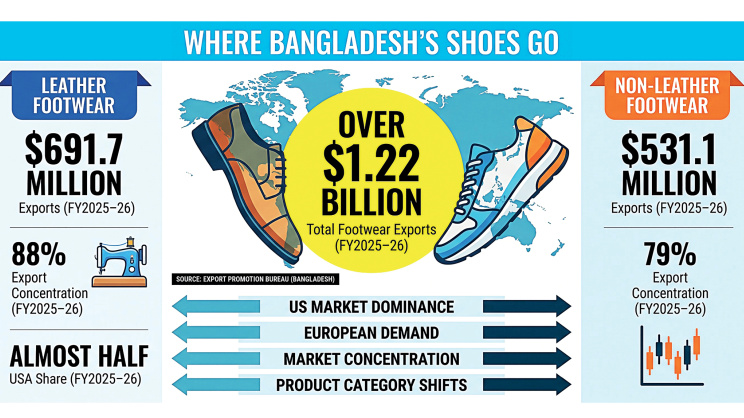
Bangladesh’s footwear export figures reveal similar promise and restraint. Export Promotion Bureau data show that leather and non-leather footwear together earned around $1.22 billion in fiscal year 2025–26. Leather footwear brought in approximately $691 million, while synthetic, rubber, plastic and textile footwear earned about $531 million.
Non-leather footwear has been one of the industry’s most dynamic segments over the past decade. Global demand for sneakers, athletic shoes and affordable casual products continue to rise. But its exports grew by only 1.6 percent in FY2025–26, after stronger rebounds in the preceding two years. The latest result suggests that demand alone is not enough to sustain rapid expansion.
Bangladesh is among the world’s largest footwear producers by volume, but its earnings remain modest beside Vietnam’s annual footwear exports of more than $25 billion and Indonesia’s more than $6 billion. Those countries have deeper supplier networks, higher productivity, stronger logistics and longer relationships with major brands.
 For all latest news, follow The Daily Star's Google News channel.
 Buyers diversifying beyond China still create an opening, particularly in non-leather and sports-inspired footwear. Bangladesh offers competitive labour costs, large-scale export experience and a workforce familiar with international supply chains. Domestic hides also give leather footwear the potential for high local value addition.
But global orders are won on more than price. Buyers assess consistency, lead times, environmental performance, traceability and product-development ability. Bangladesh must move from being an alternative source of capacity to a dependable source of design, materials and finished footwear.
Digital marketplaces and international logistics also allow Bangladeshi brands to test demand without first building an overseas retail chain. This will not replace large manufacturing orders, while returns, sizing and customer acquisition remain expensive. It can, however, help brands reach diaspora and niche markets, learn from overseas customers and gradually develop an identity beyond factory production.
The constraints beneath the surface
Several obstacles continue to slow that transition. Producers cite high borrowing costs and limited access to finance as barriers to installing new lines or expanding factories. Energy costs and unreliable supply raise production expenses, while delays in importing raw materials and clearing shipments can make delivery schedules harder to meet.
The problem is especially acute in non-leather footwear, where local backward linkages remain weak. Industry estimates place dependence on imported raw materials and components other than leather as high as 80 to 90 percent. Fabrics, synthetic uppers, specialised soles, chemicals, adhesives and accessories are sourced largely from abroad, particularly China, increasing lead times and exposure to exchange-rate movements.
This creates a structural mismatch. Bangladesh’s clearest domestic raw-material advantage is leather, but some of the fastest-growing consumer and export categories are sneakers, athletic shoes and other non-leather products. If synthetic footwear expands without a corresponding local component industry, more production will not necessarily create proportionate domestic value. Investment in soles, lasts, moulds, technical fabrics, accessories and chemical inputs could shorten production cycles, reduce supply risks and spread the industry’s gains beyond final assembly.
Skills present another constraint. Footwear requires specialised knowledge in pattern-making, mould development, stitching, finishing, merchandising and quality control. Productivity and product development will remain limited without stronger industry-linked training.
Leather footwear faces an additional compliance burden. The Central Effluent Treatment Plant at the Savar Tannery Industrial Estate has yet to resolve longstanding operational and waste-management problems or secure the recognition required by many high-value buyers. As environmental and traceability standards tighten, the inability of much of the leather supply chain to meet them restricts access to premium orders and weakens one of Bangladesh’s clearest raw-material advantages.
Sustainability is not only an export requirement. For domestic consumers, its most practical expression may be durability: a longer-lasting pair reduces replacement costs and material waste. Better construction, repairability and responsible materials can therefore support value-conscious buyers and environmental goals, provided longevity does not put products beyond their reach.
Comments