


Fixed vs fluid: The tactical battle between Carrick and Maresca in the Manchester derby
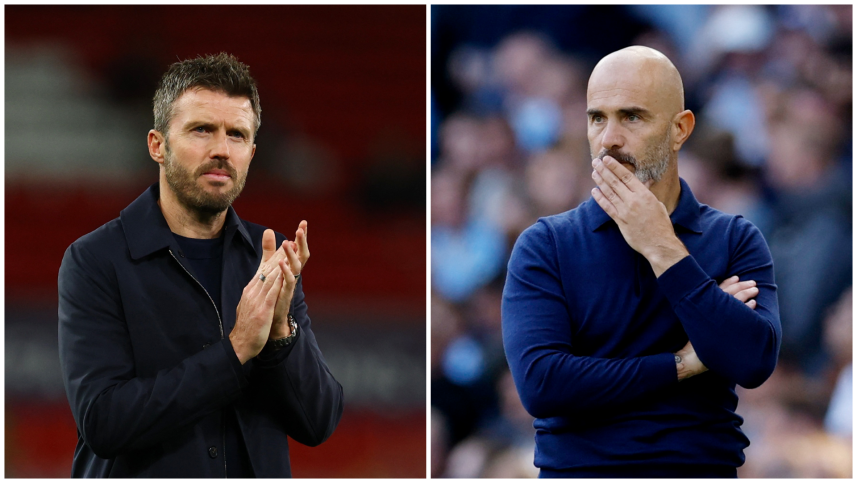
Manchester United and Manchester City share a city, a history of rivalry and the same ambition to return to the top of English football.
But under Enzo Maresca and Michael Carrick, they are taking strikingly different routes to get there.

When City and United meet on Sunday, the most intriguing battle may not be between Erling Haaland and Bruno Fernandes, or even in the two penalty areas. It could be between structure and freedom.
Maresca wants City to control games through precise positioning, clear roles and rehearsed movements. Carrick has built a United side around a looser framework, giving players positional references but greater freedom to interpret the game as it unfolds.
Fixed versus fluid. That contrast could shape the derby.
Maresca's City: control through structure
Maresca's football has strong roots in positional play, the philosophy associated with his former mentor Pep Guardiola.
The basic idea is simple: put players in the right places and reduce the number of unpredictable situations.
City's shape in possession often resembles a 3-2-5 or 3-1-3-3, with players occupying specific zones across the pitch. There are rotations, but they usually have a purpose and end with City restoring the structure.
City's shape in possession often resembles a 3-2-5 or 3-1-3-3, with players occupying specific zones across the pitch. There are rotations, but they usually have a purpose and end with City restoring the structure.
It can make them predictable to watch but difficult to defend.
Everyone knows where the next passing option should be. Everyone knows where the space ought to be created. And because those movements are repeated in training, players do not have to invent solutions every time they receive the ball.
Maresca's view of freedom is revealing.
"If the freedom for you is that you can move everywhere, that is not freedom, that is chaos," he once said.
For City, freedom comes within the system.
Rayan Cherki is a useful example. The French playmaker has the technical quality to drift around the pitch looking for the ball, but Maresca wants him in dangerous areas when City are attacking. The instruction is not to eliminate creativity, but to channel it.
That is the trade-off with a fixed system. Individual expression is sometimes restricted, but collective execution becomes sharper.
Carrick's United: structure, then freedom
United are not without positional rules.
Their centre-backs hold their positions in the build-up, while the deepest midfielder can drop between them to create a back three or remain alongside the other central midfielder.
The full-backs have their own reference points too. Higher up the pitch, their positioning changes according to where the wingers are, with one able to move inside while the other stays wide.
But from there, Carrick gives his players considerably more freedom.
 For all latest news, follow The Daily Star's Google News channel.
 Bruno Fernandes is the obvious example.
Starting as a No 10 does not mean he remains in the same corridor for 90 minutes. If he believes moving towards the ball or drifting into another area can create an advantage, he is trusted to do it.
Matheus Cunha has similar licence.
That movement can unsettle defenders because it forces them to make decisions rather than simply follow a pre-programmed pattern.
Follow Fernandes and space opens elsewhere. Do not follow him and United can create an overload around the ball. That uncertainty is part of the plan.
Follow Fernandes and space opens elsewhere. Do not follow him and United can create an overload around the ball. That uncertainty is part of the plan.
Carrick's players are essentially given a tactical language rather than a complete script.
Where the derby could be won
That difference could make for a fascinating battle in midfield and between the lines.
City's structure is designed to stretch opponents, move them around and create space through disciplined positioning. United, meanwhile, will look to attract pressure towards the ball before exploiting the gaps that appear elsewhere.
The interesting question is what happens when those philosophies collide.
If United's roaming players repeatedly drag City defenders and midfielders away from their zones, Maresca's carefully constructed shape could be tested in situations it was not designed to handle.
If United's roaming players repeatedly drag City defenders and midfielders away from their zones, Maresca's carefully constructed shape could be tested in situations it was not designed to handle.
But there is a danger for United too.
Fluidity only works when everyone understands what everyone else is doing.
A player may have the freedom to leave his position, but somebody else has to recognise that movement and cover the space behind him. A moment of hesitation can turn improvisation into imbalance.
City's fixed structure offers fewer such risks.
Their players may be easier to read, but that does not mean they are easier to stop. When the movements are rehearsed and executed quickly, knowing what is coming is one thing; stopping it is another.
That is why Maresca's approach can provide consistency, particularly with a team still developing its chemistry.
Carrick's method may ultimately offer United something different: unpredictability.
Comments