Sixty shades of Durga

What does a goddess look like when she is not holding a trident? At Gallery Chitrak in Dhaka, sixty artists have answered in their own sixty ways. She is a tree that endures. A devotee who is also Maya. A pair of eyes that fill an entire canvas: a gaze that finds you. A hand gripping another hand. A column of light falling on a silent earth.
This is the Durga seen mostly outside the temple. The exhibition, which opened at Gallery Chitrak on October 9 and closed yesterday, drew no religious boundaries. It began, instead, a conversation about power, equality, empathy and humanity, with each artist speaking in a language entirely their own. No two Durgas on these walls were alike.
Start with the tree. Bipasha Hayat's Silent Strength is a canvas that commands an entire wall. A tree, black as a shadow, rises from the lower edge and spreads its branches across the frame. It is dense and heavy, like a banyan that has stood through centuries of storms. The branches do not taper into airy twigs; they thicken and reach, dark veins against a golden-ochre sky. Behind them, the background glows faintly with the soft, hazy warmth of a Bengali autumn afternoon or the first breath of dawn.
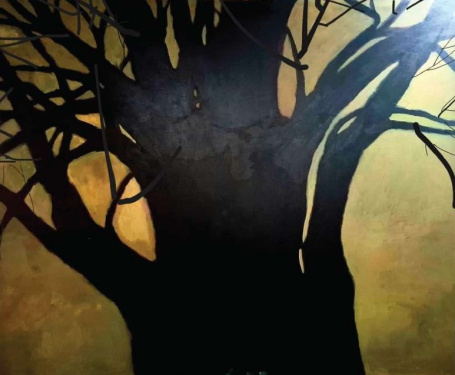
Durga is usually a warrior riding a lion, ten-armed, her trident raised. But Bipasha paints the other face: the one who waits, who holds, who endures. Shakti doesn't necessarily mean the power to destroy. It is also the power to sustain, and that is what the tree symbolises. Its roots go deep into the dark, unseen places where life is nourished. It does not announce itself. It simply is.
The warrior goddess gets the songs and the drums. But the tree gets the silence. And perhaps that silence is the deeper strength.
From that silence, we move to Shakila Khan Chayan’s The Power of Maya. A woman in a white sari with a red border carries a plate of petals and a clay pot of burning incense. At first glance, she is simply a devotee, offering her worship. But the title points elsewhere. Maya, in Vedantic philosophy, is the creative power of the Divine, the force that makes the one appear as the many, the infinite appear as form. Here, the woman is Maya herself.
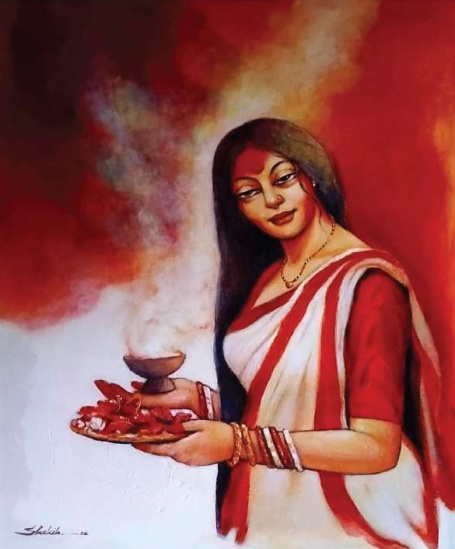
The red that blazes behind her is the passionate energy of the cosmos. The smoke rising from the pot is the veil itself, pouring into being. Her gaze is gentle, knowing, almost amused, because Maya is not cruel. She is enchanting. She offers us the flowers, the incense, the beauty of the world, and asks us to love it all. This is the Goddess disguised as the very life she creates.
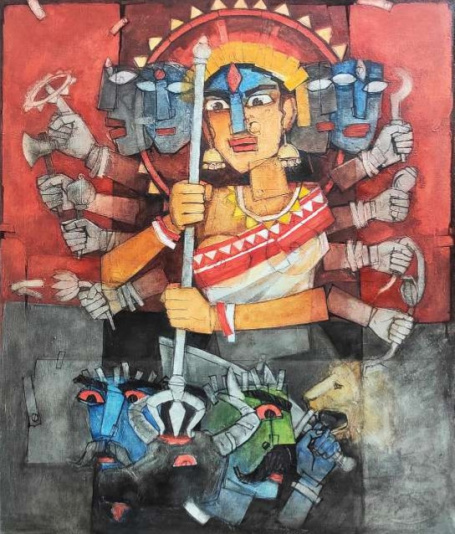
Sunil Kumar Malo's She Who Dispels Sorrow speaks an entirely different language. The goddess is built from stark, almost tribal geometry, with bold, angular shapes that give the painting a rugged energy, like a folk carving. There is nothing soft here. The goddess is a fortress. Her ten arms fan out, holding the discus, the mace, the conch and the sword. Yet the eye is drawn to the centre: the long, red-handled trident she grips with both hands, driving it straight down. Above her, a fiery halo radiates. At the bottom, in the shadowy realm, lies the demon Mahishasura, a tangle of dark, fragmented shapes. The painting reflects the sheer physicality of the goddess.
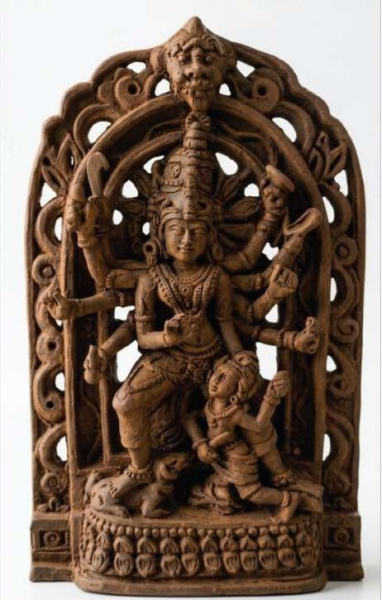
Mukti Bhowmik's terracotta sculpture Mrinmoyi Mahishasura Mardini pulls everything back to the earth. The goddess stands within an arched, pierced prabhavali, her foot pressing down on the buffalo demon at the base. The surface is rough, earthy and warm, the clay fired and shaped by hand. It is kin to the clay of the pandal idols of Bengal, shaped each year by the potter’s hands from river clay and returned to the river when the festival ends. But where those idols are made to dissolve, this one has been designed to stay. It carries the memory of every Durga idol ever made and unmade.
After the weight of clay, one painting held me for a long time: Anisuzzaman Anis's Recalling Goddess Durga. The canvas abandons realism, texture and narrative entirely in favour of pure, flat, graphic colour. The goddess is reduced to her most essential feature: her eyes. They are enormous and almond-shaped, dominating the canvas. The colours are electric: brilliant marigold yellow, fiery orange, deep ultramarine blue and bold red. There is no shading, no brushstroke texture, no depth; it is flat like a poster, like a modern pop-art icon. Instead of showing us the whole idol, he shows us only what the devotee sees when the veil lifts: her gaze. And her gaze is upon us.
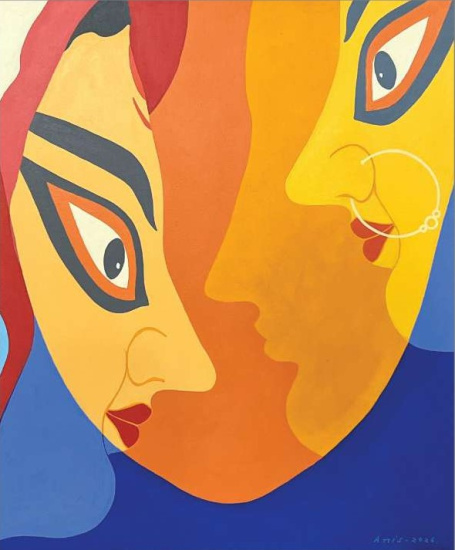
What makes this painting even more powerful is its place in the gallery. Immediately to its left hangs Kanak Chanpa Chakma's Desires. Against a deep, velvety indigo-and-black night sky, dozens of glowing paper lanterns rise into the heavens. In the centre, a few large lanterns burn with intense, golden-orange fire, while smaller ones fade into the distance like stars. The thick impasto brushstrokes make the darkness feel tangible and the light liquid and warm.
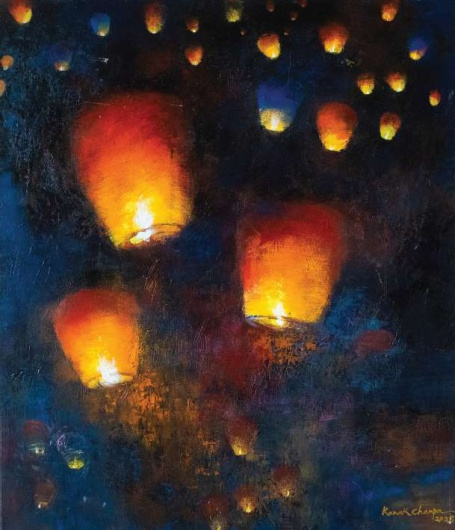
Under that title, each lantern becomes a wish, a hope, a hunger released into the dark: beautiful but fragile, and utterly human. Some burn brightly and close by, some fade into the distance, and some are already tiny sparks. That is the landscape of desire itself.
From the night sky, we turn to Mohammad Iqbal's Holy Circle, a monumental square canvas. Against a field of deep brick-red and rust, a colour that sits somewhere between dried blood, sindoor and the soil of the riverbank, three faces emerge from a dense, cross-hatched texture. They are women, painted with extraordinary tenderness, their gazes soft, direct and slightly pensive. The canvas is overlaid with fine, woven lines that suggest the veil of mystery itself, giving the painting a tactile quality, as though the faces are being seen through something. What strikes me most is its intimacy. This is not the distant, iconographic Durga.
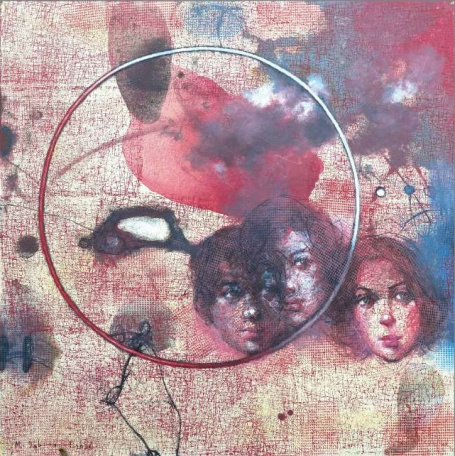
Inside the circle are two faces, together, almost merging, one darkened and one clearer. Outside the circle, to the right, lower down and larger, is a third face. She looks straight out at us, her eyes wide, her expression unguarded, almost searching. That placement is deliberate, and it is the emotional centre of the painting. The circle holds its two faces together. But the third face holds the question: What about me? She is, perhaps, all of us.
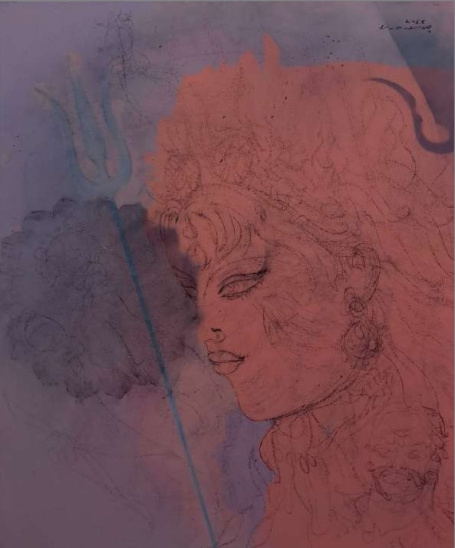
Anukul Chandra Majumder's Peace is a different kind of tenderness. Against a soft, peachy-pink background, the artist has drawn the profile of the goddess in fine, wiry charcoal lines. She looks downward, her eyes heavy-lidded, her expression lost in deep contemplation. This is not the peace of absence or emptiness. It is the peace that comes after the war. The trident is planted; the demon is vanquished; the cosmos is restored. And in that moment, she simply breathes. She looks down at the world she has saved, and she is at rest, the visual equivalent of a deep exhalation after a long, hard cry.
Where that goddess rests, Hasura Akther Rumky's Invincible reaches out: a painting made entirely of hands, with no faces, no bodies, just hands gripping, holding and pulling one another upward. They are painted in rich, earthy tones of terracotta, bronze and burnt sienna, and the texture is thick and tactile, making the skin look weathered, real and deeply human. At the centre, one hand reaches high towards the top of the canvas while other hands clasp its wrist and forearm, pulling it up. Below, more hands reach and intertwine, forming a chain of support.
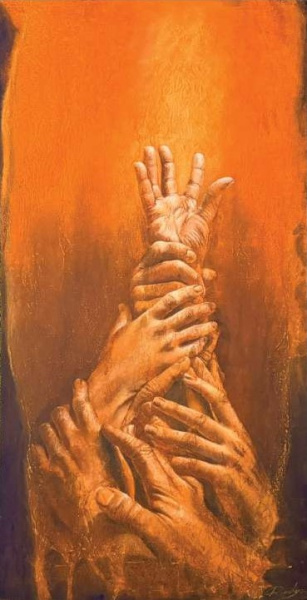
The painting makes it clear that invincibility is not the strength of one isolated individual; it is the strength of a community, the grip of one hand on another. Durga is the embodiment of the accumulated power of all the gods, the expression of collective strength. But Rumky shifts the focus. Instead of showing the Goddess alone with her weapons, she shows the people, the human chain of hands through which they lift one another up.
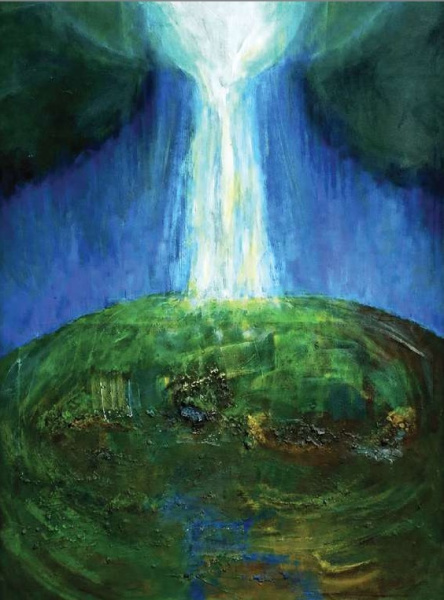
And then there is the painting that shows no face, no weapon, no demon, only light: Ziaul Haque Raju's Blessing from Beyond. A column of white-gold light descends from an unseen source, piercing the dark blue-green sky, and lands on a green earth that curves like a hill or a globe. The land is heavy and textured, with thick strokes of green, ochre and shadow, as if the earth itself were dense with life, memory and longing. The light that descends from above touches the earth. It blesses. And the earth receives it in silence. The title keeps the source unnamed, which is beautiful.
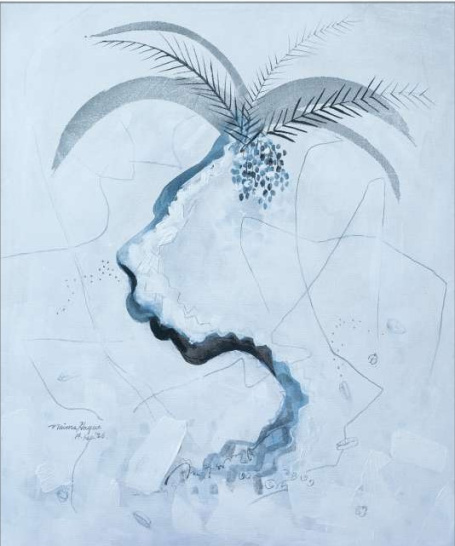
Another landscape appears in Naima Haque’s Strength, painted in pale grey-blue. Faint lines run across it like the contours of hills and fields, scattered with tiny dots and small seed-like forms, as if the land were still waking. Through the middle falls a single thick stroke of ink-dark indigo, a stream perhaps, or a crack in the earth. Tilt your head, and it becomes something resembling a woman’s profile.
A woman’s profile appears again, this time unmistakably, in Shamsul Alam’s Benevolent Force, which turns the goddess into a woman in motion. She stands in profile, her face a single calm plane of light ochre, her long black hair swept sideways by the wind. A red sari falls from her shoulder in broad, scraped strokes. One arm reaches high, gripping a long, dark staff, perhaps a trident, raised not to strike but to hold up the sky. Behind her head glows a pale, chalky disc, a halo worn thin like old plaster.
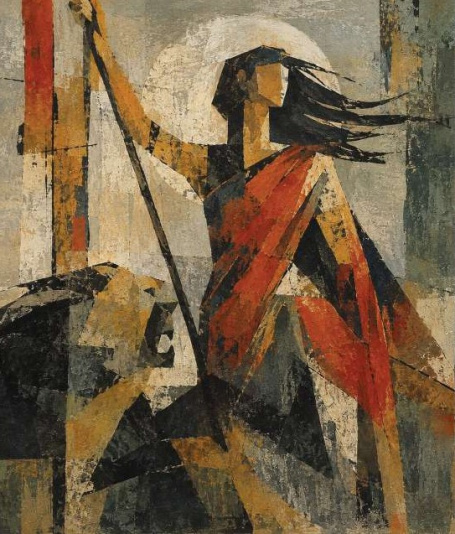
The palette is earth after rain: rust, burnt orange, charcoal and ash-grey. Tall slabs of brick-red and brown rise on either side like the pillars of a ruined temple, and the whole surface is scratched and weathered, as if the painting had been left out in the elements for centuries. At the lower left, a dark, angular mass crowds the corner: the lion, or the fallen demon, dissolved into shadow. Nothing here is ornamental. And yet the title insists that this force is benevolent. She is not the fury of the battlefield but the strength that stands upright in the wind and does not bend.
Durga was never only in the idol. She is in the tree and the lantern, the hands and the eyes, the earth and the falling light, and the traces she leaves within us. The paintings will come off the walls after the exhibition ends. She will remain.
Arun Devnath is the Deputy Editor at The Daily Star.
Send your articles for Slow Reads to slowreads@thedailystar.net. Check out our submission guidelines for details.

Rereading Gloria Steinem and second-wave feminism from South Asia
Does Islam discourage independent thinking?
And still, my father lives

Why this year’s Nobel-winning brain technology matters to you

Why do humans naturally drift to the left?
From chai to shampoo: The extraordinary journeys of ordinary words
Between Bangladesh and Australia: Learning the rules of freedom

When loyalty decides what counts as facts: Welcome to the age of epistemic fragmentation
Revisiting the origins of Sufism: Competing narratives of authenticity and borrowing