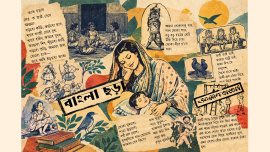
Rereading Gloria Steinem and second-wave feminism from South Asia

Gloria Steinem, the renowned American feminist, journalist and social activist, spent two formative years in India before emerging as a leading figure of second-wave feminism. Her encounters with grassroots movements and political thinkers helped shape her approach to social change. Dr Rashida Shafiq, a historian specialising in gender, Cold War cultural diplomacy and United States–India relations, speaks to The Daily Star about Steinem’s experiences in India, the geopolitical context of her journey, and the overlooked South Asian influences on American feminist organising.
The Daily Star (TDS): Before becoming a leading figure of American feminism, Gloria Steinem spent two formative years in India. What drew her to the country in 1957, and how did her background and early experiences shape her outlook at the time?
Rashida Shafiq (RS): When Gloria Steinem visited India in 1957, she had yet to become the prominent public figure she is known as today. She was only twenty-two years old and had recently graduated from Smith College. Originally from Toledo, Ohio, she had spent much of her childhood in impoverished circumstances following her parents’ divorce, taking on the role of a carer from a very young age because her mother struggled with severe mental health issues. Attending Smith College was deeply liberating for her, offering her an opportunity to explore ideas and subjects she had never encountered before.
In her memoirs and biographies, Steinem often noted that she went to India partly to avoid getting married. She was engaged to a man at the time, but she felt unready for marriage and recognised that, in the context of the 1950s, getting married would prevent her from pursuing other opportunities. However, that desire to escape was only part of the story. Her mother and both her paternal and maternal grandmothers were Theosophists. They belonged to a spiritual movement with deep ties to India. As a child, Steinem accompanied them to local Theosophical meetings, absorbing knowledge about India almost through osmosis, long before she travelled there herself.
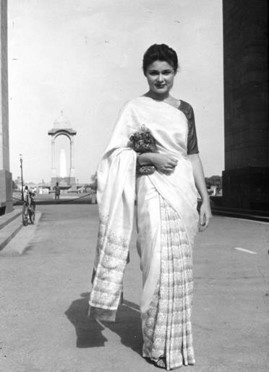
Her academic interests further strengthened this inclination. At Smith College, she took courses with Professor Vera Micheles Dean, a prominent foreign policy scholar specialising in United States–India relations. She was eager to deepen her academic understanding and willing to explore the country firsthand. Steinem applied for the Chester Bowles Asian Fellowship at the end of her senior year. Named after the former US ambassador to India, the two-thousand-dollar fellowship provided the perfect opportunity to travel abroad, explore a country she had long wanted to visit, and step away from her engagement. At that stage, she was a conventional, polite and curious college student who operated within the framework of Cold War political liberalism and was eager to explain American culture to Indian audiences through her fellowship reports.
TDS: Her stay coincided with Cold War cultural diplomacy and institutional exchanges in the region. How did this geopolitical backdrop shape the scope of her work in India?
RS: The framework of the cultural Cold War effectively paid for Steinem’s ticket and set the initial itinerary of her trip, even though it could not fully control what she learned or whether she went off script. The fellowship was created in accordance with the vision of Chester Bowles, a liberal Cold War warrior who believed that non-aligned nations such as India should be won over through educational aid and exchanges rather than force. Believing that students were central to winning hearts and minds, Bowles established the fellowship programme, and Steinem arrived in India as an informal cultural ambassador, writing careful, friendly reports for her American sponsors.
Steinem initially attended Miranda House, the women’s college at the University of Delhi, where she attended lectures and met reformers and intellectuals. She was also recruited by Clive Grey of the National Student Association to help recruit female Indian students to represent India in international student organisations. In her reports, she initially sought to convey the achievements of American capitalism, but her experiences in Indian classrooms quickly unsettled those assumptions. Indian students raised sharp, challenging questions, such as asking her to explain the difference between the United States’ intervention in Guatemala and the Soviet Union’s suppression of the revolution in Hungary. Significantly, Steinem recorded these difficult exchanges candidly in her official reports rather than omitting them.
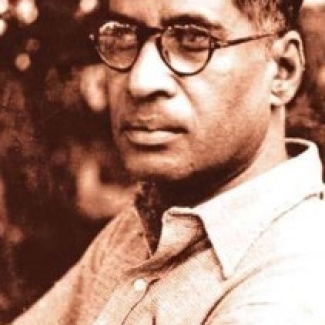
When the semester ended at the University of Delhi, Steinem remained in India despite having run out of funds. She attended a ten-day radical humanist camp in Mussoorie organised by Ellen Roy, the widow of M. N. Roy, an Indian Marxist who had subsequently evolved into a radical humanist. At this camp, Steinem absorbed the core principle that the means employed by a social movement must shape its ends, and that being ‘radical’ meant getting directly to the root of a problem rather than applying superficial fixes.
Upon returning to the United States in 1959, Steinem was eager to write about her time in India, but mainstream American publications were not hiring women to cover serious international politics. Facing financial hardship and sleeping on friends’ floors, she accepted employment with the Independent Research Service, an organisation funded by the CIA to coordinate American youth participation in the Soviet-sponsored Vienna Youth Festival. Idealistic and desperate for work, Steinem viewed the position as an opportunity to engage in international youth dialogue and counter Soviet propaganda, years before the covert and controversial nature of CIA funding operations became public and was subsequently examined in the Church Committee hearings of the 1970s.
TDS: After returning to the United States, how did she translate those Indian grassroots practices, such as collective listening circles, into American feminist organising?
RS: Steinem did not invent consciousness-raising, a practice named in 1968 by New York Radical Women, drawing on the Civil Rights Movement and the Chinese revolutionary practice of ‘speaking bitterness’. What her time in India provided was a clear, living model of collective listening in action.
While Steinem was in India, caste violence broke out in the southern region of Ramnad, prompting the government to seal off the area to the press. Workers from Vinoba Bhave’s Sarvodaya (‘welfare for all’) movement bypassed the restrictions and deployed small peace teams to the villages. Because the teams consisted entirely of men and needed a woman to enter the women’s quarters, Steinem volunteered to join them. At night, groups ranging from six to fifty people gathered around kerosene lamps in the villages, where anyone could speak in turn and everyone else was expected to listen. The foundational lesson Steinem took away from this experience was: ‘Ask the people what they want; don’t tell them what they need.’
When she returned to the United States, it took roughly a decade for this approach to organising to find its place in her activism. In 1969, she attended an abortion speak-out in New York, where women publicly shared their personal experiences, reinforcing her understanding that effective organising begins with listening to people’s lived experiences rather than imposing directives. Later, when she embarked on national speaking and lecture tours, she insisted on partnering with women of colour, such as African American activist Dorothy Pitman Hughes and attorney Florynce Kennedy, and structuring events so that audience members spoke more than the presenters themselves.
When she launched Ms. magazine in 1972, this philosophy guided both its internal structure and its public role. The magazine’s masthead was organised alphabetically, editorial decisions were made by consensus, and correspondence from readers was given prominent placement. Steinem frequently described the publication as a national talking circle, explicitly linking the concept to both the village assemblies (gram sabhas) she had witnessed in India and the traditional talking circles introduced to her by Native American feminists such as Wilma Mankiller.
TDS: What lessons can contemporary South Asian movements, from Bangladesh’s garment workers’ struggles to Pakistan’s Aurat March, draw from Steinem’s approach to grassroots organising?
RS: There is a striking historical irony in this question, given that Steinem’s organising philosophy was itself profoundly influenced by South Asian traditions. Applying these methods today is not a matter of exporting American ideas, but rather of returning those traditions to their original context while recognising their wider transnational circulation.
The methodology Steinem learned offers a practical framework for contemporary movements. First, effective organising must begin with local needs, listening before speaking and remembering that the way a movement is organised structurally shapes its ultimate outcomes.
Second, representation must be strategic and contextual; just as the Ramnad peace teams required a female member to reach women in the villages, modern movements must consider who is best positioned to connect with specific groups and communities.
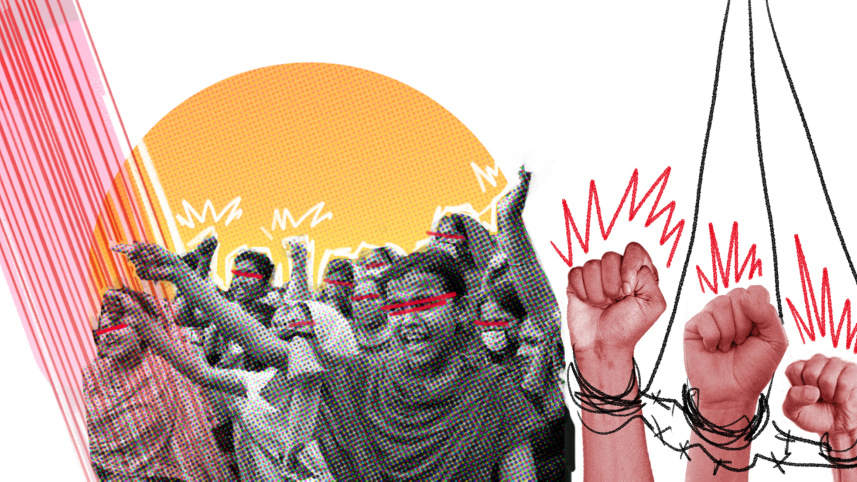
This philosophy aligns directly with contemporary South Asian mobilisations. The Aurat March in Pakistan draws on women transforming their private experiences into public political testimonies, putting into practice the very mechanism of collective consciousness-raising. Similarly, in Bangladesh, where garment workers, the majority of whom are women, organise strikes for safe working conditions and fair wages in an industry tied to global corporations, organising must remain firmly grounded in the material realities of survival and the economic needs of local communities.
TDS: What were the strengths and limitations of Steinem’s feminist organising, particularly in addressing race, class and economic inequality, and what lessons do they hold for contemporary movements?
RS: Steinem’s career offers important lessons through both its strengths and its limitations. One of her primary achievements lay in recognising the importance of what would later be conceptualised as intersectionality, at a time when many of her more conservative contemporaries did not acknowledge the interconnected nature of different forms of oppression. In the 1960s and 1970s, she insisted on cross-racial partnerships and recognised that gender oppression intersected directly with race, class and sexuality.

Where her model proved weaker was in its treatment of economic class. Steinem remained largely liberal and reformist, initially believing that existing institutions could be reformed from within before later coming to recognise that patriarchal and capitalist systems required far more fundamental transformation. As her activism evolved, she increasingly emphasised equity alongside equality, recognising that genuine liberation requires meeting the most basic human needs of all people, including food, shelter, healthcare and economic dignity. This also meant recognising the needs of working-class men who experience systemic forms of oppression.
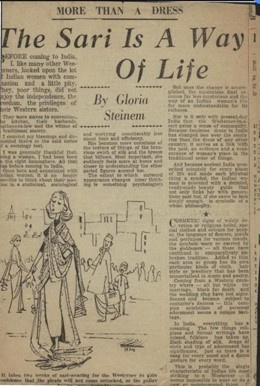
For modern transnational organisers operating in a digital landscape, her experience underscores the importance of resisting the superficial flattening of complex histories by the media. Today’s fast-paced digital platforms and clickbait culture frequently reduce historical figures and complex movements to sensationalised snippets, such as focusing exclusively on Steinem’s fashion choices or repeating misleading claims about her CIA-funded youth work. Organisers must look beyond these superficial narratives and return to the foundational work of organising: getting to the root of people’s material concerns, listening directly to their struggles and building sustained, equitable movements.
TDS: How does examining Steinem’s life through a South Asian lens challenge conventional narratives of American feminism and reveal the overlooked influences that shaped her activism?
RS: Conventional historical narratives frequently frame American second-wave feminism as a purely domestic phenomenon arising almost exclusively from the New Left or the Civil Rights Movement. While those domestic influences were significant, examining Steinem through a South Asian lens reveals the transnational circulation of feminist ideas and acknowledges the South Asian intellectuals, reformers and grassroots activists who directly influenced organising practices beyond the region. Steinem never concealed these influences; she documented them extensively in her memoirs, articles and interviews, even if mainstream American feminist narratives have not always fully acknowledged their significance.
Examining Steinem through a South Asian lens also humanises her by challenging romanticised narratives about her life. She originally arrived in India in 1957 with Orientalist expectations of ancient wisdom, only to have those romantic illusions challenged almost immediately by everyday realities, such as being sprayed with insecticide upon landing at Mumbai airport by an Air India worker concerned about insects. Her willingness to have her assumptions challenged, to accept correction and to continue learning and adapting remains one of her most important qualities.

Finally, a rigorous historical approach helps correct persistent misinformation surrounding her life, including claims that she acted as a covert intelligence operative or frivolously abandoned her university studies in Delhi. Restoring the actual chronology of her academic fellowship and village fieldwork demonstrates that she was a deliberate and conscientious learner. Examining Steinem from this perspective removes her from an artificial pedestal and presents her as a real human being whose influential life’s work was deeply enriched by cross-cultural solidarity and South Asian intellectual traditions.
The interview was taken by Adrin Sarwar.
Send your articles for Slow Reads to slowreads@thedailystar.net. Check out our submission guidelines for details.
Does Islam discourage independent thinking?
And still, my father lives

Why this year’s Nobel-winning brain technology matters to you

Why do humans naturally drift to the left?

From chai to shampoo: The extraordinary journeys of ordinary words
Between Bangladesh and Australia: Learning the rules of freedom

When loyalty decides what counts as facts: Welcome to the age of epistemic fragmentation
Revisiting the origins of Sufism: Competing narratives of authenticity and borrowing
International Translation Day 2026 / Beyond equivalence: Translation and the politics of being understood