The poison tree of Rangpur

While farmers in other parts of the country are improving their livelihoods by producing high-quality crops using modern methods, many in the agriculture-dependent northern Rangpur region remain tied to the “poison tree” of tobacco. Here, tobacco cultivation is widely seen as a path to financial stability. Local and foreign tobacco companies reinforce that belief by offering free seeds, fertilisers, pesticides, interest-free loans and gift items. Many farmers have fallen into what can be described as a leaf trap. Rather than getting out they are becoming even more entangled.
The consequences are far-reaching. Tobacco farming is damaging soil fertility, reducing food crop production and affecting the environment and the health of farming families. Heavy use of subsidised fertilisers in tobacco fields has created shortages, leaving growers of other crops struggling to secure fertiliser supplies. Despite these problems, many farmers continue to prioritise tobacco in the hope of immediate profit. Although the agriculture department holds courtyard meetings to raise awareness, officials admit their efforts are failing to counter the influence of tobacco companies.
According to the Department of Agricultural Extension, tobacco has been cultivated this year on 21,290 hectares across five districts of the Rangpur region, up from 18,734 hectares last year. Of this, 1,810 hectares are in Rangpur, 10 in Kurigram, 35 in Gaibandha, 18,225 in Lalmonirhat and 1,210 in Nilphamari.
Khorshed Alam Sagar, a member of the Anti-Tobacco Media Alliance, claims the actual area is nearly double the official figure. “Wherever you look now, you see nothing but the poison tree tobacco. There is little visible campaign from the agriculture department to discourage farmers. On the other hand, tobacco companies are constantly campaigning. Company representatives are going door to door,” he said. “Unless tobacco companies’ activities at the field level are stopped, tobacco cultivation cannot be controlled. Three foreign and four local tobacco companies are openly encouraging farmers, yet no action is being taken.”
He added that the tobacco leaf market in Rangpur exceeds 10 crore kilograms annually. One foreign company alone purchases more than four crore kilograms each year. On average, 9 to 10 kilograms of tobacco leaves are produced per decimal of land.
Omar Faruk, Agriculture Officer of Aditmari upazila in Lalmonirhat, said nearly half the upazila’s land is under tobacco. “This year tobacco has been cultivated on 8,375 hectares here, compared to 7,520 hectares last year. As the offices of all local and foreign tobacco companies are located here, the tendency is higher,” he said. He warned that tobacco farmers are using subsidised government fertilisers, creating shortages. “Without a strong government plan, tobacco cultivation cannot be controlled. Tobacco is destroying soil fertility. From children to the elderly, members of farmers’ families work in tobacco fields, putting their health at risk.”
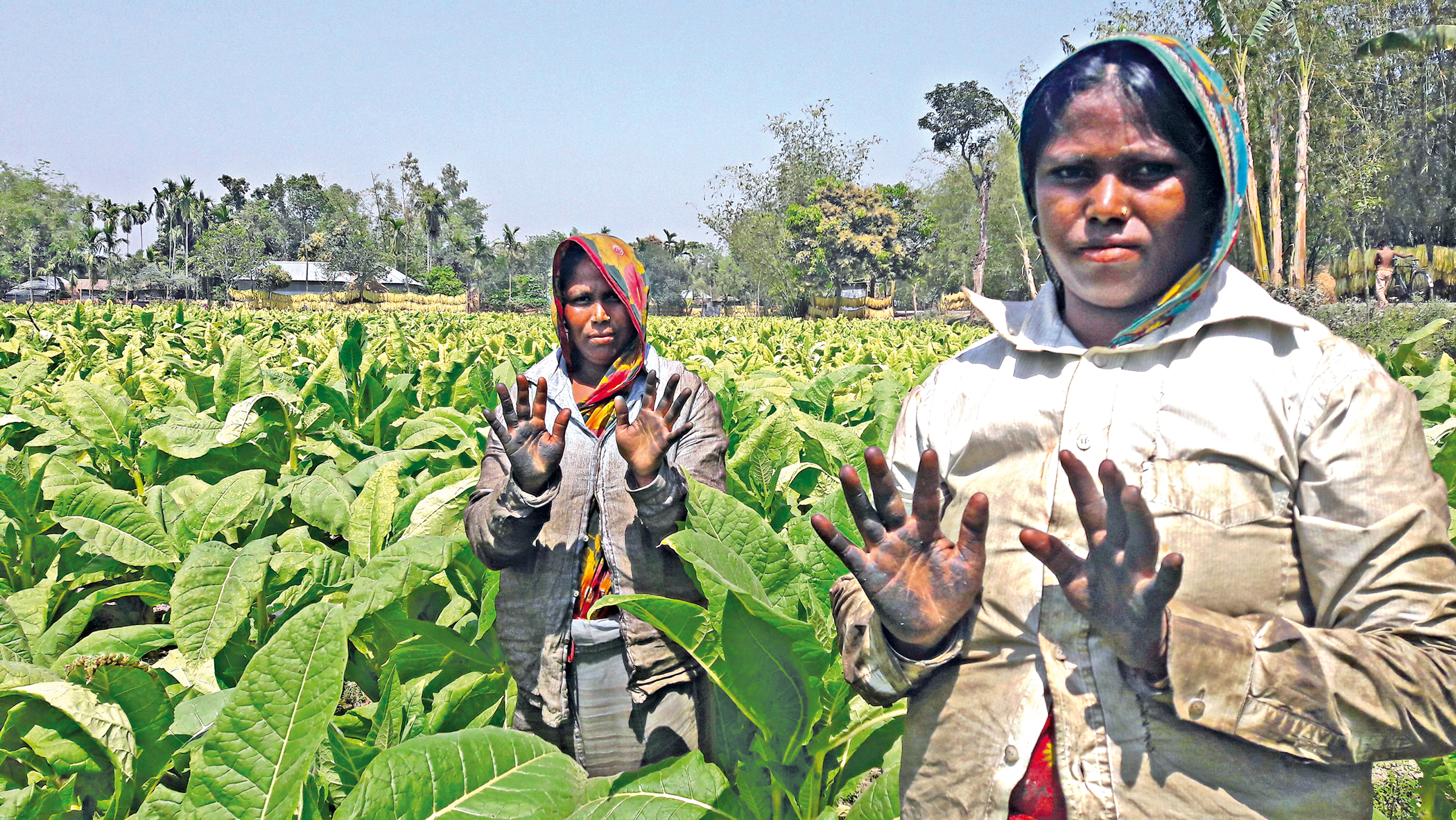
Anwar Hossain, 65, from Mominpur village in Rangpur Sadar, said tobacco must be grown on the most fertile land and requires large quantities of chemical fertilisers. From sowing seeds in November to bringing tobacco home in March, hard labour is needed. “Last year I cultivated tobacco on eight bighas; this year on 11 bighas. When we sell to the company, we receive the money at once,” he said.
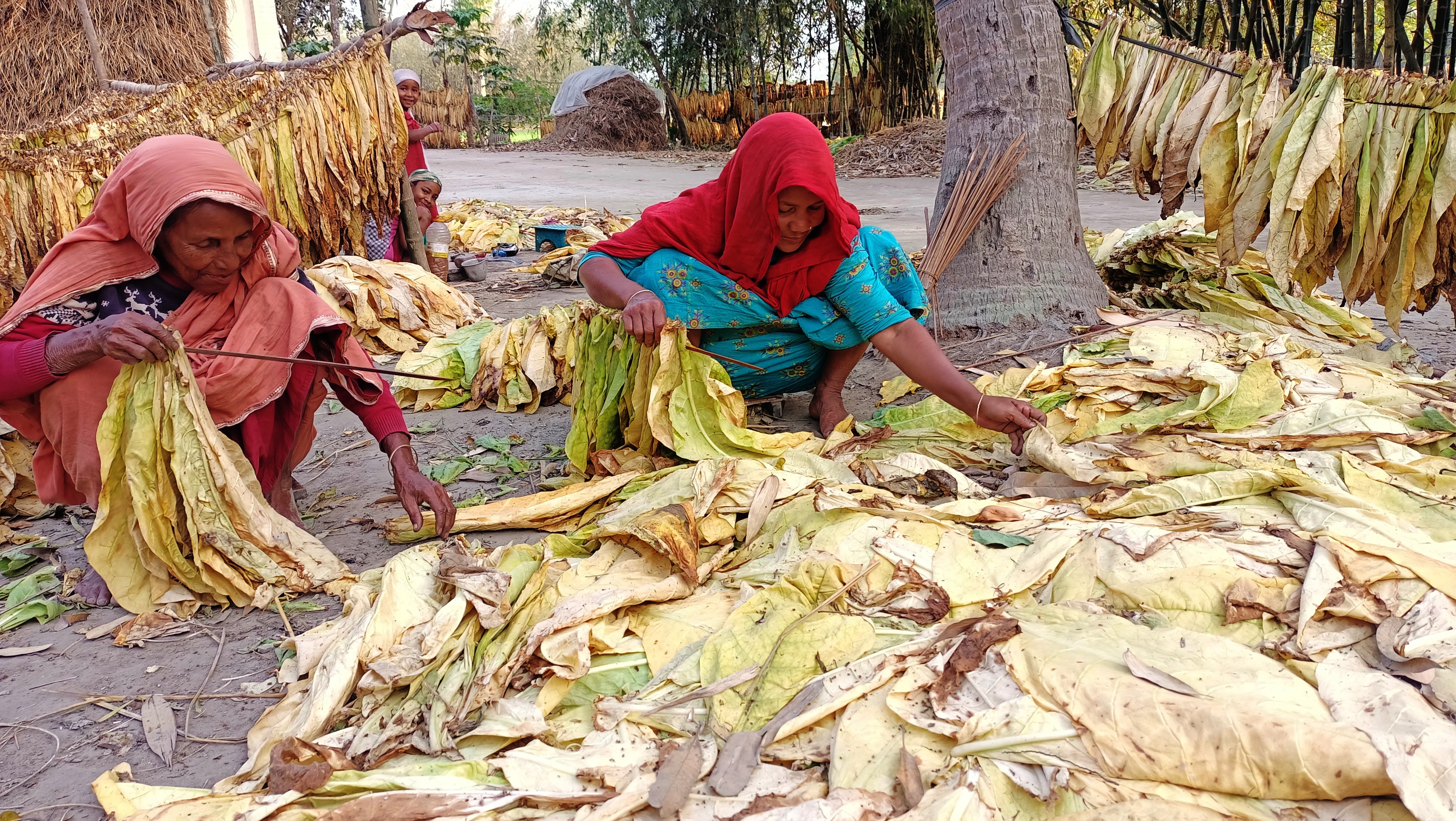
His wife, Fatema Begum (58), said in an irritated tone that their suffering increases during the tobacco season. She cannot tolerate the smell but is forced to work cutting, drying and tying leaves. During the season she suffers nausea, fever and body pain. “Tobacco cultivation is very harmful. I tell my husband to quit, but he does not listen. Due to the encouragement of company people, I am failing to make him aware,” she said.
Noren Chandra Barman (75), from Sarpukur village in Aditmari, said he entered tobacco cultivation about 35 years ago when companies moved into the area. “I fell into the trap 35 years ago. Financially I am benefiting, but soil, environment and health are being damaged. My family members often fall ill,” he said, adding that other crops yield poorly on tobacco land and require heavy fertiliser use.
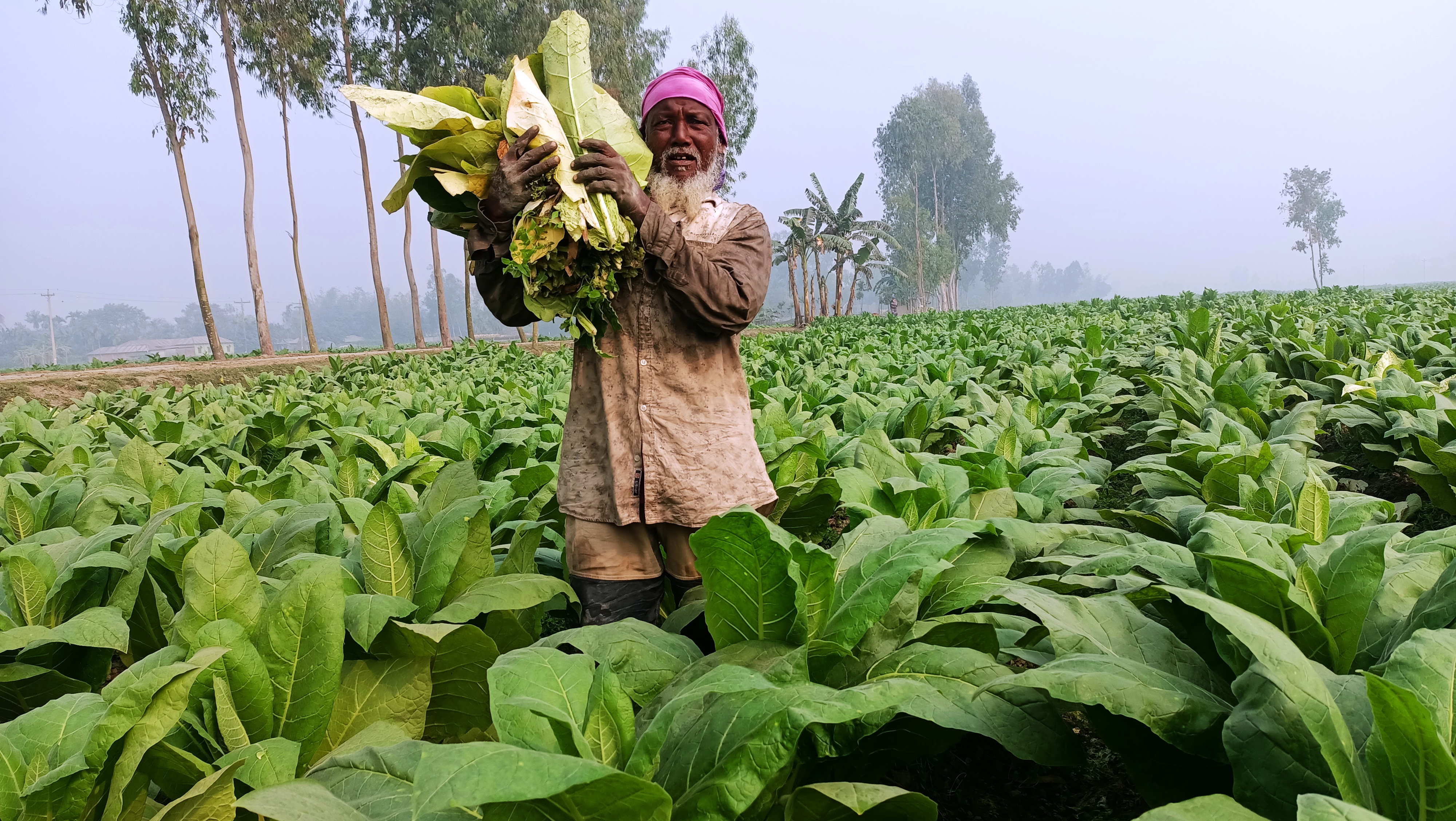
Didarul Islam (55), another farmer from the same area, said 8 to 10 maunds of tobacco are produced per bigha. Production costs range from Tk 20,000 to 25,000, and tobacco sells at around Tk 8,000 per maund. “Although expected profits can be made, the risks are also high. Tobacco requires constant care. The whole family must spend time on it. Initially we make profits, so we cultivate tobacco. We do not make much profit from other crops,” he said. For 20 years he has cultivated tobacco with a company card and expanded from 10 bighas last year to 13 this year.
Dhiren Chandra Barman (60), from Bhadai village, acknowledged the damage but said they cannot leave it. “Women and children in our families work in tobacco fields. We profit because we work together. If we hire labourers, it is not profitable,” he said.
Sanjida Yasmin, Fisheries Extension Officer in Lalmonirhat, warned that the excessive use of chemical fertilisers in tobacco fields is having a severe impact on indigenous fish species. Chemicals wash into canals and wetlands through rain and irrigation water, affecting fry and brood fish. Native species are gradually disappearing.
Dr Shaykhul Arifin, Deputy Director of the Department of Agricultural Extension in Lalmonirhat, said efforts to reduce tobacco cultivation are facing resistance. “We are working to reduce tobacco cultivation, but farmers are not listening. Farmers are more attached to tobacco companies. The current level of cultivation is severely affecting food production. If these lands were used for food crops instead, a large quantity of food could be produced,” he said, adding that without a government ban they cannot act against companies.
Dr Safinur Rahman, Senior Scientific Officer at the Rangpur Divisional Soil Resource Development Institute said the increasing trend of tobacco cultivation is putting agricultural land at serious risk. “Tobacco plants have extensive roots that absorb large amounts of nutrients, reducing soil fertility. Eventually, the land loses its ability to produce crops. Immediate action is needed to save fertile land from the aggression of tobacco; otherwise, the poison tree tobacco will one day push agriculture to the brink of destruction,” he warned.
Rangpur Civil Surgeon Dr Shaheen Islam said those working in tobacco fields, especially children, women and the elderly, suffer from stomach ailments, fever, vomiting and ulcers. “Children and women must be kept away from the aggression of tobacco,” she said.
Sirajul Islam, Additional Director of the Rangpur Regional Agricultural Extension Directorate, said the ministry has sought suggestions to curb tobacco cultivation. “Since there is no specific government law, we cannot take strong measures. If tobacco cultivation is not brought under legal control swiftly, Rangpur’s agriculture will face a severe crisis,” he said.
S Dilip Roy is a journalist at The Daily Star.
Send your articles for Slow Reads to slowreads@thedailystar.net. Check out our submission guidelines for details.

Where have Bangladesh’s hilsa gone?

Lead poisoning in Bangladesh: A crisis ignored for too long
Who recycles Bangladesh’s garment waste?

Bangladesh running out of options on Rohingya crisis: Is there a way out?
Construction of the Sugandha-Kalatoli beach road / A grave threat to Cox’s Bazar’s sand dunes

Why have Nihar Koli and Samrat been sent back to their alleged abusers?
The reality of vocational training for Bangladeshi women

Can we save young Bangladeshis from deadly Mediterranean crossings?

Breastfeeding in Bangladesh: What is holding mothers back?