The sacred water world of the Sundarbans
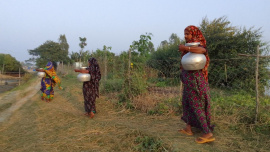
In Shyamnagar, a coastal upazila of Satkhira bordering the Sundarbans, people live amidst rivers, canals, ponds, and wetlands, yet safe drinking water remains scarce because of rising salinity. In this fragile coastal landscape, water is not merely a physical resource but part of a larger social and cultural world shaped by local beliefs, rituals, and generations of ecological knowledge surrounding hydrology and everyday survival.
In coastal villages, domestic water use, such as drinking, cooking, and bathing, is primarily dependent on ponds. Ponds with good-quality water are mostly owned by landed households. Thus, owning a good pond is a matter of prestige and confers social status in the villages of the Sundarbans. Due to the social and utilitarian value of a good-quality pond, villagers follow certain rituals when one is dug.
Shusila Mandal, a Hindu woman in her mid-eighties and a resident of Golakhali village in Ramjan Nagar Union of Shyamnagar Upazila, shared her experience and said, “I saw in my childhood that before digging a pond, the owner of the household would offer shirni to children and neighbours to keep the pond free from dushon (literally meaning evil spirits) and to obtain sweet water from the pond.” Shirni is considered a sacred food, and it can consist of sweets such as jilapi, batasha, or pitha made with rice, sugar, or other sweet ingredients. She further said, “Now people do not follow this ritual, and that is why the pond water is becoming saline day by day.”
In coastal villages, as with ponds, when people install tubewells, they offer shirni and donate money to religious institutions to appease God so that the tubewell water will remain good. Shusila Mandal’s reminiscence of offering shirni, alongside her concern about dushon affecting pond water, reflects the purity-pollution dimension of water from a cosmological perspective. Her remarks regarding increasing salinity further indicate ecological degradation and climate change, which are raising salinity levels in the water, as well as how people in the Sundarbans are experiencing intergenerational changes both in ritual practices and in water quality. Given the precious value of water, various social customs related to water culture have long been practised among villagers in this region.
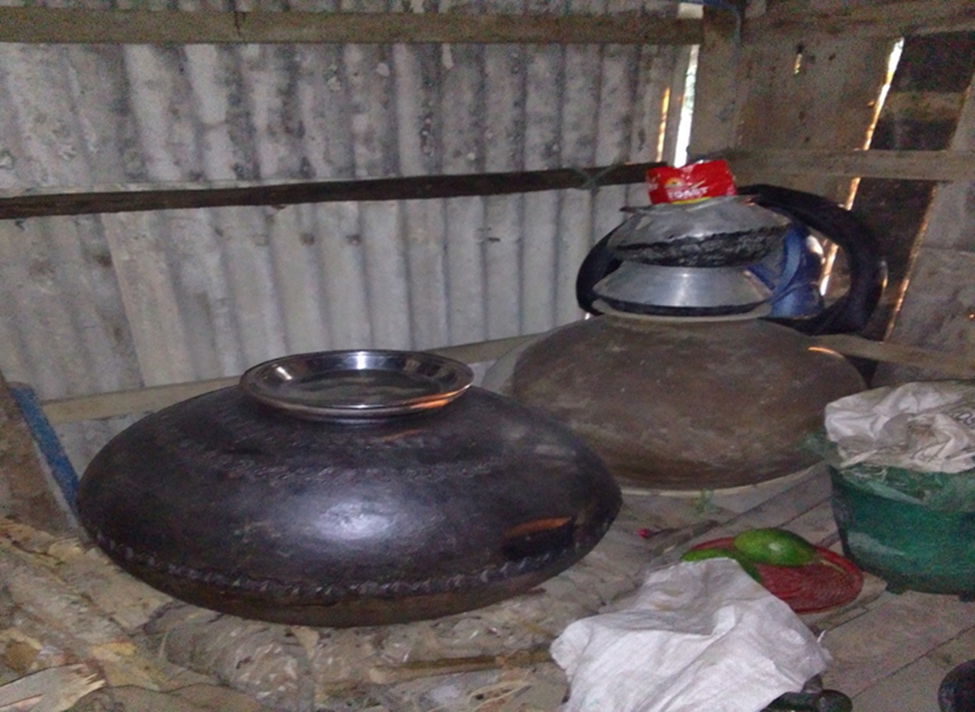
Momotaj Begum, a 40-year-old woman and resident of Gabura Union in Shyamnagar Upazila, shared, “If I go to fetch water from my neighbour’s pond, then I must return with a bhora kolshi (a pitcher filled completely with water).” In coastal villages, a bhora kolshi symbolises prosperity for landed households. A household that owns a pond does not allow anyone who comes to collect water to return with an empty pitcher by crossing the middle of the household courtyard. These are social norms associated with collecting water from ponds that villagers are expected to obey. Returning with an empty pitcher is considered a symbol of “ku-lokkhon” (a bad omen). It symbolises adversity and the future decline of the landed household. Villagers are therefore required to follow the rules surrounding water, which are shaped by the materiality of water itself and its relationship with local inhabitants.
In this social landscape, villagers widely use pond water for drinking and cooking, either directly or through Pond Sand Filters (PSFs) attached to ponds, along with other sources. Generally, there are very few PSFs in the region. One PSF is often located far away from another. To avoid the burden and time involved in collecting water, women try to collect water from ponds near their houses. When they fetch water without using a PSF, they collect it and keep it in an earthenware or aluminium pitcher for around one day. Local people refer to this practice as “bosano pani” (settled water).
Women also use fitkiri (alum) to purify drinking water. After collecting water from the pond, they put fitkiri into the pitcher and keep it there for several hours or a full day so that the dirt and impurities settle at the bottom of the pitcher. This is one of their traditional practices and forms of embodied knowledge for purifying water for drinking and cooking. To ensure the availability of potable water, they follow several other rituals and practices in their daily lives.
At the peak of the summer season, when most pond water almost dries up, villagers arrange marriages between frogs to appease the gods of rain and water so that rain will come soon and their ponds will fill with rainwater that can then be used for various purposes. Though this traditional practice is now very rarely observed, it still exists among some Hindu believers, whereas in the Muslim community this ritual is considered shirk or haram.
In the coastal area of the Sundarbans, water, by both its nature and necessity, has always been an epistemologically present and relational entity connected to people and place. In this landscape, water is not only a vital source of sustenance but is also deeply embedded within everyday life and at the core of human existence and dwelling.
Villagers also sense the probability of rain by observing the behaviour of non-humans. Villagers often say that if a group of ants carries their eggs in their mouths from one place to another, rain will come soon. It is also believed that if frogs croak in a pond, ditch, or pool, then rain will arrive shortly. In the coastal belt, the sound of croaking serves as a cue for impending rainwater. In the Sundarbans, the uses of water transcend domestic purposes and extend to other aspects of society through beliefs and practices in multiple ways.
In the Sundarbans, villagers believe that ponds are places of disposal where they throw away unused para pani (sanctified water) or tabish (amulets) given by a religious leader or kabiraj (folk healer considered a spiritually powerful person). Villagers believe that pond water will destroy the dushon, or spiritual power, of that para pani and tabish. Sometimes villagers take special vows at the edge or steps of a pond so that they can rid themselves of dushon. In coastal areas, para pani is closely associated with faith across religions. In some cases, villagers use para pani to obtain relief from illness. Sometimes a kabiraj gives the condition that the water used as sanctified water must be brought from the middle of the pond before sunrise so that the pond water remains as pure and clean as possible.
In this landscape, villagers also use para pani during childbirth. They believe that if para pani is used during childbirth, labour pain will be minimised. The dhatri (midwife) offers the pregnant woman this para pani, which has been provided or collected from the kabiraj or religious leader. Like para pani, other forms of water, such as river water, are also deeply embedded in the everyday beliefs, practices, and water world of the Sundarbans.
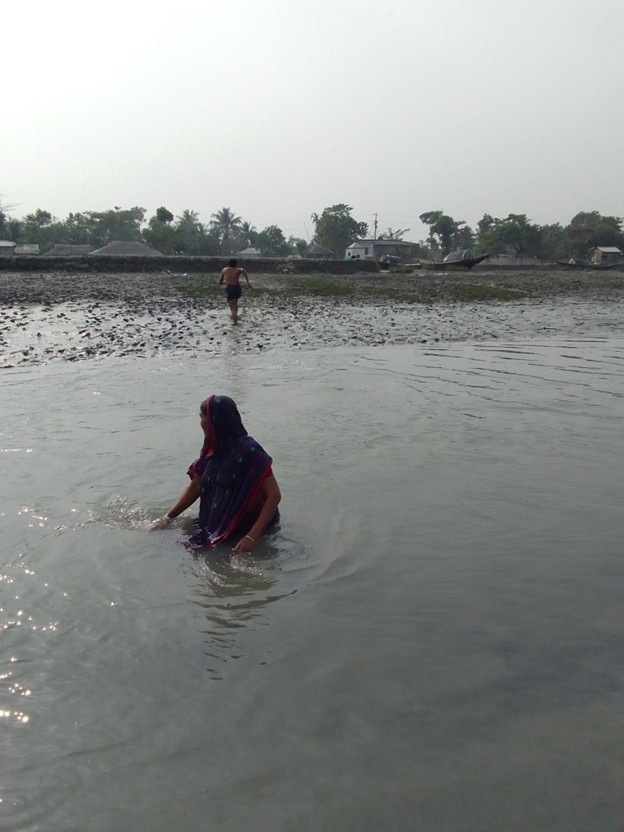
Bakul Begum, a resident of Datinakhali village in Shyamnagar, said that if someone has just recovered from a fever, they should take a bath in river water. According to her, river water is flowing water. People believe that it will wash away all illnesses, and that the salinity of the river will destroy germs and pathogens in the body. That person has to dip into the river water either three times or seven times. If someone follows this ritual, they will be purified and freed from the evil eye (dushon) and illness.
In the coastal area of the Sundarbans, water, by both its nature and necessity, has always been an epistemologically present and relational entity connected to people and place. In this landscape, water is not only a vital source of sustenance but is also deeply embedded within everyday life and at the core of human existence and dwelling.
Md Rahamatullah is a PhD scholar in the Department of Sociology at South Asian University researching drinking water in the Sundarbans of Bangladesh. He can be reached at rahamattullah17bsmrstu@gmail.com.
Send your articles for Slow Reads to slowreads@thedailystar.net. Check out our submission guidelines for details.
Why Dhaka cannot simply ban the rickshaw
The elephants had to be rescued again. Where is the accountability?

‘Situation under control’, but at whose expense?
The untold side of Bangladesh's climate migration

Dhaka's unbearable heat: Who suffers the most?

Enforced disappearance in Bangladesh / Who investigates the state?

Gibbons, kingfishers and the changing world of Adampur Reserved Forest

More than refugees: How Rohingya youth are reclaiming their story
Behind every cup / The mental toll on women tea workers