Bangladesh speaks to the world
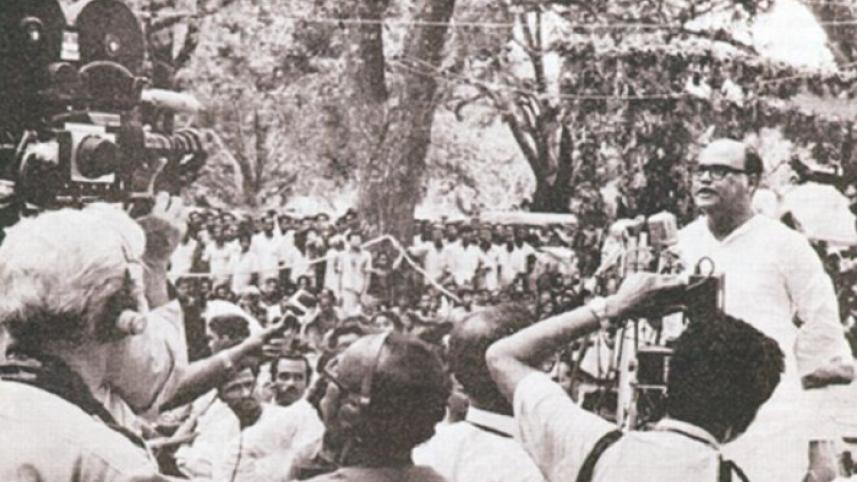
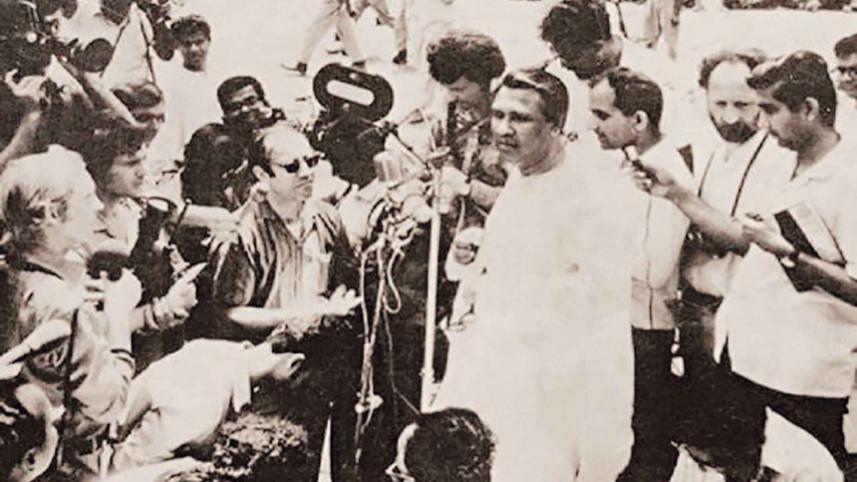
On behalf of the Government of Bangladesh and Bangabandhu Sheikh Mujibur Rahman, I extend my sincere thanks to our journalist friends for travelling from far and wide and enduring great hardship to visit the soil of independent Bangladesh at our invitation.
Before I say anything, I first extend my sincere thanks on behalf of the Government of Bangladesh to the representatives of newspapers and news agencies for supporting the struggle of the seven and a half crore people of Bangladesh for their independence from the very beginning and for trying to publish the truth. The Yahya government and its bandit forces refused entry to foreign journalists and forcibly expelled those already inside on the night of the 25th.
I further thank you and express my sincere gratitude for your utmost efforts and for showing the right path to ensure that the struggle of the seven and a half crore people of my Bangladesh—the struggle for independence—is not hindered in any way and is not misinterpreted under any circumstances.
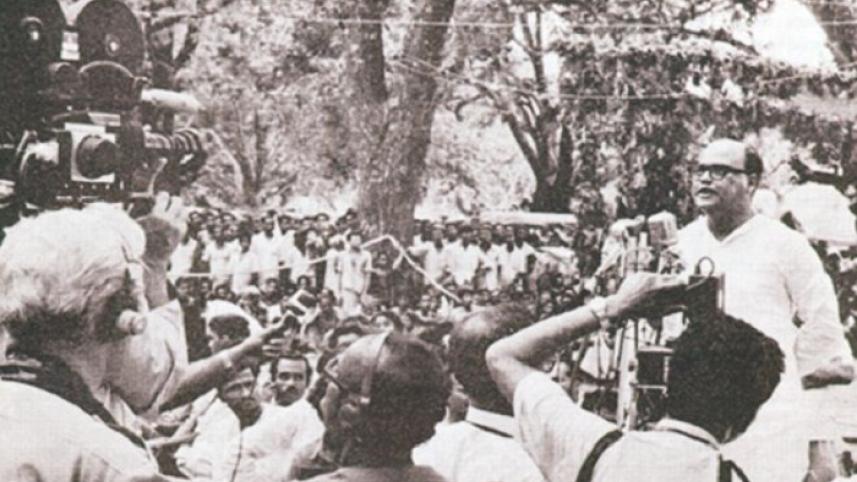
On behalf of the Government of Bangladesh, on behalf of the seven and a half crore people of Bengal, and on behalf of Bangabandhu Sheikh Mujibur Rahman, I appeal to you to kindly continue your efforts in the future to ensure that accurate news is disseminated, so that no miscreant, enemy, or agent can misinterpret our movement or create any misunderstanding. In addition, I request that you, on behalf of the Government of Bangladesh, consider the handouts issued by the Government of Bangladesh to be its official version and use them as the basis. I also have one more request for you—I do not know how it will be possible—but I ask you to think about how you can collect news from the soil of Bangladesh and how you can maintain liaison with the Government of Bangladesh; we will accept your advice in this regard with great pleasure and gratitude.
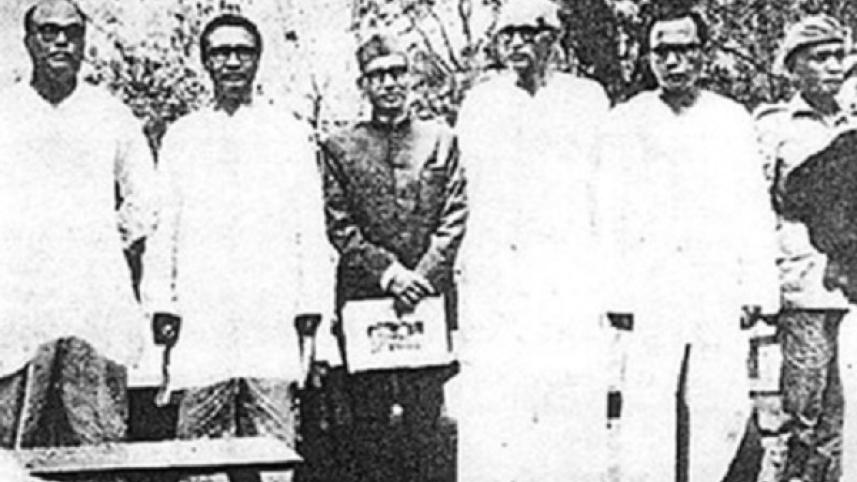
Now, on behalf of the Government of Bangladesh, I will present my statement. Bangladesh is now engaged in a war. We have no alternative but to achieve the right to self-determination through a national war of independence against the colonial oppression of Pakistan.
In the face of the propaganda by the Pakistan government aimed at covering up the real incidents of genocide in Bangladesh, the world must be informed of how the peace-loving people of Bengal chose the parliamentary method instead of an armed struggle. Only then will they truly be able to understand the just hopes and aspirations of Bangladesh.
As a final attempt to preserve Pakistan's national integrity, the Awami League, with full sincerity, sought autonomy for Bangladesh in line with the 6-point programme. In 1970, based on this 6-point election manifesto, the Awami League won 167 out of the 169 seats allocated for Bangladesh out of a total of 313 seats in the Pakistan National Assembly. The electoral victory was so decisive that the Awami League received 80 per cent of the total votes. Through this final verdict of the election, the Awami League emerged as the majority party in the National Assembly.
Naturally, the post-election period was a hopeful time for us. This was because such a definitive mandate from the people in a parliamentary democracy was unprecedented. The people of both provinces believed that this time, it would be possible to formulate an acceptable constitution for both provinces based on the 6-point programme. However, the Pakistan People's Party, which won the majority of seats in Sindh and Punjab, had avoided the 6-point programme during their election campaign. Therefore, the party had no accountability to the people to either accept or reject the 6 points. The National Awami Party, the leading party in Balochistan, was a full supporter of the 6 points. The influential National Awami Party in the North-West Frontier Province also believed in full provincial autonomy in light of the 6 points. Thus, the 1970 election, which marked the defeat of the reactionaries, carried the promise of a hopeful future for democracy in Pakistan.
It was expected that the major political parties would meet to discuss preparations for convening the National Assembly. The Awami League was always willing to present interpretations of the constitution based on such proposals and counterproposals for discussion. However, the party believed that to keep true democratic values alive, the debate on the constitution should take place in the National Assembly rather than in secret conferences. In this context, the Awami League sought to convene the National Assembly as soon as possible. The Awami League is set to draft a constitution to be presented at the upcoming National Assembly session. It examined all legal and practical aspects of formulating such a constitution.
The first important meeting between General Yahya Khan and Sheikh Mujib to discuss the political future of Pakistan took place in mid-January 1971. In this meeting, General Yahya Khan analysed the Awami League's 6-point programme and sought firm assurances from the Awami League about the likely outcome. But Yahya Khan refrained from expressing his own comments regarding the proposed constitution. He acted as if he had not found anything seriously objectionable in the 6 points. However, he emphasised the need to reach a compromise with the Pakistan People's Party.
The subsequent discussion between the Pakistan People's Party and the Awami League was held in Dhaka on 27 January 1971. Mr Bhutto and his party met with the Awami League in several sessions during this time to discuss the constitution.
Like Yahya, Bhutto did not present any specific proposals regarding the constitution's framework. Rather, he and his party were more interested in discussing the practical consequences of the 6 points. Since their reaction to this was negative and they had no prepared stance on the matter, it was not possible to reach a compromise. Yet, the door to efforts to bridge the differences between the two parties was always open. It also became clear from these discussion meetings that Mr Bhutto himself had no position on the level at which a compromise formula could be reached.
It needs to be stated clearly here that the Pakistan People's Party (PPP) did not give any indication before leaving Dhaka that a deadlock had been created in the discussions with the Awami League. On the contrary, they gave assurances that all doors for discussion remained open and that after consulting with other leaders of West Pakistan, the Pakistan People's Party would sit for a second, more fruitful round of discussions with the Awami League, or that they would have many opportunities to discuss matters differently in the National Assembly as well.
In the subsequent phase, Mr Bhutto's decision to boycott the National Assembly session surprised and shocked everyone. His decision was all the more surprising because, instead of convening the National Assembly session on 15 February as demanded by Sheikh Mujib, President Yahya had called the session on 3 March precisely as Bhutto had requested. After announcing the decision to boycott the assembly, Bhutto launched a campaign of intimidation against the members of all other parties in West Pakistan. The objective of this campaign was to prevent them from attending the assembly session. To strengthen Bhutto's hand in this endeavour, the Chairman of the National Security Council and Yahya's close associate, Lt Gen Omar, personally met with West Pakistani leaders and began pressuring them not to attend the assembly session. Despite the pressure from Mr Bhutto and Lt Gen Omar, all members of other parties, except for the PPP and the Qayyum League, booked tickets to fly to East Bengal to attend the 3 March National Assembly session. Even half of the Qayyum League members booked their seats. There were even assurances that many PPP members might rebel against the party's decision and come to Dhaka.
When no headway could be made even after forming such a united front against Bangladesh, General Yahya announced the indefinite postponement of the National Assembly session on 1 March to please his friend Bhutto. Not only that, but General Yahya also dismissed the Governor of East Bengal, Ahsan. Governor Ahsan was known as a moderate within the Yahya administration. The cabinet that had been formed at the centre with the inclusion of Bengalis was also dissolved, and all powers of the government were handed over to the West Pakistani military junta.
Under these circumstances, all of Yahya's actions can be seen as nothing other than an attempt to sabotage Bangladesh's popular mandate by colluding with Bhutto. The National Assembly was the only place where Bangladesh could make its voice effective and demonstrate its political strength. Attempts continued to sabotage this. Efforts continued to turn the National Assembly into a 'toothless tiger' instead of a true source of power. The reaction to the postponement of the National Assembly session was exactly what had been feared. People across Bangladesh spontaneously took to the streets to protest Yahya's autocratic act. This was because the people of Bangladesh understood that Yahya Khan had no intention of transferring power and that he was making a mockery of parliamentary politics. The people of Bangladesh clearly understood that there was no possibility of achieving the legitimate rights of Bangladesh within the framework of one Pakistan. The way Yahya himself called the National Assembly session and then shut it down has taught the Bengalis a lesson. Therefore, they began to pressure Sheikh Mujibur Rahman to declare full independence.
Despite this, Sheikh Mujib continued to strive for a political solution to the problem. While calling for a non-cooperation programme on 3 March, he chose the weapon of peace to confront the occupying forces. Even then, he hoped the military clique would regain their senses. The example of Bangabandhu's non-violent non-cooperation movement in the face of thousands of unarmed and innocent people being shot and killed by the military clique in cold blood on 2 and 3 March is rare in the history of the world.
Sheikh Saheb's non-cooperation movement is now a part of history. He created a new history in the context of the non-cooperation movement. The way the non-cooperation movement progressed in Bangladesh from 1 March to 25 March has no precedent in the history of liberation movements. Nowhere else has a non-cooperation movement achieved such success. A total non-cooperation movement continued nationwide. No High Court judge could be found to conduct the oath-taking ceremony of the new Governor, Lt. Gen. Tikka Khan. Employees of the public administration department, including the police and the Pakistan Civil Service, refused to report for duty. The people stopped supplies to the army. Even the civilian employees of the military department boycotted their offices. They did not stop at refraining from joining the work; the people of the civil administration and the police department also expressed active support and allegiance to Sheikh Saheb. They clearly declared that they would not follow anyone's orders other than those of the Awami League administration.
Facing this situation, the Awami League was compelled to take responsibility for Bangladesh's economic and administrative systems into its own hands during the non-cooperation period, despite not being officially in power. In this regard, they received unequivocal support not only from the masses but also from the administration and the business community of Bangladesh. They wholeheartedly accepted the directives of the Awami League and recognised it as the sole authority for resolving problems. As Bangladesh's administrative system broke down due to the non-cooperation movement, various difficult problems emerged. But even amidst these problems, the work of the country's economic and administrative departments continued as usual under Bangabandhu's directives. The ideal of maintaining law and order that the Awami League volunteers established with the police's cooperation, despite there being no legal authority in Bangladesh, should be emulated by others even in normal times. Seeing the people's overwhelming support for the Awami League and the historic non-cooperation movement, General Yahya changed his strategy. On 6 March, Yahya seemed determined to create tension for a confrontation. This is because, in his provocative radio speech that day, he placed the entire responsibility for the crisis on the Awami League. Yet, he did not say a single word about Bhutto, who was the architect of the crisis. He had assumed that Bangabandhu Sheikh Mujibur Rahman would declare the independence of Bangladesh at the Race Course Maidan on 7 March. The army in Dhaka was put on full alert to crush any such initiative if it were to be taken. Lt. Gen. Tikka Khan was sent in place of Lt. Gen. Yakub Khan. This reshuffle proves the military junta's despicable attitude.
But by then, the freedom-loving people had become desperate to attain independence. Despite this, Sheikh Mujib remained steadfast on the path of a political solution. The four-point proposal he submitted regarding joining the National Assembly reflected the will of the people on the one hand, and, on the other, it was his final opportunity to help Yahya reach a peaceful solution.
In the current context, it is absolutely evident that Yahya and his generals had no intention of resolving Pakistan's political crisis through peaceful means. Their sole objective was to buy time to strengthen Bangladesh's military power. Yahya's visit to Dhaka was, in reality, a preparation for carrying out genocide in Bangladesh. It is clearly understood today that a plan to create a similar crisis was made well in advance.
Shortly before the events of March 1, tanks deployed for border protection were brought back from Rangpur. From March 1, the families of army personnel, along with those of West Pakistani billionaire business families, began to be sent to West Pakistan on a priority basis.
After March 1, the buildup of military strength in Bangladesh accelerated and continued at a steady pace until March 25. Armed forces personnel in plainclothes were brought into Bangladesh on PIA commercial flights via Ceylon. Weapons and supplies were brought in and stockpiled in Bangladesh with the help of C-130 transport aircraft.
According to estimates, an additional division of troops, along with the necessary equipment, was deployed in Bangladesh between March 1 and March 25. To secure the matter, Dhaka Airport was brought under the control of the Air Force. A web of artillery and machine guns was spread across the entire airport area. Strict control measures were imposed on passenger arrivals and departures. A group of SSG commandos, trained in carrying out subversive activities and killings, were released into various important centres in Bangladesh. They were the ones who perpetrated the atrocities that took place in Dhaka and Saidpur in the two days preceding March 25. The purpose of all this was to create a climate of tension by inciting clashes between locals and non-locals, in order to provide a pretext for military intervention.
As part of concealing this strategy of deception or hypocrisy, Yahya adopted a compromising attitude in his talks with Sheikh Mujib. When the discussions began on March 16, Yahya expressed regret for what had happened previously and expressed a sincere interest in a political solution to the problem. At a crucial stage of discussions with Sheikh Mujib, Yahya was asked what the military junta's stance was on the Awami League's four-point conditions for the transfer of power. In response, Yahya stated that they had no major objections to this. He hoped that, by fulfilling the four-point conditions, the advisers of both sides would be able to draft an interim constitution.
The fundamental issues on which consensus was established during the discussions were—
1. Withdrawal of martial law and transfer of power to a civilian government through a presidential proclamation.
2. Transfer of power to the majority parties in the provinces.
3. Yahya would remain President and would run the central government.
4. The East and West Pakistani members of the National Assembly would meet separately.
Today, Yahya and Bhutto are giving a distorted interpretation of the proposal for separate sessions of the National Assembly. Yet, it was Yahya himself who had proposed this for Bhutto's nomination. While explaining the benefits of this proposal that day, Yahya himself had said that the 6-point programme was a reliable blueprint for determining the relationship between Bangladesh and the Centre. Conversely, its implementation would create various difficulties for West Pakistan. In such a situation, the West Pakistani MNAs must be allowed to sit separately and build a new type of arrangement in light of a constitution based on the 6-point programme and the abolition of the One Unit system.
After this agreement in principle between Sheikh Mujib and Yahya, only one question remained: the distribution of power between the Centre and Bangladesh during the interim period. In this case, both parties agreed that the distribution of power between the Centre and Bangladesh would align with the constitution to be drafted in the near future, based on the 6-point programme.
To prepare a plan regarding this interim settlement, the President's Economic Adviser, Mr M M Ahmed, was flown to Dhaka. In discussions with the Awami League advisers, he clearly stated that once a political consensus was established, there would be no rare problems in implementing the 6-point programme. Not even during the interim period.
The three amendments he proposed to the Awami League's draft showed that the gap then between the government and the Awami League was not one of principle, but rather about where to place which word. At the March 24 meeting, the Awami League accepted the amendments with minor changes. Thereafter, there were no obstacles left in the way of Yahya and Mujib's advisers meeting for the final round to finalise the interim constitution.
In this context, it must be noted that the discussions did not reach a deadlock at any stage. Yet, neither Yahya nor his advisers even hinted that they had any such position from which they could not budge.
To cover up the genocide, Yahya has also resorted to fraud today regarding the legal umbrella for the transfer of power. In the discussions, he and his cohorts agreed that he would transfer power through a proclamation, as had been done under the Indian Independence Act of 1947. Yahya has endorsed the hurdle that Bhutto later raised regarding the umbrella for the transfer of power. Surprisingly, Yahya did not even inform Mujib of this at the same time. If Yahya had even hinted that a session of the National Assembly was needed for the transfer of power, the Awami League would certainly not have objected to it because such a trivial matter could not be allowed to derail the discussions. Moreover, as the majority party in the National Assembly, the Awami League had nothing to fear. The proposal for separate meetings of the National Assembly members of the two parts of the country, to which the Awami League had agreed, was done only to please Bhutto. It was never a fundamental policy of the Awami League.
On March 24, at the final meeting between General Yahya and the Awami League advisers, Mr M M Ahmed presented his amendment proposals. A final meeting was supposed to be held at the call of General Peerzada to take a final decision regarding this draft proposal. Regrettably, no final meeting was held. Instead, Mr M M Ahmed left for Karachi on March 25 without informing the Awami League.
By 11:00 pm on March 25, all preparations were complete, and the army began taking up 'positions' in the city. By midnight, a pre-planned programme of genocide was unleashed upon the peace-loving people of Dhaka city. No precedent for such treachery can be found anywhere in contemporary history. Yahya did not issue any ultimatum to the Awami League. Nor was any curfew order issued before machine guns and artillery-equipped tanks pounced on the people and began their destruction. The next morning, Lt. Gen. Tikka Khan issued his first martial law order via radio. But 50,000 people had already lost their lives by then without resistance. Most of them were women and children. Dhaka city turned into a hellscape; indiscriminate firing began in every alley and corner. People who tried to leave their beds in the dark, facing the indiscriminate arson by the military personnel, were gunned down by machine guns.
Despite the sudden and unexpected attack, the police and EPR fought like heroes. But the weak, innocent people could offer no resistance. They died in their thousands. We are preparing a reliable list of the massive genocide carried out by the army under the orders of the President of Pakistan, and we will publish it soon. The barbarity and cruelty we have heard of in the history of human civilisation have all been eclipsed by their barbarity and cruelty.
Yahya left Dhaka on the night of March 25 after unleashing the Pakistan Army. Before leaving, he gave them a free licence to kill Bengalis. Why he resorted to this barbarity was explained to the world at 8:00 pm the next day. In this statement, he offered an explanation to the world for the carnage. His speech was, on one hand, contradictory and, on the other, filled with lies. The world could find no consistency between the situation in Bangladesh or the discussions and his declaration of the party—with which he was discussing a peaceful transfer of power just 48 hours earlier—as traitors and illegal. People could think of nothing but a mockery of the free expression of the seven and a half crore Bengalis when he declared the Awami League, the sole representative of Bangladesh and the holder of the majority of seats in the National Assembly, illegal, and made a mockery of the transfer of power to the people's representatives. It became clear from his speech that Yahya no longer wanted to resort to logic or morality and was determined to use militant law to exterminate the people of Bangladesh.
Pakistan is dead today, and its grave has been built under the corpses of countless human beings. The death of hundreds of thousands of people in Bangladesh stands as an insurmountable wall between West Pakistan and East Pakistan. Before becoming obsessed with pre-planned genocide, Yahya should have thought that he was digging the grave of Pakistan himself. The destruction his licensed butchers carried out on the people under his orders was in no way conducive to national unity. The goal was barbaric hatred and the destruction of a nation. There is not a trace of humanity in them. Under the orders of their superiors, professional soldiers violated their military code of conduct and behaved like predatory animals. They carried out massacres, rape, looting, arson, and indiscriminate destruction. There is no precedent for this in the history of world civilisation. These activities suggest that the idea of two Pakistans has become firmly rooted in the minds of Yahya Khan and his cohorts. If it had not, they could not have committed such cruel barbarity against the people of the same country. This indiscriminate genocide by Yahya is not politically meaningless for us. This act of his is the final chapter of the tragic history of Pakistan's separation, which Yahya has written with the blood of Bengalis. Before being expelled from or eliminated from Bangladesh, they want to finish off the Bengali nation through genocide and a scorched-earth policy. Meanwhile, Yahya's goal is to eliminate our political, intellectual, and administrative systems, destroy educational institutions, factories, and public welfare organisations, and ultimately raze the cities to the ground, so that we can never stand tall as a nation.

The army has already advanced a long way on this path of targets. As a parting kick, they have left the very Bangladesh they exploited for their own interests for 23 long years, 50 years behind Pakistan in every sphere.
There has been no such heinous incident of genocide since Auschwitz. Yet, the major powers have been following an ostrich policy regarding the events in Bangladesh. If they think that doing so has helped maintain Pakistan's unity, they are mistaken because Yahya Khan himself is disillusioned about Pakistan's future.
They should understand that Pakistan is dead today, and Yahya himself is the murderer of Pakistan. Independent Bangladesh is now a reality. Seven and a half crore Bengalis have given birth to an independent Bangladesh through invincible morale and courage, and every day, thousands of Bengali children are nurturing this new infant state with their blood. No nation in the world will be able to destroy this new power. Sooner or later, every state in the world, big or small, will have to accept this new nation. It must be given a place in the United Nations.
Therefore, in the interest of politics and humanity, the major powers should now put pressure on Yahya, cage his licensed killers, and force them to return to West Pakistan. We will forever remember with gratitude the support given by the freedom-loving people of the Soviet Union, India, and other countries of the world to our struggle. We expect similar support from the People's Republic of China, the United States, France, Great Britain, and other countries, and if we receive it, we will congratulate them. Every state should exert pressure on Pakistan at its own level, and if they do so, it will not be possible for Yahya to continue the attack against Bangladesh for even one more day.
In terms of population, Bangladesh will be the world's 8th-largest state. Our only goal will be to build a new country on the ashes and ruins created by Yahya's army. This is a difficult and huge responsibility. Because we are already one of the poorest nations in the world. Besides, people have engaged in a historic struggle for a bright future. They are engaged in the struggle with all their might. They are shedding blood ungrudgingly. Therefore, we cannot let their hopes fail. We must make their future bright.

A nation that can shed its own blood, that can make so many sacrifices, will not fail in fulfilling its responsibilities. No obstacles can stand in the way of establishing the unbreakable unity of this nation.
In this struggle for our survival, we desire the friendship of every nation in the world, big or small. We do not want to be part of any power bloc or military alliance—we only hope that everyone will come forward to help us unhesitatingly with a spirit of goodwill. Our people have not shed so much blood and are not making so many sacrifices in this long struggle for self-determination to become someone's stooge.
Therefore, in this national struggle of ours, we make an earnest appeal to the nations of the world for state recognition and material and moral support.
Every day of delay in this regard is bringing about the premature death of thousands of people and the massive destruction of the main resources of Bangladesh. Therefore, our appeal to the people of the world is, do not delay any longer; come forward at this very moment and thereby earn the eternal friendship of the seven and a half crore people of Bangladesh.
We have presented our case to the world; no other nation has a greater claim to recognition than we because no other nation has struggled harder or made greater sacrifices than we have.
Joy Bangla.
Source: Tajuddin Ahmad: Itihasher Pata Theke. Pratibhash, First Publication: Baishakh 1407, pages 109-121. The speech has been translated by Khairul Hasan Jahin.
Send your articles for Slow Reads to slowreads@thedailystar.net. Check out our submission guidelines for details.

Beyond 1947 / A personal essay
Abul Mansur Ahmad / A global quest in search of a nation

Chand Bibi and the forgotten history of Muslim women’s political resistance
Women’s voices in Nazrul’s Dhumketu
How Milad-un-Nabi shaped Muslim cultural life in colonial Bengal
What Rashomon teaches us about truth and human behaviour
Why Chittagong never became a maritime city
The many worlds of Ghulam Murshid