When Britain’s Bengalis stood up to racism
Tower Hamlets
The racist murder of Altab Ali in 1978 was indeed a turning point for the east London Bengali community. According to Ethnie Nightingale, ‘The Battle of Brick Lane in 1978 signified the moment when young Bengali activists, mostly male, supported by trade unionists, anti-racists and socialists, decided to confront the National Front (NF) after years of intimidation, physical attacks and even murder on the streets of east London, including that of a young Bengali worker, Altab Ali.’ Others, including community activist John Eversley, felt that the anger of the community was directed not only at the murder of Altab Ali, but also at how the institutions reacted.
Before the murder of Altab Ali, the community was facing racism in silence despite the vigilantism of some young men. However, 1978 drove the entire Bengali community of the East End to unite and rise up against racism. Doing nothing was no longer an option. The Asian community was under attack, and it could not stay at home and do nothing.
As a result of the racist violence and resistance, Brick Lane became heavily policed. Race Today reported, ‘After Northern Ireland, the East End of London, particularly the Spitalfields area around Brick Lane, is the most policed sector of the British Isles. Uniformed bobbies walk in pairs at intervals of 50 yards down the length of Brick Lane, from the Bethnal Green Road corner to the Aldgate corner. The summer of 1978 made the corner of Bethnal Green Road and Brick Lane something of a curiosity. It is the site of a Sunday morning political circus’ (Race Today, 1978:127).
In 1978, Altab Ali’s murder was not the only racist killing. Further violent attacks on local Bengali people, including the murder of a 45-year-old Bengali man, Ishaque Ali, in neighbouring Hackney, took place within a month, prompting a summer of protests and political mobilisation during which local Bengali organisations formed alliances among themselves and with other political factions as part of an anti-fascist and anti-racist struggle (Eade 1989; Leech 1994).
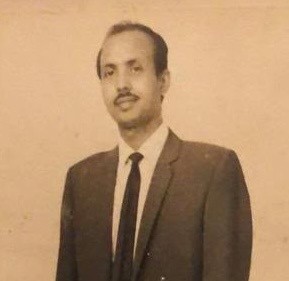
Hackney attack
In the early morning, at around 2:30 am on 25 June, 45-year-old Ishaque Ali and his brother-in-law, Faruk Uddin, aged 20, were attacked in Urswick Road, near Ali's home. Ishaque Ali lived nearby at No. 65 Coopersale Road. As it was getting late, his uncle asked his eldest son, Faruk Uddin, to walk him home. The attackers were described as white males aged between 18 and 20. They were said to be casually dressed and of medium height, approximately 5 feet 5 inches to 5 feet 7 inches tall. A white youth approached the two men and first asked for a light, then for money. When they refused, he kicked Ishaque and was soon joined by two other white youths who assaulted both Bengali men. They were beaten, and one account states that a shoelace was used in an attempt to strangle them (Socialist Worker, 1978). Ishaque Ali, a father of five, suffered a heart attack and died at around 3:32 am after being taken to hospital.
Ishaque Ali: A family man
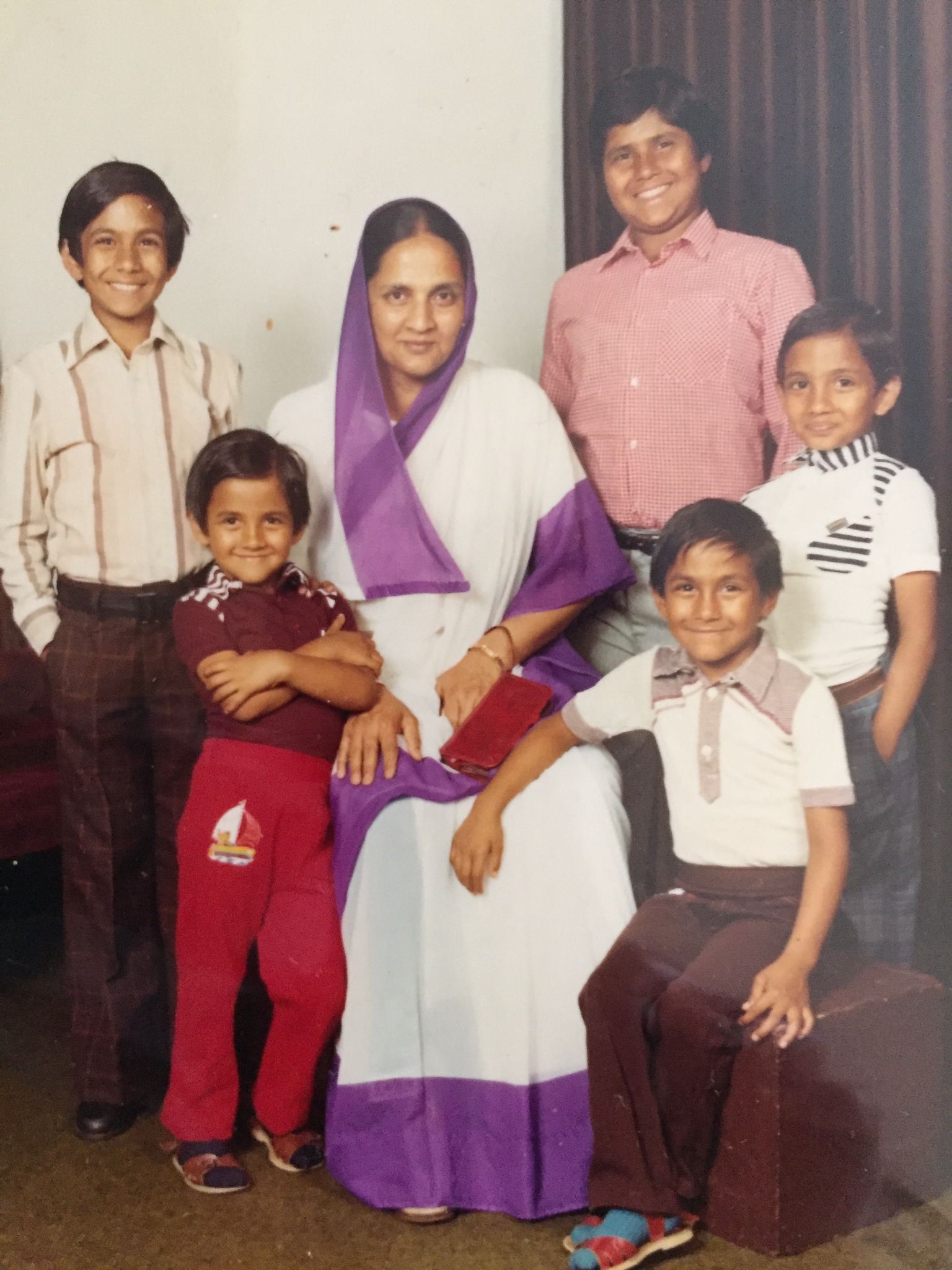
Ishaque Ali had come to London from Bangladesh nine years earlier, in 1968, and worked as a tailor. He also owned a factory in Brick Lane. His hometown was the village of Fengram, Beani Bazar, Sylhet. At the time of his death, he left behind five young children, Shamim, Kabir, Babor, Juber and Shuhel, the youngest being only nine months old, and his wife, Latifa Akthar. Ishaque Ali was buried in his village of Fengram, Sylhet, Bangladesh, in August.
Ishaque Ali was quite an entrepreneur. He had a clothing shop in Dhaka’s Gausia Market, a sari shop in Beani Bazar, and had worked in Chattogram. He was also instrumental in bringing over his cousins and nephews to the UK. Ishaque Ali was born in 1933 in Fengram, Beani Bazar, Sylhet. He was the youngest of seven children, with one elder brother and five older sisters.
After marrying, he first came to the United Kingdom in 1965 at the age of 32. He initially worked as a machinist in Brick Lane before establishing his own leather factory. Having purchased a house in Hackney, he brought his wife and three sons to the UK in 1975. The couple later had two more sons.
A progressive and forward-thinking man, Ishaque Ali believed strongly in helping his family advance and succeed. He sponsored the migration of many relatives, including nephews and cousins, and provided them with employment in his factory. He was also a keen footballer and was highly respected by both friends and family. Those who knew him spoke of his charisma, intelligence and determination. He was widely regarded as someone destined to achieve success in life, owing to his sharp mind and strong work ethic.
Sadly, the death of Ishaque Ali had a lasting impact on the family and caused them considerable hardship. In 1984–85, his wife, Latifa Akthar, suffered a stroke. Although doctors initially gave her only months to live, she fought on with remarkable resilience. The stroke left her paralysed on her right side.
During this difficult period, two of Latifa Akthar’s sisters provided invaluable support to the family. They spent much of their time helping with cooking, cleaning, raising the boys and caring for their sister. In the early 1990s, Latifa Akthar’s mother travelled from Bangladesh with her son, Jahangir Khan, and stayed with the family in Hackney for several years. Latifa Akthar passed away in 2021.
Speaking to this author, Shuhel Ahmed reflected on the family’s journey: “All my brothers are married and have children. We now live across different parts of the country. I think that has something to do with finding a level of peace.”
Police response
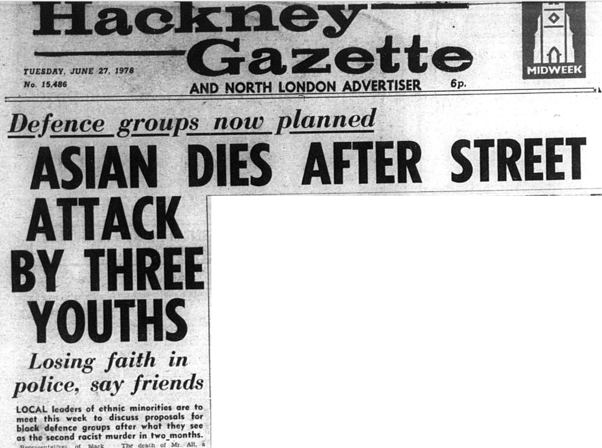
Detective Chief Superintendent George Atterwil, who led the investigation into the killing, told The Times that “the motive here is theft and robbery”, implying that it was not racism. However, others, including the bereaved family, took a different view. Ishaque Ali’s cousin, Sofar ud Din, told the Hackney Gazette: “He was attacked because of his colour. There was no money taken. It happens all the time in the East End.”
Alok Biswas of the Socialist Workers Party (SWP), who knew the family, said: “Faruq, who is recovering in hospital from his severe beating, told me that the white youths called the two Bengalis ‘Paki bastards’ and ‘stinking blacks’.” Their attackers only left when a West Indian man who was passing in his car came to their aid (The Guardian, 26 June 1978). According to Alok Biswas, had it not been for a West Indian man who came to their assistance, Faruq would also have died.
Alok Biswas also noted that the family was not aware of Ishaque Ali having any heart problems. I am sure that people will come to their own conclusions about this, but given what we now know about policing in the late 1970s and the general culture of the time, it seems unbelievable that racism played no part in the incident. Alok Biswas, who was also the Secretary of the Hackney Asian Association, expressed his concern that his fellow countrymen living in Hackney were being targeted by racially motivated attackers who were moving into Hackney from their previous haunts in Tower Hamlets, where attacks on Bengalis took place regularly (The Guardian, 26 June 1978).
As noted earlier, just a month before, in May, another Bengali man, Altab Ali, was fatally stabbed in a racist assault in St Mary’s Churchyard in Whitechapel (the site was later renamed Altab Ali Park in 1998).
Two weeks after that, the Hackney Gazette ran a front-page headline reading “State of siege for us – protest Asians”, reporting on an unprovoked attack in which eight Bengali men were assaulted by youths arriving in three carloads in Bow.
At the same time, members of the National Front were further inflaming tensions by holding large-scale newspaper sales every weekend in Brick Lane, provoking and intimidating the local community.
Patrick Kodikara of the Hackney Council for Racial Equality told the Hackney Gazette that confidence in the police’s ability to protect ethnic minority communities was rapidly declining. In response, the paper’s editorial proposed recruiting more Black and Asian police officers as a constructive solution, while warning against any move towards vigilantism. A later editorial reinforced this stance, criticising what it described as “hysterical prodding” by certain individuals acting for their own motives.
However, Roy Hiscock from Hackney South and Shoreditch Labour rejected this view, arguing that a long tradition of defending vulnerable communities should not be dismissed by commentators who were themselves insulated from such violence. Meanwhile, Tim Miller, a Conservative candidate, advocated increased police presence and tougher sentencing as the solution. In contrast to these debates, members of the community chose to take to the streets themselves.
Three young men were eventually arrested for the attack and charged with murder: James Mitchell, a 17-year-old cabinet-maker from Kentish Town Road, Camden, and two sixteen-year-old males from Homerton. All three were granted bail at Old Street Court on 30 June 1978 and were required to live outside London until the hearing, which was scheduled for 6 September. On 21 September 1979, the accused were found guilty of assault with intent to rob and actual bodily harm (ABH), receiving six months for each offence, to run concurrently.
A progressive and forward-thinking man, Ishaque Ali believed strongly in helping his family advance and succeed. He sponsored the migration of many relatives, including nephews and cousins, and provided them with employment in his factory. Those who knew him spoke of his charisma, intelligence and determination. He was widely regarded as someone destined to achieve success in life, owing to his sharp mind and strong work ethic.
Community response
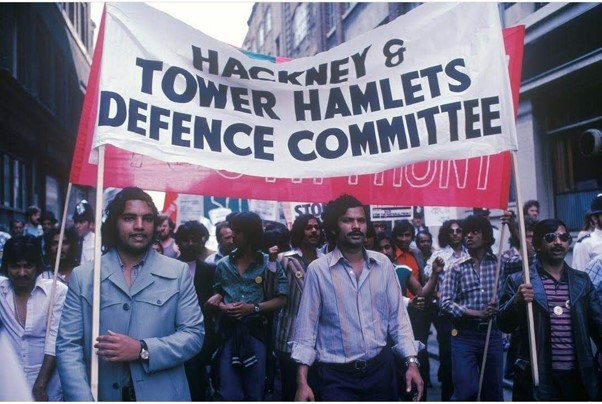
On Friday, 30 June 1978, 300 people marched with black flags and black armbands from the site of Ishaque’s attack to Hackney Police Station. The protest was organised by the Hackney and Tower Hamlets Defence Committee. The group announced a day of action on 17 July.
Hackney and Tower Hamlets Defence Committee
In the month following the death of Ishaque Ali, activists from Hackney and Tower Hamlets formed the ‘Hackney & Tower Hamlets Defence Committee’. It was an amalgamation of the Hackney Committee Against Racism and the Tower Hamlets Movement Against Racism and Fascism, led by Revd Ken Leech.
Sunday, 16 July, marked the start of two days of action organised by the Hackney and Tower Hamlets Defence Committee, the Council for Racial Equality (CRE) for Hackney and Tower Hamlets, and the Anti-Nazi League (ANL). Anti-racists staged a sit-down protest in Brick Lane from 10:30 am to prevent the National Front (NF) from selling its papers.
On Monday, 17 July, Bengali workers and others went on strike. Speakers at an associated rally addressed a huge crowd of 8,000–10,000 local workers who took part in this ‘Black Solidarity Day’ against racial violence. Strikers were joined by the Grunwick Asian Women Strikers, workers from the Ford Dagenham plant and school students.
On the day, 70 per cent of Asian shops in Hackney were closed, and many children did not attend school. A number of pupils from Clapton School attended a rally at Hackney Town Hall and spoke out against the police and the SUS laws alongside trade union and other community leaders. The day culminated in a three-hour sit-down demonstration outside Bethnal Green Police Station and the arrest of three protestors (Hackney Peoples Press, August 1978).
Due to the strike, virtually all of Brick Lane and Spitalfields were shut down. According to Patrick Kodikara of the Hackney and Tower Hamlets Defence Committee, 80 per cent of Asian and West Indian shops closed in solidarity.
On 20 August 1978, the Hackney and Tower Hamlets Defence Committee, together with the Anti-Nazi League (ANL) and Bengali youth organisations, organised a huge march of 5,000 people through the East End, from Brick Lane to St Mary’s Churchyard (now Altab Ali Park).
Hackney activists
One of the key Hackney activists was Alok Biswas, a Bengali from the Indian state of West Bengal, who was a founder member of the Hackney and Tower Hamlets Defence Committee, the Socialist Workers Party (SWP), the Anti-Nazi League (ANL), and the Hackney Asian Association. Later, in the 1980s, he emerged as a leading figure in organising the Hackney anti-deportation movement.
Bhajan Chatterjee, another Hackney activist of Bengali origin and a close associate of Alok Biswas, was part of the Hackney Black United Front in 1985. He was also involved with the Hackney Asian Association/Asian Centre around 1983–1985, when the centre opened on Dalston Lane.
In 1978, another Hackney activist, Patrick Kodikara, a Sri Lankan, was the Labour councillor for the New River Ward in north Hackney. He was also chair of the Hackney Council for Racial Equality and a member of the Hackney Asian Association and the Hackney Campaign Against Racism.
NF’s presence in Hackney
Around 1978, the far-right National Front (NF) had become the second-largest political force in several wards in Hackney. During the 1970s, Bengali communities across the UK, especially in London’s East End, were subjected to violent racist attacks carried out by the NF and associated skinhead thugs. In September 1978, the NF deliberately relocated its headquarters to 73 Great Eastern Street in Shoreditch, aiming to provoke unrest in the East End. Every Sunday, its members would set up a stall at the northern end of Brick Lane, where they sold newspapers, distributed leaflets, recruited members and intimidated Bengali residents. As a result, anti-racist activists and groups from across London, including Hackney, were drawn to the area throughout 1978 to oppose them, turning Brick Lane into a site of frequent confrontation. There was also strong resistance from anti-racists to the NF moving its headquarters to Hackney (Hackney People’s Press, October 1978).
In 1978, Altab Ali’s murder was not the only racist killing. Further violent attacks on local Bengali people, including the murder of a 45-year-old Bengali man, Ishaque Ali, in neighbouring Hackney, took place within a month, prompting a summer of protests and political mobilisation during which local Bengali organisations formed alliances among themselves and with other political factions as part of an anti-fascist and anti-racist struggle.
The NF represented a major threat to the Bengali community. Its regular Sunday presence on Brick Lane, combined with efforts to incite racial hatred, created a climate of fear and hostility. Its propaganda and rhetoric intensified tensions, encouraging antagonism from some local white residents and leaving Bengali people increasingly vulnerable to discrimination and violence. These weekly gatherings were clearly intended to intimidate and spread hostility. Through harassment, vandalism and violence, the NF fostered an atmosphere of fear for Bengali families. Although not all local white residents supported the NF outright, some sympathised with its anti-immigrant views. While the NF failed to achieve significant electoral success in areas such as Tower Hamlets, it maintained a tangible presence in places like Brick Lane through intimidation, sometimes aided by local racist sympathisers.
Over time, however, the NF’s influence in the area declined. It eventually stopped appearing at the Sunday market and became embroiled in a dispute with Hackney Council over its headquarters on Great Eastern Street. In 1979, Hackney Council served the NF with notice to vacate the premises, as its use was contrary to planning permission (Hackney Herald, 1979). On 13 May 1980, Hackney Council won its fight to stop the NF from using 73 Great Eastern Street as its headquarters (Hackney Herald, 1980). By 1981, the NF had relocated its headquarters to Streatham (Dhillon, 2023).
Michael Ferreira: Another victim
In the early hours (1:30 am) of Sunday, 10 December 1978, Michael Ferreira, a 19-year-old West Indian (Guyanese) mechanic, was killed in Hackney by three white men on Stoke Newington High Street. Michael and five of his friends were returning home from a party. They stopped outside the Astra Cinema, 117 Stoke Newington Road, to get a drink. Their attackers, standing on the other side of the road, started to taunt them with NF slogans. Some of Michael’s friends decided to leave while Michael stood his ground. The three men then dashed across the road, and one of them stabbed Michael in the chest. The killer was known for attending NF newspaper sales in Chapel Market, Islington.
Michael’s friends returned and carried him the short distance to Stoke Newington Police Station. They arrived there at 2 am. The police began to question the others about what they were doing out at that time and did not seem interested in the fact that Michael was bleeding to death. It took 45 minutes for an ambulance to arrive. Shoreditch Ambulance Station was less than a ten-minute drive away. Michael was eventually taken to St Leonard’s Hospital, where he died of a ruptured liver at 4 am. Michael Ferreira was born in Stanleytown, Guyana, in 1959. In 1971, he emigrated to the UK to join his parents, who had moved there a few years earlier. He was a pupil at Downsview School, Hackney, and left at the age of 16 to become a mechanic. Michael was still a teenager when he was killed (Hackney People's Press, 4 January 1979).
According to the Hackney Council for Racial Equality, “The police were more interested in questioning him, instead of getting him to the hospital immediately, although they said later that they called an ambulance straight away. His friends saw that he was rapidly weakening but could not get the police to accept that the most urgent action was needed. When the ambulance eventually came, it was too late. He died in the ambulance on the way to hospital.”
21 December 1978
Over 150 people attended the meeting on 21 December 1978 to protest the circumstances of Michael’s death. They agreed to set up a group called the Hackney Black People’s Defence Organisation. The group held regular public meetings at Ridley Road Market and organised pickets of Hackney police stations.
On Friday, 12 January 1979, the men accused of being Michael’s assailants appeared at Highbury Magistrates’ Court. They included 17-year-old Mark Sullivan, a market trader from Kingsland Road, Shoreditch; 18-year-old James Barnes, a meat porter from Bethnal Green; and a third whose identity was not known. According to the West Indian Times, the accused had been picked up by police officers shortly after the stabbing and had confessed to their involvement. Sullivan was accused of being the one who fatally stabbed Michael Ferreira. Barnes’s charge was reduced from murder to “disturbing the peace”. His bail conditions included not setting foot in Hackney “for his own protection”.
The year 1978 was a dark one for the Black and Asian communities of East London, as four innocent lives were lost to racist violence. In April 1978, before the murders of Altab Ali and Ishaque Ali, Kennith Singh, a 10-year-old Sikh boy, was murdered yards from his home in Newham. Racist violence against Bengalis, Asians and the Black community continued in east London and the neighbouring boroughs throughout the 1980s and 1990s.
Ansar Ahmed Ullah is a contributor to The Daily Star.
Send your articles for Slow Reads to slowreads@thedailystar.net. Check out our submission guidelines for details.

Bangladesh's cottage industries need more than nostalgia

Can a social media ban for children work in Bangladesh?
Why Bangladesh keeps suffering from an epidemic of bad projects
Big Picture / The long transformation of rural Bangladesh

Islamic banking’s problem is the model, not the name
What India and Bangladesh get wrong about the Teesta
The unanswered questions of the Ganges Barrage

From seconds to hours: How reels are changing the way we think
Why do some men sexually abuse children?