


Women must be allowed to lead, not just participate, in labour force
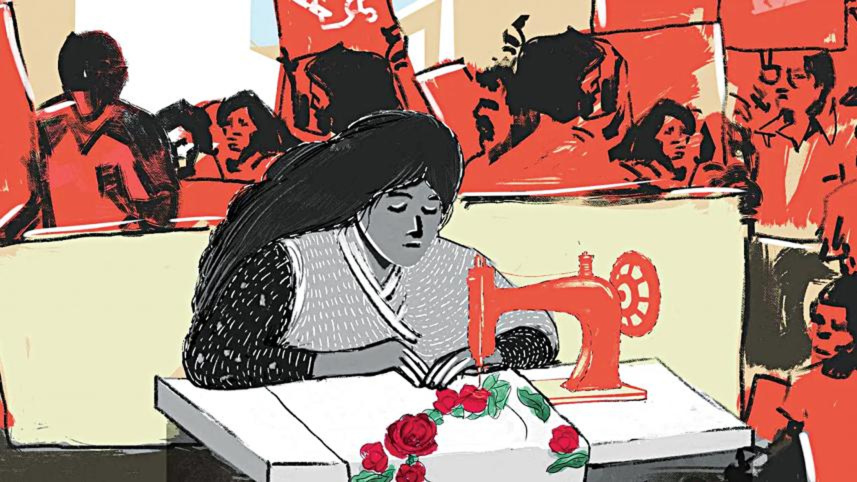
Bijly Baroi is the sole breadwinner for a family of six. A caregiver in Barishal, Bijly entered the healthcare workforce after her father, a former carpenter, became unable to work due to illness. She received the specialised training and certification necessary for formal employment to build a life of dignity for herself and her siblings. Across Bangladesh, working women like Bijly are empowering themselves, strengthening household resilience, and contributing to key economic sectors and social services.
Yet the data tells a troubling story: women’s labour force participation fell from 2.53 crore to 2.37 crore between 2023 and 2024, according to the Bangladesh Bureau of Statistics. Despite near-parity in secondary school enrolment, only 20 percent of women proceed to university, and of those who do, just one in four enters the workforce. This gap between education and employment is not an accident; it is the product of persistent social expectations, the unequal distribution of unpaid care work, and workplaces that remain unwelcoming, or outright unsafe, for women. Frequently, societal expectations for women to manage the household and take on the primary responsibility for raising children prevent even highly educated women from entering or remaining in the labour market.
 For all latest news, follow The Daily Star's Google News channel.
 The International Labour Organization’s (ILO) starting point is the labour law, and the organisation worked closely with the government to strengthen the Bangladesh Labour Act in 2025, which now includes many positive provisions that explicitly prohibit discrimination, gender-based violence, and harassment in employment. While women are technically protected by law, the reality is often shaped by power asymmetries that make voicing grievances impossible.
The law now recognises both direct and indirect discrimination; crucially, this can address unwritten restrictions and informal exclusions that have long defined women’s experience at work: being passed over for promotion without cause, being assigned lower-value tasks, or being quietly edged out by unwritten rules regarding overtime that reduce their earnings compared to men. Critically, Bangladesh recently ratified ILO Convention No. 190 on violence and harassment at work, a landmark commitment that provides the necessary legal teeth to ensure gender equality moves beyond rhetoric and into workplace practice.
Ratification alone, however, does not change what happens on a factory floor, in a hospital ward, or in a corporate office. That is why the ILO’s work goes beyond legislation by supporting the strengthening of labour inspection systems so that rights are enforceable in practice. We work to build accessible, confidential complaint mechanisms that women can use, which is particularly important given that workplace harassment remains severely under-reported.
With over 90 percent of women workers in the informal economy, where legal protections are weakest, the ILO supports the government and social partners to develop policies that progressively protect all workers. While domestic workers are legally recognised, they must achieve full equality of opportunity and treatment under the Bangladesh Labour Act. Central to this is the fundamental right to freedom of association. Women must be able to organise, participate in workplace decision-making, and raise concerns without fear of retaliation.
Legislative reform alone cannot close the gap in labour force participation; consequently, Bangladesh and its partners have recognised the urgent need to invest in skills development. The inter-ministerial Gender and Skills Taskforce (GST) represents a critical institutional response: a coordination platform designed to address occupational segregation and increase women’s entry into high-growth sectors, including digital services, green technology, and skilled professions.
To close the gender gap, the ILO is driving a Transformative Care Agenda in Bangladesh. By applying the 5R Framework for Decent Care Work—recognising, reducing, and redistributing unpaid care, while rewarding and representing care workers—ILO tackles the “time poverty” that holds women back. Through the Gender and Skills Action Plan 2025–2027, the ILO is mobilising investment in childcare and social protection to ensure that vocational training translate into sustainable economic empowerment.
The reform agenda is clear: increasing women’s participation in education, formal employment, and broader economic activities. The ILO stands as a long-term partner in this effort: supporting the government, employers, and workers together to build a labour market where women are not just present, but protected, valued, and anchored as leaders.
The resilience of women like Bijly helped build the Bangladesh of today. But the Bangladesh of tomorrow—one defined by dignity, productivity, and shared prosperity—cannot be built by leaving them behind. Rights must be enforced and justice made accessible. But for rights to be real, they must be anchored by market-responsive skills and a robust care economy.
Bangladesh now has a transformative opportunity to push this agenda forward. Therefore, action must be immediate and bold. Now is the time to move from promises to implementation, placing women’s decent work at the very heart of Bangladesh’s next chapter.
Max Tunon is country director of the International Labour Organization (ILO) in Bangladesh.
Views expressed in this article are the author's own.
Follow The Daily Star Opinion on Facebook for the latest opinions, commentaries, and analyses by experts and professionals. To contribute your article or letter to The Daily Star Opinion, see our guidelines for submission.
Comments