


Who pays for stability? A climate and feminist question

In October, Bangkok is hosting two conversations about the future that are rarely held together. Climate Action Week will see the gathering of activists, communities, young people, and climate advocates. Days later, finance ministers, central bankers, economists, and civil society representatives will get together for the IMF and World Bank Annual Meetings.
The proximity of these two events is important to note, as it signifies that climate change is no longer an environmental crisis alone. It is also a debt crisis, a fiscal crisis, and a question of who carries the cost of adjustment. The feminist question in this regard is this: who pays for stability?

Macroeconomic policy is often presented in neutral terms. But budgets are lived differently. When governments cut spending, remove subsidies, or tighten fiscal policy, the costs can move from the treasury into households and communities. And it is women who frequently absorb them through unpaid care, additional work, and reduced access to essential services.
The IMF has moved in recognising this. Its recent work acknowledges that fiscal policy affects women and men differently, and that childcare, social protection, and public services impact women’s economic participation. But recognition is only the first step towards genuine transformation.
An economist sees the removal of a subsidy as fiscal reform. But what does a woman see when transport, cooking fuel, or food become more expensive and her unpaid working day becomes longer? Research examining fuel-subsidy reform in Bangladesh, Egypt, and Kenya has found that adjustment can impose disproportionate costs on women and marginalised groups through higher household expenses, increased unpaid care, and weaker access to food, transport, housing, and essential services.
This is not an argument for preserving every subsidy. Some are poorly targeted, costly, or environmentally damaging. But reform cannot be judged only by what it saves for the state. It must also account for what it costs society, and who pays.
The same question applies to debt. ActionAid’s latest “Debt Fuels the Climate Crisis: How the Finance Flows” report shows that across 65 highly climate-vulnerable countries, debt servicing absorbs around 65 percent of government revenue and is nearly 25 times higher than spending on climate action. Global South countries are projected to repay around 225 times more debt in 2026 than they receive in grant-based climate finance. This signals not a debt problem, but misplaced choices.
When debt service consumes scarce public resources, governments have less room to strengthen health systems, expand social protection, invest in resilient infrastructure, support locally led adaptation, or finance a just transition.
Climate-vulnerable countries are being asked to borrow to recover from and adapt to disasters, then find additional resources to repay those loans. When climate finance consists mainly of debt, adaptation efforts can deepen fiscal vulnerability.
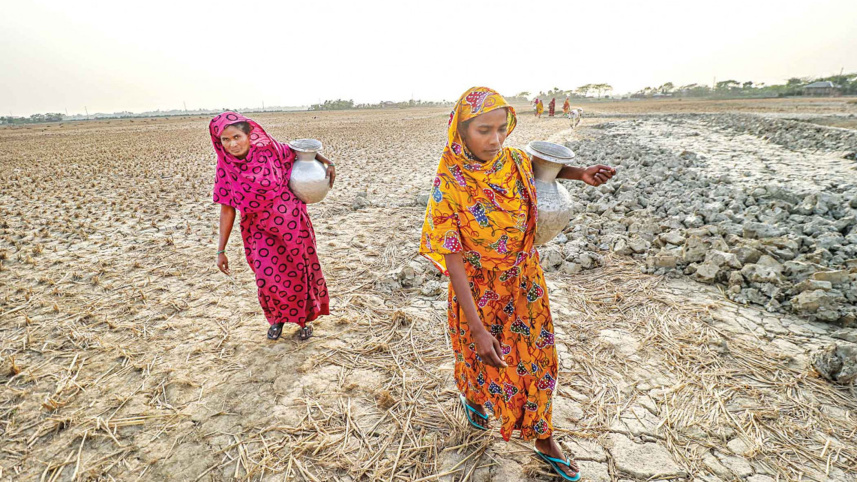
When public services weaken, the task of care work falls on families. When food or energy costs rise, households have to adjust accordingly. When water becomes scarce or infrastructure fails, someone spends more time securing what the state or market no longer provides reliably. Much of that invisible work remains women’s work. This is why climate change and debt cannot be treated as separate conversations.
Campaigners gathering in Bangkok are pressing for debt cancellation and a fairer debt architecture, including mechanisms to suspend debt payments after climate disasters; grant-based climate finance; progressive taxation; and a shift in financial flows away from fossil fuels towards a just transition. Their demands challenge a system in which countries facing the greatest climate risks can have the least fiscal space to respond.
Establishing fiscal justice means treating care, health, education, social protection, and climate resilience as economic infrastructure, rather than expenditure to be trimmed when budgets tighten. It means judging debt sustainability against a country’s ability to protect its people and prepare for future shocks, not only its capacity to repay creditors. It also requires moving beyond gender mainstreaming. A gender statement attached to a budget is useful but a budget that changes who controls resources, performs care, and has economic opportunity can be transformative.
The real test of economic policy is whether it expands people’s capabilities to withstand shocks—not merely whether it restores fiscal ratios. The questioning carried from Bangkok’s climate gatherings into the IMF and World Bank meetings should be: what kind of stability are we building, whose resilience does it protect, and who is paying for it?
A stable economy cannot be one that balances its books by exhausting its people. Its ultimate measure is whether, when the next shock arrives, people have the resources, services, and choices to withstand it.
Farah Kabir is country director at ActionAid Bangladesh.
Views expressed in this article are the author's own.
Follow The Daily Star Opinion on Facebook for the latest opinions, commentaries, and analyses by experts and professionals. To contribute your article or letter to The Daily Star Opinion, see our guidelines for submission.
 For all latest news, follow The Daily Star's Google News channel.
Comments