


Any cyber law reform must uphold digital rights, not undermine them

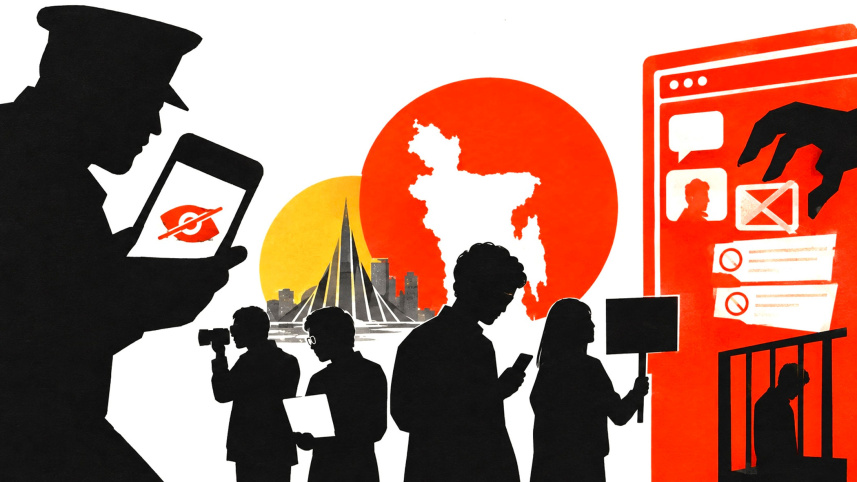
Bangladesh’s cyber security laws have historically expanded the criminalisation of dissent and stifling of civic space, creating a culture of self-censorship. During past regimes, cyber laws prioritised the government’s image over freedom of speech and the press. The misuse of such laws drew widespread criticism, relegating cybersecurity to secondary importance and fostering public mistrust in the governance of cyber issues. They were drafted using broad and vague terms and definitions which left ample room for biased and arbitrary interpretation as well as manipulation. In this context, misuse of law remains a concern, while the very “use” of a vaguely drafted law can inherently lead to harassment and suppression of dissent.
The interim government passed the Cyber Protection Ordinance, 2025 to address gaps and criticisms levelled at the previous versions of the law. Despite some loopholes in the text and processes, the ordinance dropped several controversial provisions from the earlier law. Recently, however, the government proposed some changes to the Cyber Protection Act, 2026 that raised concerns about digital rights, online freedom, privacy, and press freedom. The government justified the amendment as a way to address disinformation, rumours, AI-generated deceptive content, and online harassment. However, from a human rights perspective, it carries far-reaching risks.

The draft amendment includes provisions that define offences with vague terms, dismantle some of the previous safeguards, impose disproportionate penalties, grant excessive police powers, and reinstate executive overreach. It criminalises “defamation”, “humiliation” and “bullying” and increases prison terms and fines. It defines defamation by reference to the definition provided under Section 499 of the Penal Code, 1860, while adding the digital aspects. The constitution, in Article 39, guarantees freedom of speech, expression, and the press. These rights are qualified and subject to reasonable restrictions, and defamation can be interpreted as a reasonable ground. But any such restriction needs to pass the test of precision and reasonableness under constitutional and international human rights principles, especially the International Covenant on Civil and Political Rights (ICCPR).
The UN Human Rights Council (UNHRC) requires the reasonable restrictions on the rights to freedom of opinion and expression to be narrowly tailored with precision, pursue a legitimate aim, and be necessary and proportionate. However, the provisions on defamation, humiliation, bullying, or rumours under the draft amendment of the cyber law reflect overly broad and vague language covering a plethora of expressions, clamping down on rights guaranteed under the constitution and international human rights laws.
Moreover, the proposed amendment increases the maximum penalty for defamation, humiliation, and bullying to five-year imprisonment, extending to 10 years in cases of spreading rumours and disinformation/“fake news”. Such high penalties for speech-related offences contradict the proportionality and reasonableness test under international human rights instruments.
The real concern here is the worrying history of the use/abuse of defamation provisions leading to arrests of numerous activists, journalists, and human rights defenders. Though defamation cases rarely result in conviction, the existence of criminal defamation provisions and the filing of cases threaten media freedom as the litigation process itself, with its wide and discretionary ambit, carries the penalty of intimidation and harassment.
The proposed amendment also criminalises “rumour”, “disinformation”, and “fake news” with vague and overly broad definitions and severe penalties. Without clear definitions, executive authorities have ample room for subjective interpretation and arbitrary enforcement of the legal provisions. This relates to the broad powers given to the cyber protection agency, law enforcement agency, the Ministry of Information and Broadcasting, or any other agency or force authorised by the government. The proposed changes allow the authorities to remove or block not only any data or information, but also “disinformation” or “rumour” published or disseminated in cyberspace or through a digital or electronic medium that poses the risk of undermining the country’s integrity, security, defence, or public order, or inciting religious or communal hatred or ethnic violence.
The formulation of this provision in vague terms is open to excessive, unfettered and disproportionate exercise of authority that may lead to harassment and suppression. Notably, the proposed amendment removed the safeguards stipulated under the existing law. For example, it removed the requirement to make information about blocked content public in the interest of transparency and the requirement to obtain the tribunal’s permission within three days of the removal or blocking of data. There remains reasonable doubt that blocking and removal measures by the executive, without oversight or limitations, may often affect a wider range of content or a larger number of users than necessary.
The proposed amendment also removed the chairperson of the National Human Rights Commission (NHRC) from the National Cyber Protection Council, which is entrusted to take necessary steps in fulfilling the proper implementation of the law. This move reflects weakening institutional human rights safeguards.
Against this backdrop, the following measures can be undertaken to help align the law with international human rights standards.
The provision criminalising defamation should be removed from the proposed amendment, as it is already an offence under the penal law of the country. Similarly, the government should gradually move towards decriminalising defamation under the penal law in light of the UNHRC recommendations, which repeatedly asked state parties, including Bangladesh, to repeal criminal defamation laws as they violate international standards and unreasonably restrict people’s right to freedom of speech. Notably, the Organization for Security and Co-operation in Europe (OSCE) reports that 15 participating states have already decriminalised defamation, and some members are considering additional repeal proposals on general criminal defamation and insult laws.
In line with this, the definitions of the offences, including rumours, disinformation, and bullying, should be precisely formulated in the definition clause of the proposed amendment in light of international human rights treaties. In defining such offences, an explicit exemption clause for publishing the truth for public good and in good faith should be included. This may safeguard journalists and media workers from speculative harassment.
The penalty for online speech-related offences, including rumours and disinformation, should be significantly reduced in compliance with the proportionality requirement of international human rights law. In such cases, a proportionate penalty structure may be introduced considering the nature of the speech, truthfulness of the information, unintentional error, or unverified information published in good faith and for public good, among others.
The provision allowing ample authority to block or remove information should be narrowly defined to check the arbitrary exercise of power. As per international human rights law, content removal and blocking should only be carried out based on a law clearly defining the circumstances in which these acts can be taken, based on the decision of an independent, ideally judicial body.
The law should specify objective criteria for the authorities before blocking content or information. The threshold test, as suggested by the OHCHR, may include the consideration of social and political context, status of the speaker, intent to incite the audience against a target group, content and form of the speech, extent of its dissemination, and likelihood of harm. It should require authorities to make a written order recording reasons for requesting the removal or blocking of certain content. It should also reinstate the requirement of publishing information about the removed or blocked content publicly available for the sake of transparency.
Finally, as journalists, including online journalists, engaged in professional duties are often victims or are at risk of violence, threats, and harassment under cyber laws, the government should immediately formulate and enact a rights protection law for journalists, as proposed by the Media Reform Commission. Once this law is passed, a new subsection can be added to the application of the draft amendment of the cyber law (Section 3). The new provision should assert that the application of the cyber law would be complementary to the journalism rights protection law. This added provision may help close the gap in press freedom and provide adequate legal protection for journalists, online human rights activists, and bloggers.
Mohammad Golam Sarwar a Chevening and Commonwealth scholar, is doctoral fellow in law and alternative development at SOAS University of London. He is also an assistant professor of law at Dhaka University (on study leave).
Views expressed in this article are the author's own.
Follow The Daily Star Opinion on Facebook for the latest opinions, commentaries, and analyses by experts and professionals. To contribute your article or letter to The Daily Star Opinion, see our guidelines for submission.
 For all latest news, follow The Daily Star's Google News channel.
Comments