


Protection or control? The politics of women’s residence halls

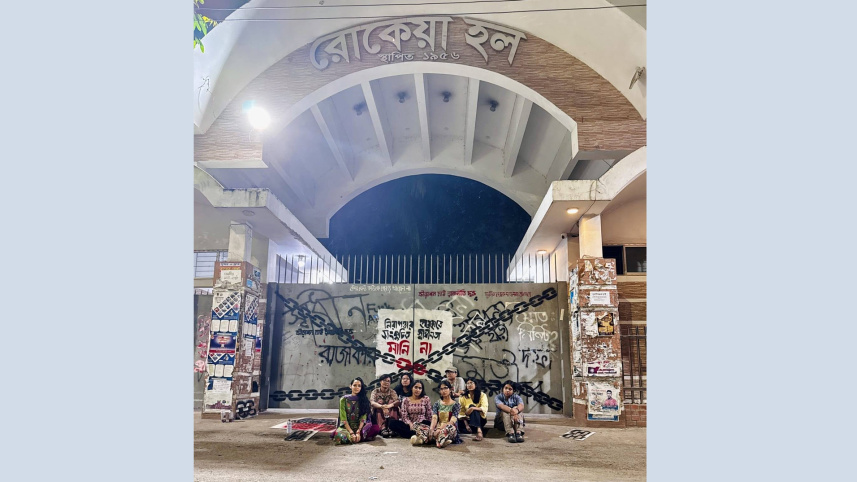
“My home is in Khagrachhari. Whenever I travel back to Dhaka, my bus drops me off around 4:00 a.m. But the gates of our residence hall do not open until 6:00 a.m. Where am I supposed to stay during those two hours? What am I supposed to do? If the hall gates are locked from 10:00 p.m. until 6:00 a.m. in the name of security, does that mean women students face no security risks during those intervening hours? That is why we demand that the hall gates remain open 24 hours a day.”
These words by Ducsu Executive Member Hema Chakma expose a fundamental paradox in the University of Dhaka’s approach to women’s safety. If the campus is unsafe after 10:00 p.m., who is responsible for a woman student dropped off at 4:00 a.m.? If the university cannot ensure her safety, then what purpose do locked residence hall gates actually serve—protection, or control? Hema’s experience is not exceptional. Aditi Roy, a student of Begum Rokeya Hall, shared her story too. “We were returning from a study tour last winter. Our bus reached campus at around 3:30 a.m. The hall gate was opened only briefly before being locked again. Because I was ill, I could not get off the bus in time. Another student and I were left waiting outside in the cold until 6.00 a.m. in the morning.”

Another student recounted that a friend who had fainted after falling seriously ill was denied entry because her local guardian was absent and was even threatened with losing her residential seat. Such incidents expose a troubling irony: policies enacted in the name of security often make women students more vulnerable, effectively confining them within a carceral system. Yet even in 2026, debates about women’s safety continue to revolve around regulating women’s mobility and policing the ways they occupy public space, instead of confronting the structures that produce violence in the first place.
This contradiction is evident in a recent initiative by Ducsu. At the Teacher-Student Centre (TSC), which is known as the biggest cultural hub at the University of Dhaka, a curtained seating area labelled as “Female zone” has been introduced. At first glance, it appears to be a simple attempt to accommodate women students who prefer privacy. But symbolically, it also extends a much older tradition of regulating women’s presence in public spaces. Criticising this initiative does not mean arguing that women who prefer to sit behind a curtain should be denied that choice. Women who choose such an arrangement for religious, personal, or cultural reasons should unquestionably have that freedom. The problem emerges when accommodation transforms into representation and when one particular cultural practice or idea of freedom comes to stand for womanhood itself. Ducsu did not call the designated area a “Pardah zone.” They called it a “Female zone.” More significantly, the visual symbol chosen to represent it is a cartoon of a woman wearing a hijab. In doing so, one specific image of femininity is implicitly presented as the representative image of “the female.”
But who gets to define womanhood? The French philosopher Simone de Beauvoir famously argued that one is not born a woman but becomes one. Womanhood is not a fixed biological essence; it is a social identity continually produced through culture, institutions, and relations of power. So, when a university presents one visible cultural marker as the symbol of all women, it unintentionally elevates one particular form of femininity into a universal norm. The consequence is not merely symbolic. It shapes how women are imagined within the institution itself. Women cease to appear as diverse individuals with different beliefs, clothing practices, political commitments, and ways of inhabiting public life. Instead, they become associated with a single, predetermined cultural identity. Social psychology offers a useful concept for understanding this process: depersonalisation. It describes how individuals gradually internalise the characteristics that society defines as “normal” or “appropriate” for the groups to which they belong. As those expectations become naturalised, both individual autonomy and the collective imagination of freedom begin to narrow.
It is at this point that the idea of performative inclusivity becomes relevant. Institutions often speak the language of inclusion while silently prescribing the terms on which inclusion is granted. Throughout the 1990s, many restaurants in Bangladesh’s district towns advertised that they had “private cabins” or designated curtained seating areas for women. These arrangements were justified in the language of safety, modesty, and comfort. Yet beneath those justifications lay a different assumption: that women’s visible presence in public was itself a problem. Instead of confronting the conditions that made public spaces unsafe, society chose to conceal women from public view. This is how patriarchal norms reproduce themselves—not only through laws or explicit prohibitions, but through seemingly ordinary arrangements that gradually become accepted as common sense. The politics of security at the University of Dhaka operates in much of the same way, while any meaningful institutional accountability for sexual harassment—whether perpetrated by faculty members, fellow students, or through online abuse—remains strikingly limited. It is disturbing when institutions devote considerable energy to regulating women’s movement while investing far less in addressing the perpetrators of violence or strengthening mechanisms of accountability.
Perhaps the greatest contradiction lies elsewhere. During the 2024 mass uprising, the image of women students breaking open the locked gates of their residence halls and joining the demonstrations became one of the defining moments of the movement. Across the country, those images were celebrated as symbols of courage, resistance, and democratic participation. The locked gate came to represent authoritarian control; however, only a short time later, locking those same women inside their residence halls at night is once again defended in the language of “security.” If women’s political agency was indispensable in resisting authoritarianism, why should their agency become negotiable in ordinary democratic life? Why should freedom of movement, the ability to make decisions, or the right to participate fully in campus life become conditional once the moment of political crisis has passed? The issue extends beyond residence hall policies or a curtained seating area; at stake is a broader question about citizenship itself.
Universities occupy a unique place in democratic societies. They are expected not merely to educate but to cultivate independent citizens capable of making judgments, taking responsibility, and participating in public life. Policies that presume women require continuous institutional supervision risk undermining that very mission. They shift the focus away from transforming unsafe environments and towards regulating those who are most vulnerable within them. Women breaking out of the patriarchal cage during the struggle against fascism is, for many, like the decorative showpieces we keep in our cupboards at home—taken out when guests arrive and put back on the shelf once they leave. For many, existing as an object in this way is itself a symbol of honour. For those who do not see it as honour, the struggle to break those chains continues.
Nuzia Hasin Rasha is a student organiser and freelance writer.
Views expressed in this article are the author's own.
Follow The Daily Star Opinion on Facebook for the latest opinions, commentaries, and analyses by experts and professionals. To contribute your article or letter to The Daily Star Opinion, see our guidelines for submission.
 For all latest news, follow The Daily Star's Google News channel.
Comments