


As Gaza fades from headlines, a flotilla reminds us that silence is not peace

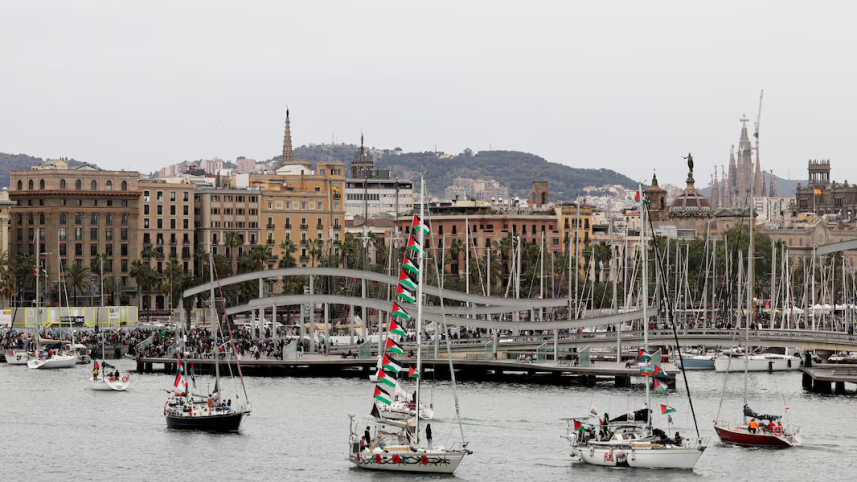
While the world’s attention has been hijacked by the new American, made-for-Israel war against Iran, a quieter act of resistance is gathering on the deep blue waters of the Mediterranean Sea. An act of defiance determined to remind the international community that there is no pause in Gaza’s genocide and there will be none for those fighting to end it. The Global Sumud Flotilla, (Sumud means "steadfast" in Arabic), is now on its 2026 spring mission. International activists, boarding close to 100 boats, with Greenpeace's Arctic Sunrise providing technical and operational support, are sailing to Gaza under the slogan: “We sail until Palestine is free.” The goal is to establish a direct maritime corridor to Gaza's shores, delivering what Israel's blockade has long denied over 22 lakh residents of Gaza. The 1,000 multinational seafarers carry something harder to quantify: the accumulated moral weight of a world that has grown tired of watching governments perform concern while doing nothing.
Before speaking of what the flotilla is sailing towards, the world must first reckon with what it has chosen to normalise: Israeli occupation of 53 percent of Gaza. Its suffocating blockade controls every calorie that enters the strip, so precisely, so deliberately engineered, that humanitarian organisations have documented an official daily intake for Gaza's children, a number calculated not to sustain life but to regulate its slow erosion. A supposed ceasefire that never ceased using food as a weapon in a war of starvation.

Since the October 10, 2025, ceasefire announcement, the headlines moved on, but Israel kept killing. Six months later, UN Human Rights Chief Volker Türk said that the “unrelenting pattern of killings reflects continuing disregard for Palestinian lives, enabled by sweeping impunity.” According to the Palestinian Ministry of Health, at least 738 Palestinians had been murdered since that ceasefire took effect, with airstrikes, gunfire, and shelling continuing daily across the strip. “Palestinians have no blueprint for survival…Whatever they do or don't do, wherever they go or don't go, there is no safety or protection afforded to them. It is hard to square this with a ceasefire,” said Türk.
It cannot be squared, because it is a one-sided ceasefire. More than six months on, Israel continues to cordon some 22 lakh Palestinians into 47 percent of their own land, an open-air prison shrinking by the day, its walls drawn not in concrete but by the calculated silence of the international community. Homes, or what had remained of them at the time of the ceasefire, have since been systematically razed to the ground. More than 10 lakh human beings are not permitted to return, not even to pitch a tent over the rubble of what was once their home. They are separated from their homes and farms by the so-called yellow line. In reality, it’s a red bloodline, demarcated not by markings, but by the corpses of murdered Palestinians. A moving death trap that follows Gazans into their streets, their neighbourhoods, their tents. A father walking his child to what remains of a school. A woman carrying water back to a tent. A man standing outside because his home no longer has walls. Any of them, at any moment, can fall within the “bloodline” death coordinates and be shot.
To hide the story, Israel kills the witnesses attempting to document the murder. On April 8, the Israeli military murdered another journalist, Mohamed Washah. Washah is the 294th Palestinian journalist targeted by Israel in Gaza since October 2023. According to Brown University, Watson School, as of April 2025, Israel “killed more journalists in Gaza than the US Civil War, World Wars I and II, the Korean War, the Vietnam War (including the conflicts in Cambodia and Laos), the wars in Yugoslavia in the 1990s and 2000s, and the post-9/11 war in Afghanistan, combined.” Israel has exported the same tactic of targeting journalists and media workers to Lebanon. It is a regional Israeli strategy of silencing witnesses, not an isolated pattern of collateral damage. The number of murdered journalists in Palestine and Lebanon is not just a statistic. It is an Israeli methodology. Where the blue helmet and the press vest have become Israeli military priorities, not because journalists carry weapons, but because Israel fears the camera more than it fears the gun.
This is why Gaza remains sealed to a complicit international press. A blackout designed to conceal what its killing machine is doing on the ground. When it cannot stop the truth from existing, it kills the locals who expose it. When it cannot stop the world from eventually seeing, it ensures the world sees as little as possible, as late as possible, and filtered through its own hasbara outlets. The camera is the enemy because the camera does not lie, does not accept military briefings as fact, and does not look away from a child pulled from under the rubble in Gaza, or a screeching cat rescuing its kitten from under concrete wreckage in Lebanon. Evidence is the one thing that cannot be bombed into rubble or starved into submission, so Israel murders the bearers of the truth.
The Global Sumud Flotilla understands this. Among those sailing are journalists, documentarians, and human rights monitors. People of conscience who have chosen to place their bodies between Gaza and the world's forgetfulness. Israel has intercepted previous attempts in international waters many times before, jamming their signals, seizing their vessels, humiliating activists, and dragging them into custody. It’ll certainly try again. But the calculus of the world’s public opinion has shifted. Every interception is new proof, and every crew member taken in the dark Mediterranean night is a witness who will tell a story.
Israel has the most sophisticated military hardware that can be bought with American taxpayers’ money. Its drones hunt journalists by name, and a diplomatic shield, held in place by Washington's veto. What it neither has nor can manufacture is the power to kill an idea whose time has come. The flotilla sails again, because Gazans have not surrendered. It sails because the blue helmet and the press vest, though stained with the blood of hundreds of journalists, still mean something to the people who wear them. Activists, representing the best of humanity, have come from all seven continents because history is being written beneath the stars and across the cobalt waters. They stand apart in a world that has chosen to look away.
Yet, and for all its firepower, Israel has not found a weapon that can extinguish people’s determination to stand up to injustice. Gaza will be free. The only question is, how many flotillas must sail, and how many witnesses must be murdered before the world’s conscience awakens.
Jamal Kanj writes frequently on Arab world issues for various national and international commentaries. He is the "Children of Catastrophe: Journey from a Palestinian Refugee Camp to America," and other books.
Views expressed in this article are the author's own.
Follow The Daily Star Opinion on Facebook for the latest opinions, commentaries, and analyses by experts and professionals. To contribute your article or letter to The Daily Star Opinion, see our guidelines for submission.
 For all latest news, follow The Daily Star's Google News channel.
Comments