


Why this disregard for migrant deaths?
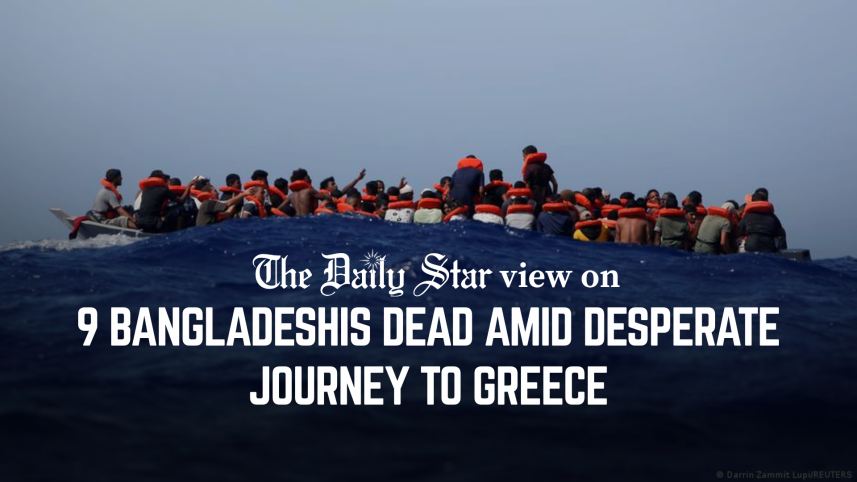
Nine Bangladeshis and one Sudanese national died after 11 days adrift in the Mediterranean. More troubling still: this is the second mass fatality among Bangladeshi migrants travelling by illegal sea routes from Libya this year, after at least 18 died in March. Sadly, this trafficking route that kills with this regularity has been allowed to operate with scandalous impunity. Between January and June this year alone, at least 3,608 Bangladeshis reached Greece by sea from Libya, while a further 4,249 entered Italy—putting Bangladesh, according to Frontex data, ahead of both Afghanistan and Sudan among nationalities using the Central Mediterranean route. Since 2009, roughly 1.10 lakh Bangladeshis have made this crossing.
The mechanics of this latest tragedy are depressingly familiar. A rubber boat built for 25 passengers was loaded with 42. It carried a single engine and no functioning navigation. It ran out of fuel in open water and drifted for 11 days before making landfall not in Greece, its intended destination, but on an Egyptian coast. Survivors, rescued by locals, who happened to notice the boat, describe bodies decomposing in the heat before being thrown overboard on the instructions of the traffickers who had sold them the passage. It is a system built to be indifferent to the deaths it produces, because the traffickers are paid whether or not their “cargo” survives. BRAC has tracked this route for years and is right to note that Bangladesh's rank in Mediterranean crossings is a reputational as well as a humanitarian problem, pointing to the country’s ranking per Frontex. Yet the response from Dhaka has been frustratingly routine. There is little sign of the sustained, cross-agency effort to break up traffickers who operate with near-total impunity.

Some of the responsibility sits closer to home than Tripoli or Brussels. Many of the families of the deceased migrants in Shantiganj upazila in Sunamganj describe brokers pressuring them into silence, assuring relatives that their sons are alive and well. This points to how deeply embedded these networks are in the communities they exploit. Meanwhile, EU member states' response has consistently prioritised deterrence and externalisation—funding Libyan coastguards of dubious accountability, tightening asylum processing—over building safe, legal channels for labour migration that might dismantle the trafficking economy.
Therefore, what Bangladesh needs is a trafficking-specific law enforcement unit with the resources and mandate to trace recruitment financing back through the districts that supply it, not merely to process paperwork after boats capsize. It needs expanded legal labour migration pathways to the Gulf and elsewhere. The EU, for its part, should expand legal migration routes. If people have a safe, legal way to migrate, they have no reason to pay smugglers.
Until then, the arithmetic will not change. Boats built for 25 will keep carrying 42. Engines will keep failing in open water. And ministries in Dhaka, Cairo and Brussels will keep issuing statements of concern about deaths that were, in every meaningful sense, foreseeable.
 For all latest news, follow The Daily Star's Google News channel.
Comments