


Uphold street children’s rights
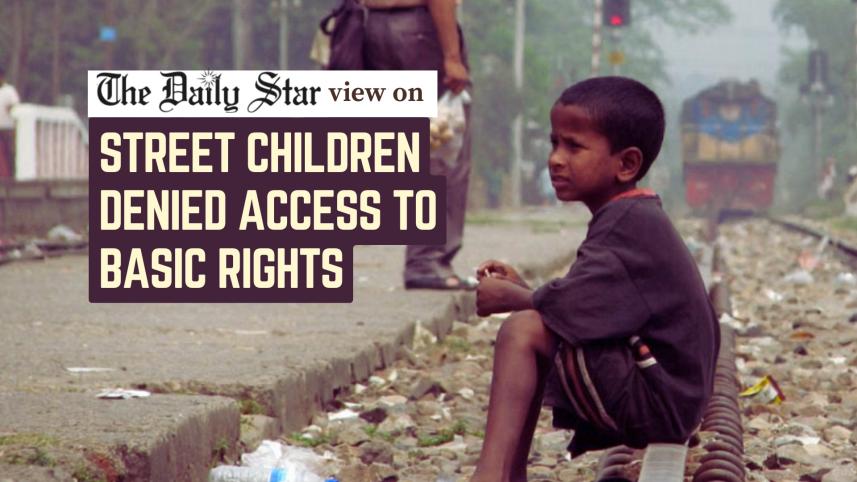
In Bangladesh, around 34 lakh children live on the streets without parental care. However, their suffering is often overlooked by the state and policymakers. These children face deprivation and abuse, lack access to education and healthcare, and are even excluded from social protection systems due to state apathy. Against this backdrop, it is encouraging to hear from a group of former street children who were rescued and rehabilitated by the non-government organisation LEEDO. Fifteen of them recently joined a discussion, asking important questions about their safety, dignity, and future.
As members of LEEDO's "Young Journalist Changemaker" group, the children asked questions that exposed the deep, systemic neglect shaping the lives of those on the streets. One asked whether there is any legal remedy if a street child is harassed by police, another questioned the use of children in political programmes, and others raised concerns about the lack of rescue services and the poor enforcement of child protection laws. The responses they received from policymakers, lawyers, and rights activists were equally revealing. While a child helpline (1098) exists in the country, it is limited to divisional cities; child protection laws and agencies are in place, but implementation is inconsistent. The same goes for legal aid: despite its availability, most children cannot access it.

Although street children belong to the most vulnerable section of society, the state has never made their education and well-being a priority, which is most unfortunate. A recent survey by Caritas Bangladesh found that nearly 94 percent of street children remain excluded from government safety-net schemes. Most of them lack the identification documents needed to access education or healthcare. Another report by this daily revealed that sexual abuse is a daily reality for many of these children, particularly girls. Several other studies also paint a horrific picture of their vulnerability.
We, therefore, urge the government to act urgently to extend the child helpline to every upazila, register street children, integrate them into education and social services, and strictly prohibit their exploitation in politics or labour. A comprehensive, well-funded child protection system with adequate rehabilitation facilities is essential to bring all street children under state care. Society, too, bears a responsibility to stand by these children, as organisations like LEEDO have done. If non-government organisations can reshape the lives of street children, the government, with far more resources and reach, should be able to ensure every child in the country grows up in a safe and caring environment. By ensuring the constitutional rights and dignity of street children, we can transform them into capable, empowered individuals who will contribute meaningfully to the country's social and economic progress.
 For all latest news, follow The Daily Star's Google News channel.
Comments