


Make disability inclusion a daily reality
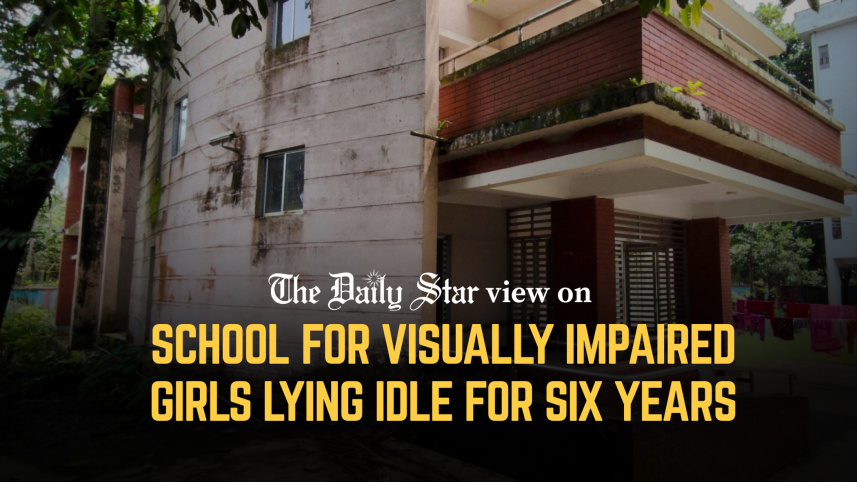
In 2026, Bangladesh still seems to treat people with disabilities as an afterthought, and recently, this indifference has been demonstrated by the state of a building in Kishoreganj. According to our report, the Integrated Visually Impaired Education Program School and Hostel, built specifically for girls with visual impairment, has sat entirely unused for six years since its completion in 2019.
The school was designed to serve 10 girls aged 6-16, complete with classrooms, dormitories, furniture, and basic amenities. It cost Tk 1.61 crore to build. Today, its walls grow algae, its doors hang dilapidated, its windows are broken, most furniture has been stolen, and not a single child has ever been enrolled. Manpower shortage, officials claim, is why the school remains closed. However, six years have elapsed without recruitment or visible administrative action. Meanwhile, a comparable school in Sholakia, Kishoreganj operates successfully with 10 enrolled students, proving that the model works.

The National Survey on Persons with Disabilities (NSPD) 2021 had found that around 60 percent of children with disabilities were not in education. Against this backdrop, abandoning a facility that was built to serve this community is deeply disheartening. Bangladesh’s Rights and Protection of Persons with Disabilities Act was enacted 13 years ago. It mandates education and employment access and establishes government job quotas, but the law’s implementation remains skeletal. Research from inclusion experts demonstrates that visually impaired individuals can navigate technology, pursue higher education, conduct research, and lead organisations when given equal access. What continues to exclude them are social stigma, bureaucratic lethargy, and discriminatory systems. It is truly extraordinary that an entire system of local administrators, school authorities, and civil society have permitted a Tk 1.61-crore facility to decay for six years.
The government must now authorise recruitment for the five required positions and start the process of enrolling girls in the school. Another welcome step would be to initiate a comprehensive audit of all education facilities for persons with disabilities across the country to identify similar failings. Overall, Bangladesh must prioritise systemic improvements in disability inclusion. Experts suggest initiatives to integrate digital accessibility standards into school curricula and infrastructure, train teachers in inclusive education, ensure competitive recruitment of qualified persons with disabilities as educators, and allocate dedicated budgets for adaptive learning materials and assistive technology. Society at large also needs to recognise that disability inclusion is not charity, but a rights issue. Opening this school would mean little if the indifference which produced six years of silence continues to persist.
 For all latest news, follow The Daily Star's Google News channel.
Comments