


Our universities face a crisis bigger than graduate employability

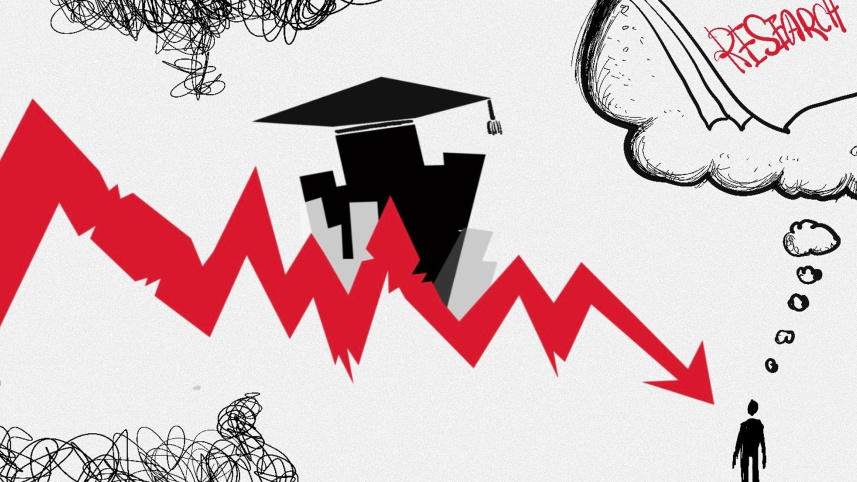
During my inaugural public lecture of the Education Reform Initiative (ERI) last month, I argued that the education system was failing to convert years of schooling into learning, skills, employment, and productivity—a broken chain that remains central to our graduate unemployment crisis. An exchange during the same event, however, pointed to another, less visible failure. Professor Rashed Al Mahmud Titumir, finance and planning adviser to the prime minister, argued that many universities have effectively been reduced to colleges: they conduct teaching and exams but do not generate knowledge. His observation raises a fundamental question: are our universities failing not only to prepare graduates for productive employment, but also to produce the scientists, researchers, and scholars required for a more productive economy?
Days later, Dhaka Central University Vice-Chancellor Professor Md Nurul Islam brought the same issue into public debate. At a University Grants Commission (UGC) policy dialogue, he argued that budgets alone could not create quality universities; Bangladesh also needs research-capable teachers and an enabling environment for generating knowledge. His remarks about BCS general education cadre teachers provoked understandable criticism, followed by an expression of regret. But the controversy should not obscure the structural problem. It would be unfair to blame teachers whom the state recruited mainly for teaching and who were then given little research time, infrastructure, training, or incentive. The more important question is whether colleges can become universities merely through redesignation.

Universities perform at least two main connected economic functions. The first is educational conversion, which means turning enrolled students into capable graduates who can contribute to society and enter productive employment. The second is knowledge-capability reproduction: producing research while training the next generation of scientists, scholars, and research-ready university teachers.
Our universities are underperforming in both functions. The mismatch between graduate unemployment and skills mismatch makes the first failure highly visible. The second failure (of knowledge-capability reproduction) attracts less attention because its costs emerge gradually—in outdated curricula, weak doctoral training, limited innovation, and an economy unable to generate adequate jobs.
The two failures also reinforce each other. Without active research communities, teaching becomes detached from discovery, technological change, and industry. Students learn established content but rarely learn through investigation. The broken transition from university learning to employment is, therefore, connected to another gap: from teaching to research, and from isolated researchers to durable research institutions.
Bangladesh’s universities do boast internationally recognised scientists and scholars. The problem is that individual excellence rarely becomes institutional capability. A university becomes research-intensive only when it can continually produce successors through functioning research groups, doctoral pipelines, mentorship, competitive grants, ethical safeguards, and international networks. The individual excellence of scholars gives a university distinction, but only the reproduction of that excellence boosts its research capacity.
This is where the Higher Education Acceleration and Transformation (HEAT) project becomes relevant. This is a World Bank-supported public investment project that seeks to strengthen research, teaching, digital capacity, quality assurance, and graduate employability. The World Bank approved HEAT in June 2021, but restructuring delayed implementation and financing became effective only in July 2023. Nevertheless, five years after approval, its theory of institutional transformation remains difficult to discern. HEAT includes competitive research grants, laboratories, faculty development, university-industry collaboration, and quality-assurance mechanisms. These are relevant inputs, but they do not automatically accumulate into research-intensive universities. Human agents must connect them and ultimately change institutional rules and cultures.
This leads to the idea of the transformative professor, one who helps students become independent learners and think critically. But for a transformative professor to effect institutional reform, the concept has to go further. A transformative professor combines credible scholarship with the capacity to mentor younger academics, build research teams, connect teaching with research, defend ethical standards, and change departmental practices. Bangladesh may have many professors with important experience and publications, but there are few academics who have demonstrated the ability to build a research community or transform an institution.
The HEAT project appears to see academics mainly as trainees, grant applicants, and project beneficiaries. It has not sufficiently treated the country’s small pool of transformative professors as strategic agents through whom capability should be transmitted. This exposes two mutually reinforcing and vicious cycles.
First, the UGC cannot lead research transformation unless its key academic decisions are shaped by people experienced in building research groups, supervising doctoral scholars, administering competitive grants, and protecting research integrity. Without such leadership, transformation risks becoming an administrative portfolio of proposal calls, procurement, training counts, and fund disbursement.
Second, universities without a critical mass of transformative professors cannot convert project inputs into lasting capability. They may acquire equipment, grants, and quality-assurance cells while leaving recruitment, promotion, mentoring, and departmental governance unchanged. The UGC then struggles to transform universities from the top, while unreformed universities fail to supply the leadership needed to transform the UGC.
HEAT thus risks becoming trapped inside the very system it was designed to change. Recent allegations make this danger harder to dismiss. Teachers at Shahjalal University of Science and Technology have alleged that recognised researchers had been overlooked in project selection. Former UGC member Professor Mohammad Tanzimuddin Khan also alleged internal obstruction, lobbying, and a potential conflict of interest in evaluating HEAT proposals. These claims have not been independently established.
But a competitive academic fund cannot maintain credibility while serious questions about selection and conflicts of interest remain unresolved. Independent investigation and greater disclosure are essential, including declarations of interest, transparent review procedures, and publication of selection criteria.
Any extension of HEAT should, therefore, be tied to a shift from distributing projects to multiplying capability. A transparent process should identify a national pool of transformative professors and organise cross-university research and teaching clusters around them. Major grants should require mentorship of early-career academics and the creation of teams and practices that survive beyond the funding period.
Success metrics must also change. The key questions are not simply about how many people were trained or how many grants were awarded, but whether new research leaders emerged; functioning teams survived; teaching became more inquiry-based; and whether recruitment, promotion, and research-integrity rules improved.
Additionally, advanced research funding should be concentrated in a smaller group of competitively selected institutions while requiring others to excel in teaching or applied professional education. But every institution claiming research status must show that it can produce knowledge, and reproduce the people who create it.
Our university crisis is, clearly, bigger than the state of graduate employability. Universities are failing both to convert students into productive graduates and to replenish the country’s intellectual and scientific capabilities. Repairing only the first failure will not be enough. The HEAT project will ultimately be judged not by its disbursement rate, but by whether Bangladesh really ends up having more academics capable of transforming departments.
M Niaz Asadullah is professor of economics at the University of Dhaka and a visiting professor at the University of Reading, UK.
Views expressed in this article are the author's own.
Follow The Daily Star Opinion on Facebook for the latest opinions, commentaries, and analyses by experts and professionals. To contribute your article or letter to The Daily Star Opinion, see our guidelines for submission.
 For all latest news, follow The Daily Star's Google News channel.
Comments