


For how long will traffickers go free?
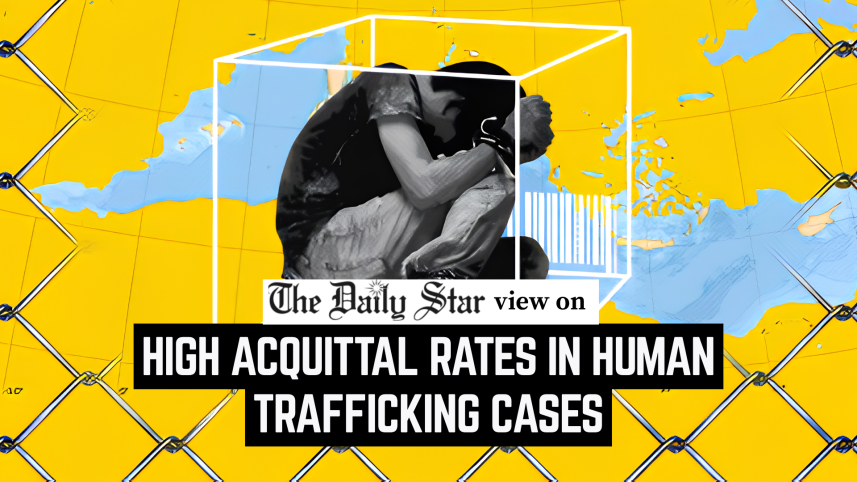
A criminal justice system that drives victims to choose compromise over justice, allowing perpetrators to walk free repeatedly, cannot be the norm in a society that strives for fairness. Sadly, this pattern has become increasingly common in human trafficking cases in recent years, according to a report published in The Daily Star. Last year, anti-human trafficking prevention tribunals across the country disposed of 245 cases, of which 236 ended in acquittal. In 2024, the acquittal rate in disposed human trafficking cases was 94 percent; in 2023, it was 95 percent, and in 2022, all disposed cases ended in acquittal.
The report explains the reasons behind such high acquittal and low conviction rates. The arrest of perpetrators is often not the issue. Rather, it is the lack of documentary evidence from abroad, the absence of witnesses, and, most importantly, the long-drawn-out legal process that exhausts the victims and their families. Thus, reaching a compromise with the perpetrators often becomes preferable to waiting for justice, which is physically, mentally, and financially draining as cases sometimes take four to five years just to reach trial.

Moreover, victims and their families, who have already spent huge sums to pay traffickers, either as ransom or as migration fees, often remain desperate to recover that money quickly. For them, enduring years of legal proceedings with no guarantee of compensation is too big a gamble. Many incur substantial debts to raise these funds, and the pressure to repay them pushes them towards settlement with the accused. In fact, such out-of-court settlements appear to be one of the key reasons behind the high acquittal rates.

The consequence of these acquittals is that perpetrators—members of trafficking networks—feel emboldened to repeat their crimes, as they see that the criminal justice system, albeit unintentionally, works in their favour. What we need, therefore, is an overhaul of the system. The government should establish more anti-human trafficking prevention tribunals, as the seven in divisional headquarters are insufficient to handle the large number of pending cases. This would also reduce costs for victims and their families who often have to travel long distances for hearings. Besides, the government must ensure stronger victim protection mechanisms and create a fund to support trafficking survivors and their families during the protracted legal battles. Coordination with foreign countries is also essential not only to obtain evidence but also to bring perpetrators to justice and curb irregular migration and trafficking.
Awareness alone will not deter people from seeking opportunities abroad through irregular and illegal channels. They need decent employment opportunities and the promise of a stable future at home. This calls for policies that equip young people with the right skills and provide access to capital, enabling them to build livelihoods in a supportive environment where they can thrive.
 For all latest news, follow The Daily Star's Google News channel.
Comments