


Ensure the rights of persons with disabilities
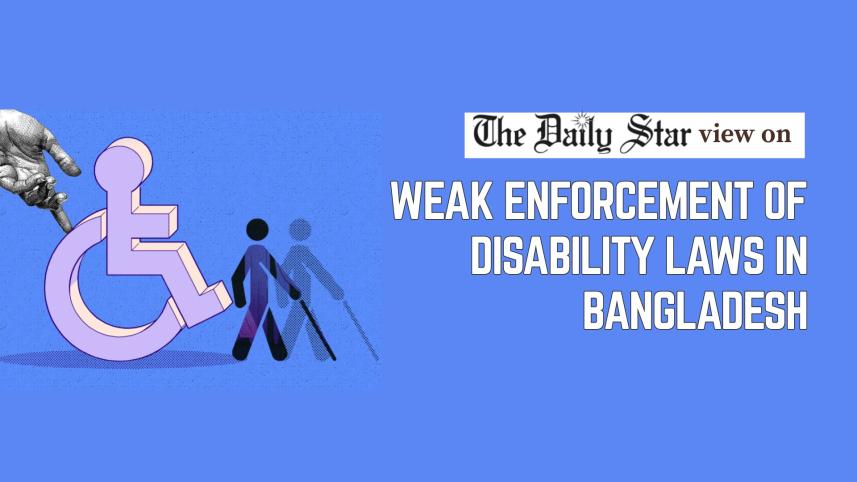
It is most unfortunate that across Bangladesh, persons with disabilities, especially women and girls, continue to face various forms of discrimination that deny them basic rights, dignity, and opportunities. Despite laws, international commitments, and years of advocacy, people with disabilities still struggle to access education, healthcare, employment, and public spaces. For girls and women with disabilities, these challenges are compounded by social stigma and institutional neglect.
The experience of Jyoti Hossain, as revealed in a report by this daily, illustrates how systemic barriers can derail even the most determined individuals. Hailing from Jhikargachha, Jashore, Jyoti has excelled academically despite being confined to a wheelchair since age four. After earning top grades in her SSC and HSC exams, she pursued her dream of studying physics at Government MM College. However, the unavailability of accessible public transport and a third-floor physics lab without a lift made her studies nearly impossible. After a year of struggle, her teachers advised her to abandon physics, saying the practical work would be too difficult for her. Jyoti's experience is not unique; countless lives in Bangladesh are constrained by inaccessible campuses and discriminatory attitudes.

According to the latest population census by the Bangladesh Bureau of Statistics (BBS), around 4.74 million people have some form of disability. Although Bangladesh has pledged to uphold their rights by enacting the Rights and Protection of Persons with Disabilities Act, 2013, ratifying the UN Convention on the Rights of Persons with Disabilities (UNCRPD), and formulating the National Action Plan on Disability, enforcement remains weak. Many educational institutions still lack ramps, lifts, accessible toilets, or adapted learning materials. Even when students with disabilities enrol, they rarely receive the support needed to thrive.
The question is, why do institutional mechanisms meant to safeguard their rights remain ineffective? While the disability rights committees, from local to national levels, are legally required to meet regularly, many reportedly are inactive and under-resourced. The National Monitoring Committee on UNCRPD implementation has also not been functioning since 2017. Although Bangladesh is obligated to report to the UN every four years, it has submitted only one report in nearly two decades. This is very frustrating.
We, therefore, urge the government to urgently enforce the laws and conventions to safeguard the rights of persons with disabilities. The disability rights committees must be revitalised, properly staffed, and held accountable. A dedicated disability budget is also essential to achieve real progress. Most importantly, disability inclusion must be mainstreamed across ministries—not just confined to the Ministry of Social Welfare—to ensure meaningful change. Overall, the state must do everything in its power to enable this vulnerable community to live their lives with dignity.
 For all latest news, follow The Daily Star's Google News channel.
Comments