


The lives behind Dhaka’s winter pitha stalls
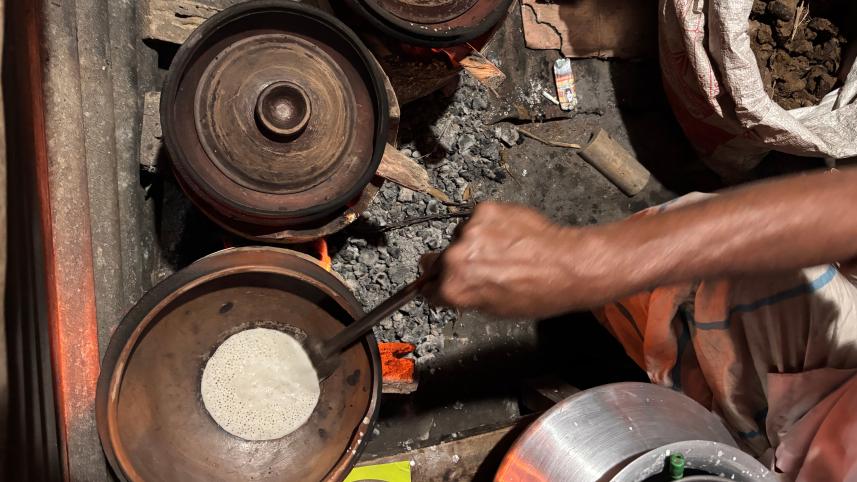
Throughout Dhaka each winter, pitha vendors set up small roadside stalls with clay stoves and steaming pots, serving chitoi and bhapa to commuters and neighbourhood regulars. For most people, it is a seasonal comfort. For the sellers, it is a brief but vital window of income shaped by long hours, skill, and necessity.
For the perennially cheerful mother-daughter duo Khadija Akhter and Eeti, pitha is not just food. It is their identity, proof of a Bengali existence they take pride in. Primarily working as househelps, they sell chitoi pitha, bhapa pitha, dim chitoi, and chhita pitha, served with tongue-tingling shutki, dhoniya, and shorisha bhorta.

They return every winter for practical reasons. Selling pitha helps them manage rising electricity bills and buy warm clothes for the family. Khadija believes food prepared with care carries its own reward. “Customers can taste the love,” she says. “That’s why they return.”
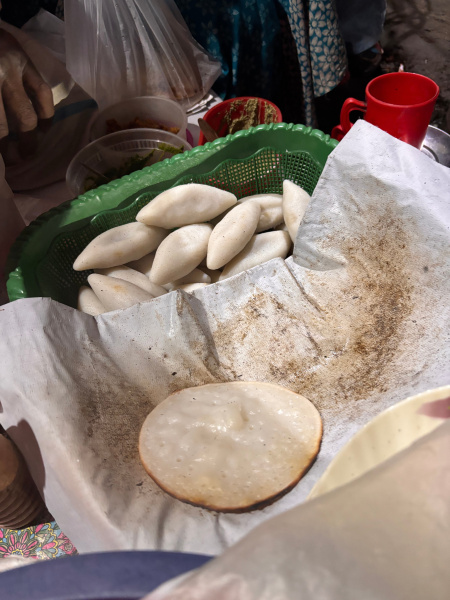
Like most sellers, Khadija buys rice flour and jaggery from the market. What sets her stall apart are the bhortas, shorisha, shutki, and dhoniya, prepared at home, hours before she steps outside. It takes extra effort, but she believes taste builds trust. On good nights, she earns Tk 400–500. Some nights are slower, but Khadija and Eeti stay put because going home empty-handed would not put food on the table or pay the bills.
Not far away, Mobarak sells the same bhapa and chitoi with equal dedication. Helping him is his wife of 20 years, Kajol. Rickshaw puller by day and pitha seller by night, Mobarak sets up a small stall each winter to earn a little extra, enough to buy sweaters for their children and cover daily expenses.
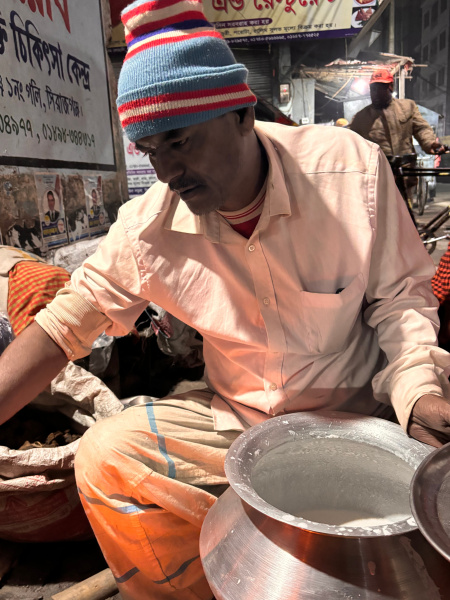
If you ask them why they do it, the answers are simple. Bills do not pause for winter. Children still need warm clothes. Groceries still need to be bought. A rickshaw puller’s income and sewing work barely stretch far enough in this economy. Selling winter pitha turns an existing skill into something marketable. “Who doesn’t like a little extra money?” Mobarak explains. “And you get to make people smile.”
Driven by the same necessity and love for pithas, Halima Bibi sits with a spatula and two clay stoves. She only sells bhapa pitha and tel er pitha as they are easier to make. Widowed and abandoned by her son, Halima lives alone in Tejgaon. For her, selling pitha is about dignity. “Earning by selling is better than begging,” she says. “Allah does not like beggars.” Pitha, for Halima, is her foundation, the work that allows her to remain independent.
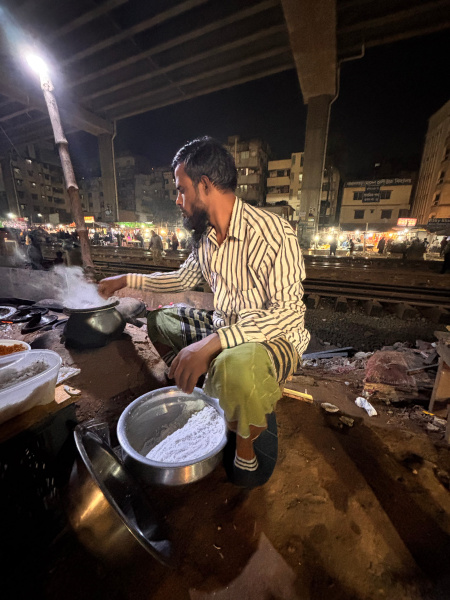
In Shaheenbagh, Morium Begum runs her own stall after finishing her day’s work as a househelp. She arrives just after Asr prayers and sells through the evening, always smiling. Her husband was paralysed after a construction site accident, and since then, Morium has been the main breadwinner of the family.
She does not speak of complaints. Instead, she frames hardship as something to move through. “You can get out of any problem if you are determined enough,” she declares. “Every problem has a solution.”
Across Dhaka, stories like these repeats with small variations. Some sellers are paying off debt. Some are covering school costs. Some are trying to remain independent in old age. All of them use winter as a narrow window where skill turns into cash.
It is because of people like Khadija, Eeti, Mobarak, Kajol, Halima, and Morium that winter pitha, once fading from everyday life, still finds its way onto plates across the city. Often underappreciated and unseen, these sellers quietly keep a tradition alive, one evening at a time.
 For all latest news, follow The Daily Star's Google News channel.
Comments