


Your complete map to Bangladesh’s most iconic Mughal mosques
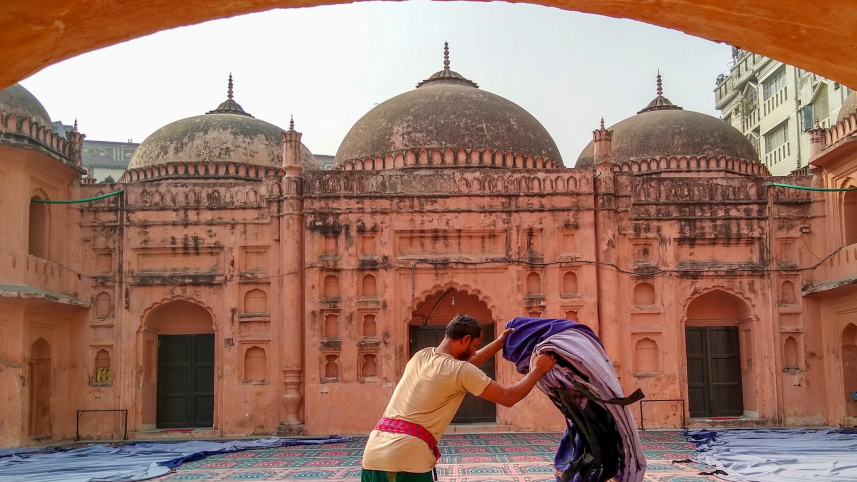
Our country is blessed with beautiful mosques. Be it the Sultanate era mosques or the modern marvels, Bangladesh is dotted with these awe-inspiring places of worship that span many centuries. Among them, Mughal mosques are indeed an interesting chapter of our heritage.
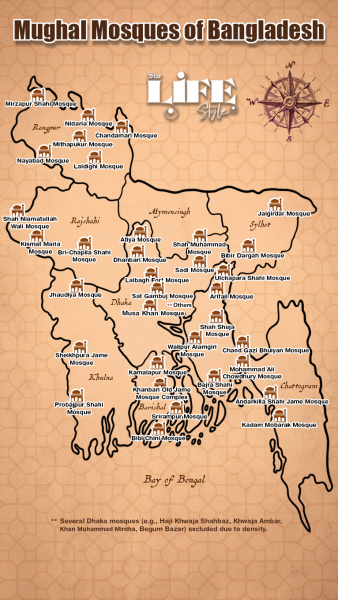
In this holy month of Ramadan, Star Lifestyle presents to you a map of Bangladesh's prominent Mughal mosques — your essential list of mosques from this era that you should definitely visit.

We invite you to see this map, which took us about a month to create, and we invite you to visit these age-old buildings.
Along with the map, this article will give an idea about our research journey, providing you with more insights than just names and geography.
Time capsule
Mughal mosques combine to form a rich time capsule, but which timeframe are we really looking into?
According to the book Mosque Architecture in Bangladesh, by Dr Abu Sayeed M Ahmed and Syed Zakir Hossain, Bengal was "conquered by Mughal rulers" in 1576. So, that is the beginning.
On the other hand, we can cut off the Mughal era at 1757 if we are very strict — an obvious year, due to the Empire's collapse surrounding the Battle of Palashi that was led by Nawab Sirajuddaula against the British.
Of course, the timeframe is up for debate. To exemplify, it can be stretched to 1857, and rightly so, because there was resistance to the "new" British East India Company regime. Nazly Chowdhury and Babu Ahmed wrote in Mughal Monuments of Bangladesh, "In 1857, the Sepoy Revolt broke out but was soon suppressed by iron hands... and the rule of the Mughals in India was finally ended."
Neither the beginning nor the end of the Mughal era happened overnight.
Given this context, even though we kept in mind the 1576-1757 time period, we prioritised those mosques that are the most Mughal-inclined in terms of architecture, reputation, etc., hence allowing flexibility for a few mosques that were likely established after the 1757 milestone.
The splendour of Mughal mosques
We will spare you the technicalities and details, leaving them for architects and historians. It is best to visit the mosques in person to appreciate it. And now, you have the map to guide you there!
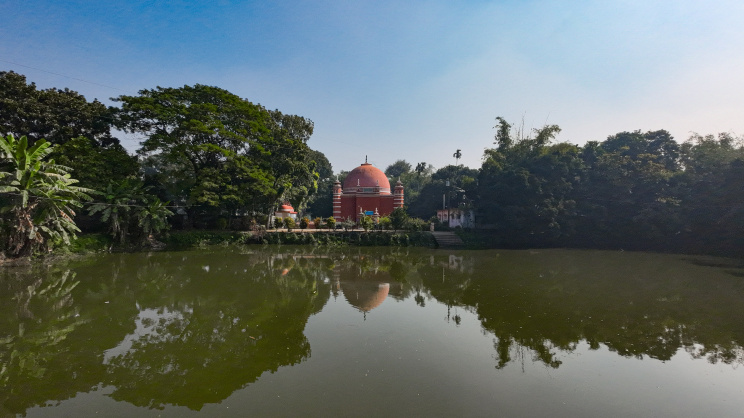
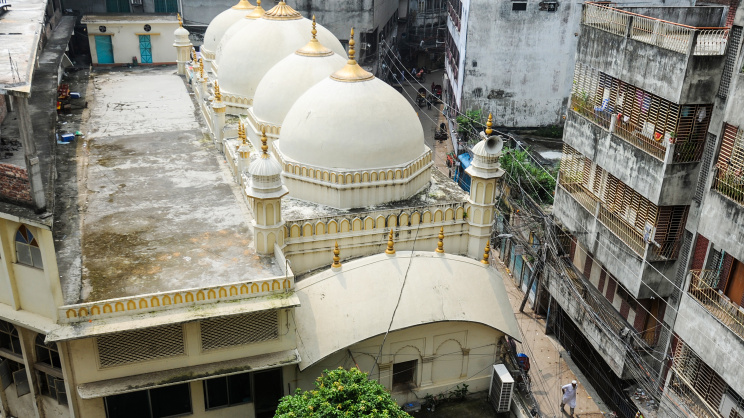
Three-domed structures are common, although variations regarding the number of domes can also be easily found. Facades are decorative. Four corner turrets (or small towers) reinforce elegance. Inside, cusped arches, floral motifs, and views of the domes above your head will strike a chord in your heart!
Mughal mosques stripped out of their Mughal vibe
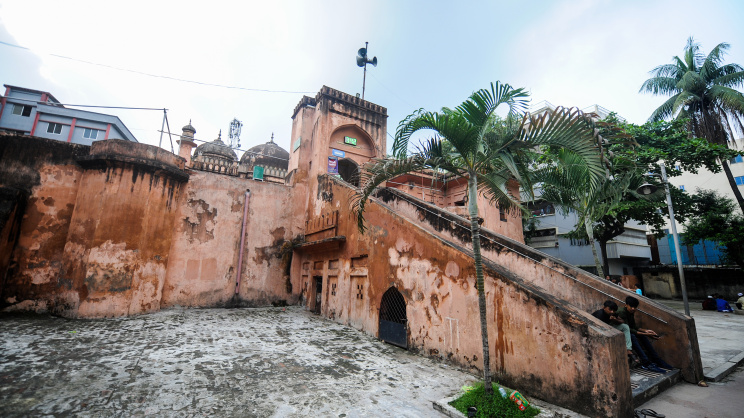
However, it is saddening that many mosques of that era underwent mindless paintjobs, addition of tiles, extensions, etc. in modern times. Where such cases were severe, we dropped them out of our list.
In some cases, old structures have more or less been completely replaced by modern ones. For such mosques, the only major Mughal connection is in the collective memory of locals, history books, or the dates on the signboards. We have not included those buildings in our map as well.
Furthermore, there are several mosques that locals believe to be Mughal, but that fact cannot be ascertained from inscriptions (or lack thereof), architecture, or books of history. We have dropped most of those as well.
Therefore, this map indicates the most prominent ones that are worth visiting for the budding history buff.
 For all latest news, follow The Daily Star's Google News channel.
 The Dhaka dilemma
You may be furious to see that very few number of mosques from the Dhaka district have made it to our map. Well, control your rage, and look at the disclaimer at the bottom of the map: Old Dhaka is home to so many magnificent Mughal-era mosques that it was not possible for us to fit them all: Haji Khwaja Shahbaz Mosque, Khan Muhammad Mirdha Mosque, Khwaja Ambar Mosque, and Begum Bazar Mosque are some of the names that have every right to be included in the map, and being history buffs ourselves, our hearts ached for this compromise.
Dhaka division posed another head-scratcher. This one had to do with the Mymensingh division. Curiously enough, this division is empty in our map! After consulting credible sources, we believe that Mymensingh's prominent mosques that are irrefutably Mughal in style, architecture, date, etc. are from the so-called "Greater Mymensingh" region, which includes places like Kishoreganj and Tangail; but in present times, they officially fall under Dhaka division!
Overcoming the many challenges throughout this journey, we have finally come up with this map. We hope it encourages you to visit the mosques and stir up conversations about the rich heritage the Mughals have left us.
Sources: Mosque Architecture in Bangladesh by Dr Abu Sayeed M Ahmed and Syed Zakir Hossain; Mughal Monuments of Bangladesh by Nazly Chowdhury and Babu Ahmed; Mosques of Bangladesh by Nymphea Publication; Banglapedia; Bangladesh government websites; UNESCO's Tentative List of "Mughal Mosques in Bangladesh".
Special thanks to Sazzadur Rasheed, architect, academician, and admin of Save the Heritages of Bangladesh for providing valuable inputs to our project. We are also grateful to The Daily Star's Habiganj and Moulvibazar correspondent Mintu Deshwara, and Sheikh Nasir, Sylhet photographer for their help in our research.
Comments