


Retaining talent: Creating local opportunities to stem brain drain


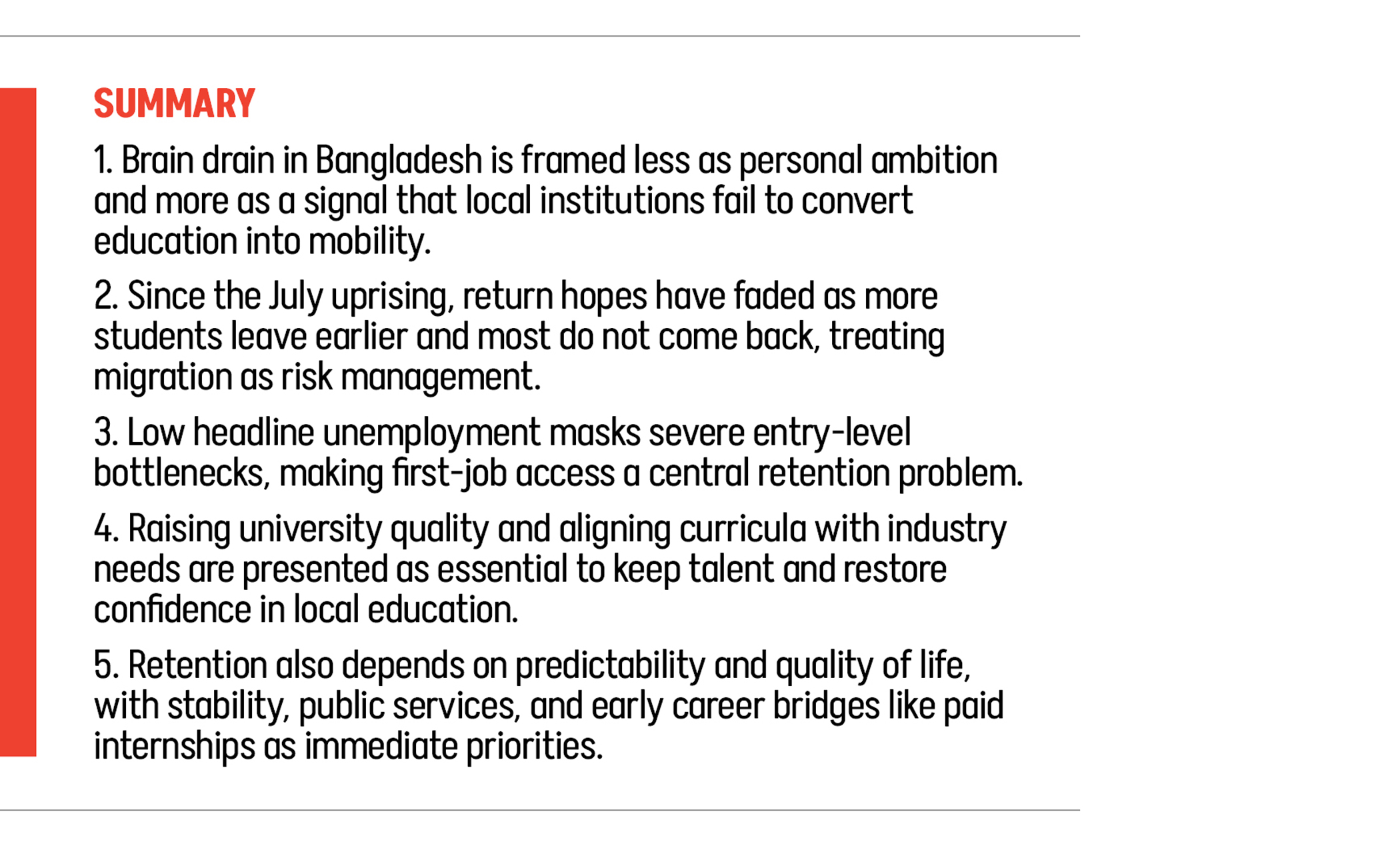
Although often said in jest, the phrase “the great Bangladeshi dream is to leave Bangladesh” is becoming a reality. Here, brain drain is less a story of lack of interest and more a structural signal that our institutions do not reliably convert education into mobility at home.
After the July uprising of 2024, there were strong calls for talented Bangladeshis to return and help reform the country. For the most part, that aspiration has not materialised. More students are leaving as early as their undergraduate years, and the vast majority never return. The reasons are clear: opportunities for growth abroad are significantly greater, and the overall quality of life, including safety and stability, feels more assured elsewhere. For young minds, migration is not just ambition; it is risk management.

Although headline unemployment remains at about 4.7% (World Bank WDI 2024), the youth picture is starker: about 1.94 million young people are unemployed (Bangladesh Bureau of Statistics, Labour Force Survey 2023). Put simply, overall joblessness is low by international standards, but entry-level bottlenecks are pronounced. This is exactly the kind of friction that nudges graduates to treat migration as risk management. Fixing entry-level demand is therefore a key priority and requires revisiting the higher education system.
RESHAPING THE HIGHER EDUCATION FOCUS
Keeping talent begins with world-class local classrooms. Today, from a global ranking perspective, Bangladesh has only three universities in the QS top 1000: the University of Dhaka at 554, Bangladesh University of Engineering and Technology at 761–770, and North South University at 951–1000. This perception gap fuels outbound mobility even at the undergraduate level. The University Grants Commission’s 2023 system reports also emphasise the need to strengthen faculty, research funding, and quality assurance so curricula can credibly claim international parity, but they do not offer a concrete action plan.
If curricula remain disconnected from industry needs, university graduates will continue to see foreign markets as the only stage for skills development. It is not only about curricula; faculty strength matters too, and Bangladesh does not yet have a university system that consistently meets international standards. This may sound demanding, but there truly is no alternative to providing top-notch higher education. Whether through pooling resources from private donors or dedicating a larger share of the national budget, this must move up the list of projects and priorities. The initial cost would be high, yes, but the long-term outcomes would be worth it.

Illustration: Zarif Faiaz
Beyond producing graduates who can contribute and lead, and helping industries compete globally, stronger universities would help retain talent. They would also change the brand of Bangladeshi higher education. Many people feel, and often rightly so, that even the best local education falls short of world-class standards. It is high time we prioritised fixing this, because it is a key element in how we develop and shape talent locally.
BRIDGING THE GAP IN INDUSTRY AND ACADEMIC COLLABORATION
Employers routinely report skills mismatches among graduates. In the World Bank Enterprise Survey (2022), firms flag an “inadequately educated workforce” among binding constraints. The World Bank policy note “Skills for Tomorrow’s Jobs (Bangladesh)” recommends curriculum co-design with industry, structured apprenticeships, and stronger quality assurance to align programmes with Fourth Industrial Revolution skills demand. This points to a clear need to update curricula in ways that match what employers actually require.
From an employment perspective, many employers cannot maximise capacity or expand because they struggle to find graduates with the skills they need. This is largely because there is a gap between what industry demands and what academia produces. The solution is straightforward. The government should revisit curricula, through institutions such as the University Grants Commission, in collaboration with industry. This can be done through roundtables and dedicated committees that include industry leaders.
In practice, this could mean redesigning MBA programmes based on feedback from corporate leaders, or revising an international relations degree based on input from practitioners and academics. It could also include practitioners teaching alongside faculty through adjunct tracks, faculty externships where lecturers spend a term inside firms, and co-supervised theses and capstones where students solve live business or policy problems. The goal is to prepare graduates who are ready to be employed, and whom employers are keen to hire.
THE CERTAINTY FACTOR IN THE QUALITY-OF-LIFE EQUATION
Talent retention is not only about jobs; it is also about dignity and security. Public services in Bangladesh, including healthcare, social protection, and urban safety, remain weak links in the retention chain. Skilled professionals weigh not just salaries but the cost of living, access to reliable healthcare, and the predictability of civic systems. Given the fear, or more accurately the valid concern, of potential instability, many people believe they are erring on the side of caution by moving abroad.
One caveat is that many Bangladeshi students leave first, only to later realise that life abroad is not as rosy as they were led to believe. It may be useful for both the government and the private sector to run awareness campaigns that explain how an improved quality of life in Bangladesh can also be excellent, and that the trade-off of leaving behind family and friends is not always worth it.
The crucial nuance is that retention depends on predictability, and statistics alone do not create it. The World Justice Project’s Rule of Law Index (2024) ranks Bangladesh 127 out of 142, while the Global Peace Index (2024) places the country 93 out of 163. These are not the kinds of signals that reassure young professionals when weighing everyday certainty. This means the government’s approach to stemming talent loss must be multidisciplinary and long-term.
RETHINKING THE “WHY” APPROACH OF BRAIN DRAIN
Of course, long-term challenges such as predictability and stronger public services will take time. But there are also short-term actions that can help.
 For all latest news, follow The Daily Star's Google News channel.
 For instance, entry-level bottlenecks can be eased through structural solutions targeted at early-career pathways. Universities and employers should embed paid internships as early as the second or third year of a bachelor’s degree, tied to academic credit, and assessed learning outcomes.
At the same time, supply-side reforms must produce graduates who are both job-ready and AI-ready. There should be a distinct focus on annual faculty upskilling in AI pedagogy and ethics so classrooms keep pace with frontier practice. All things considered, the country needs matching infrastructure that reduces friction between talent supply and labour-market demand.
Ultimately, retention rises when staying does not feel like a gamble. If we turn early internships into reliable bridges, align classrooms with the frontier of work, and make stability more legible through clear rules and benefits, the risk-management logic of migration softens. Then settling in Bangladesh becomes not an act of faith, but a reasonable plan.
Ahmad Tousif Jami is an international debate instructor and a policy researcher.
Comments