


Pushed towards extinction

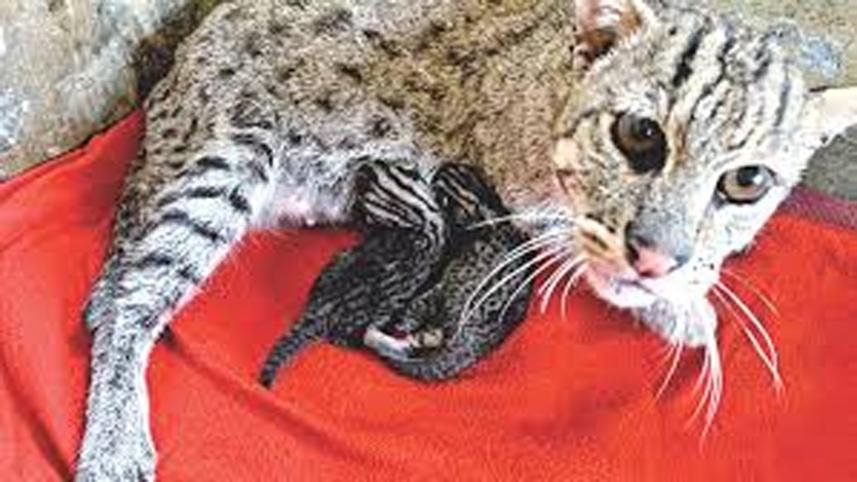
A worrying rise in retaliatory killings of fishing cats across Bangladesh, driven largely by conflict with local communities who blame the animal for losses to poultry and pond fish, is gradually pushing the species to the brink.
Bangladesh is a key global habitat for fishing cats (Prionailurus viverrinus), a medium-sized wild feline species with a stocky build, brownish olive-grey coat, short rounded ears and a muscular tail marked with dark spots and stripes.

At least 160 fishing cats were killed between 2005 and 2021, most of them by fish and duck farmers and their associates, according to a study that analysed more than 360 media reports. Around 47 percent of the recorded incidents involved a kill-on-sight response, the study found.
Contacted, the study’s corresponding author, Muntasir Akash, said that fishing cats are found across most parts of the country, except in the hilly regions, but the situation has become dire.
“People believe the cats enter homesteads and prey on poultry. However, a significant number are killed on sight even in areas where there is no proven economic loss,” he said.
The research, published in June in Global Ecology and Conservation on ScienceDirect, documented conflict involving at least 395 adult fishing cats and 170 kittens. Of them, 117 were released back into the wild, while 34 were sent to zoos or rescue centres located more than 20 kilometres from the conflict sites.
However, Akash, also a zoology professor at Dhaka University, said releasing the animals far from conflict zones may not offer a lasting solution, as human settlements continue to expand into natural habitats.
Conservationists said fear and misidentification drive much of the violence, as villagers often mistake fishing cats for more dangerous predators such as tigers or leopards due to a lack of awareness.
Recent research, however, offers some hope. A separate study conducted between 2020 and June 2024 in four districts of the northeastern Sylhet region found that a site-based rescue-and-release approach can serve as an effective short-term conservation measure.
During the study period, researchers recorded 86 live fishing cats and seven dead individuals. Of the live animals, 76, including 35 kittens, were released within a week at or near their capture sites. Reunification of released kittens with their mothers was successful in 62 percent of cases, according to a study published in December in Global Ecology and Conservation on ScienceDirect.
MA Aziz, a zoology professor at Jahangirnagar University and one of the study’s authors, said the Sylhet region was selected after being identified as a conflict hotspot.
“The landscape there is dominated by scattered swamps, patchy reserve forests and tea gardens, which provide an ideal habitat for fishing cats. That is why our research focused on improving rescue and release practices in the Sylhet region,” he said.
Aziz said timing is crucial for successful releases, particularly for kittens.
“Our study recommends releasing rescued kittens within 24 hours to maximise the chances of reunification with their mothers,” he said, highlighting the need for capacity building within the Forest Department.
As short-term mitigation measures, he also recommended installing protective net fencing around fish ponds and duck farms near waterbodies, clearing surrounding vegetation and installing light posts.
Aziz criticised the Forest Department’s practice of releasing rescued fishing cats deep inside forests, noting that the species prefers bushes near human settlements and wetlands and should be released at or near conflict sites, which are often their natural habitats.
However, he stressed that awareness campaigns must be carried out among people living in conflict hotspots.
 For all latest news, follow The Daily Star's Google News channel.
Comments