


Is public sympathy for street protests fading?

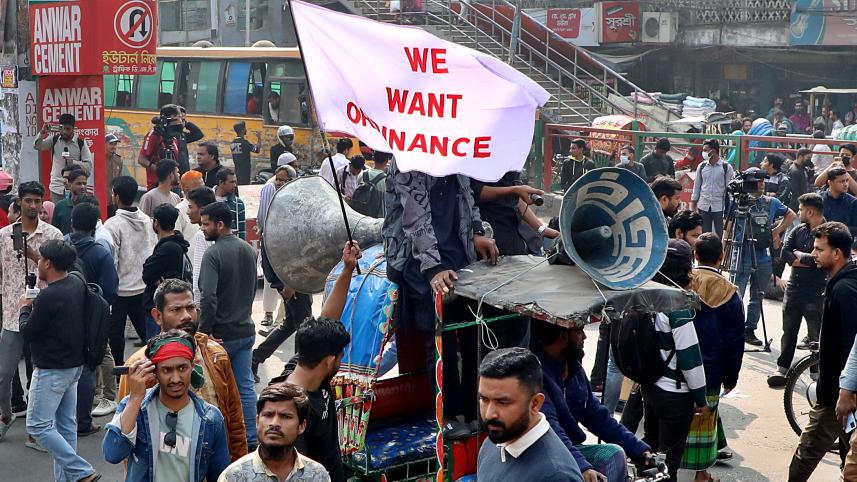
The agitating students of seven colleges in the capital are demanding the immediate issuance of the ordinance for their proposed university. These students fought earlier to decouple from their degree-giving entity, Dhaka University, and won the initial battle through the declaration of a separate administrative body. The transition faces numerous logistical challenges because the government cannot create a university overnight. Yet, the students feel the urgency to press their demand, probably before the election next month when a political government is going to replace the interim one, which has been rather sympathetic to students for their contribution to the toppling of the previous regime.
The fact that these students are blocking the roads with impunity is an example of such sympathy. The public, perplexed by the government’s inaction, is experiencing the bystander effect. The collective inaction demonstrates a situation where everyone is waiting for someone else to act first. Students need to understand that the time for moral action is rapidly approaching, and the ordinary public’s patience could quickly escalate into violence.


We have already witnessed a simmering public reaction. The passive bystanders are feeling the pressure of prolonged blockades at various choke points across the city. One sweat-soaked rickshaw puller was seen pulling the hands of a protester to his neck, asking to strangle him, as his vehicle had been stuck in the same spot for more than three hours due to the blockade. The heartfelt plea came from a man whose daily wage was disappearing because of the street demonstrations. Another paediatric orthopaedic surgeon was heard saying that if they blocked him, many children would miss timely dressings or scheduled operations. A female passenger was heard saying, “You stay in subsidised dorms, enjoy money sent to you by parents like us, and then pose difficulties for others. What kind of education is that?”
Students need to read the public pulse. They are losing the plot not because their grievances lack merit, but because their tactics have trespassed the personal spaces of others. The lifeblood of any protest is persuasion. The July uprising was successful because everyone felt the ills of discrimination. However, as the suffering visibly shifts, the backlash may become unforgiving.
Protests have a limited lifespan. When the students of seven colleges took to the streets to protest the hierarchy claimed and haughtiness exerted by their parent organisation, they gained sympathy through moral coherence. The negative experiences at the DU Registrar’s Building form the foundation of a haunting plateau, reinforced by the repetition of similar stories. One would have expected the students to defuse the tension once they secured the assurance for a separate university. But by rushing the process, they are showing their ignorance of the intricate process through which a university operates. And their tactic of arm-twisting the government is exhausting the very public whose attention they need. The slow death of their movement is inevitable as public sympathy appears to be eroding. The cause may still be just, but the methods used are no longer persuasive.
For the protest to remain relevant, students need to restore temporal boundaries. There must be cooling-off periods that signal respect for everyday life. They cannot simply choke all city arteries and bring the commuters to a halt. We must take the public’s inconvenience seriously. Students can shift from disruptive ubiquity to targeted pressure. They can negotiate with the University Grants Commission and the education ministry, who are responsible for the ordinance.
The draft ordinance outlines an ad hoc decision to spread the faculty-wise administration across the seven campuses. This has not satisfied the students’ demand for a dedicated campus. Given the current political climate, a firm commitment to the establishment of a new campus seems improbable.
The college administrators have also failed to anchor youth politics in their respective institutions. Teachers who have transitioned to teaching at the university level through civil service examinations fundamentally oppose student demands. The establishment of a university could potentially lead to the removal, withdrawal or posting of numerous Dhaka-based teachers. The issue of intermediate students, who require these teachers’ instruction, also arises. Chaos has stifled any potential for civic engagement, enabling endless street politics.
The stakeholders also need to take the anxiety economy into consideration. Many of these young protesters will probably fail to see the benefits of the creation of a new university. They will graduate with certificates that say, “affiliated with Dhaka University.” Only through civic engagements can these students and their alumni network create mobility pathways for their peers and defuse the psychological pressure of being a “second-class student,” which is fuelling the escalation.
However, the ultimate responsibility lies with the government, who must declare that enough is enough. They need to condemn violence unequivocally, listen publicly, and communicate progress honestly. Weeks before the election, the government must ask who benefits from this series of protests.
The more the students move away from their principled position, the more their disruptive acts will open space for coercive responses. If the government does not wake up from its institutional stupor, streets can become unpredictable and volatile, allowing many opportunistic actors to take advantage. And the apathy, which is the most corrosive outcome of such a situation, will hollow out democracy.
Normalcy cannot be restored by repression or indulgence alone, but by a recalibration of legitimacy, limits, and reciprocity. We can view the blockade’s performative dominance as a temporary victory. However, the sooner the protesters realise that their purpose has become conflicted and convoluted, the better. Their right to dissent is now infringing upon the right of others to mobility, work, education, and healthcare. In democracy, no right exists in isolation.
Historically, student movements earned respect because they sacrificed for a principled cause without entitlement. The prolongation of protest is reversing that moral equation. Students are coming off not as conscience-bearers of society but as harbingers of disruption—a perception that, once formed, is difficult to undo. It’s better if the students redo their homework and recalibrate their actions. The government must also provide them the scope to return to the classroom by declaring a realistic timeline for the proposed university. Meanwhile, institutions must drop ego and coordinate.
Dr Shamsad Mortuza is professor of English at Dhaka University.
Views expressed in this article are the author's own.
Follow The Daily Star Opinion on Facebook for the latest opinions, commentaries, and analyses by experts and professionals. To contribute your article or letter to The Daily Star Opinion, see our guidelines for submission.
 For all latest news, follow The Daily Star's Google News channel.
Comments