


Durga Puja can’t do without coconuts, but price hike forces cuts in the north

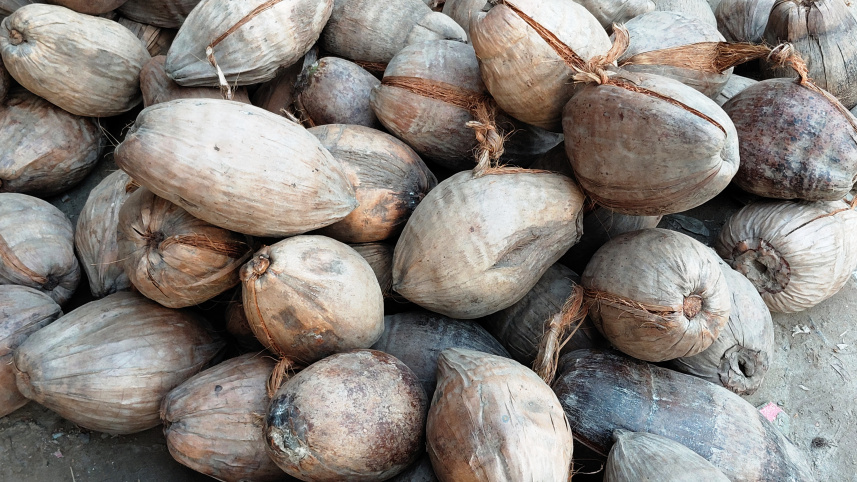
Every Durga Puja, Prabir Chandra Barman’s family buys 20 coconuts to make naru, the traditional sweet, and for religious rituals. This year, they could afford only half that number.
For the Hindu community, the festival is incomplete without coconuts, but prices have surged across the northern districts ahead of the festival.

A pair, the standard unit of sale, cost Tk 160-180 at the beginning of September. It now sells for Tk 250-300, up from Tk 190-200 at the same time last year.
Demand peaks as the festival approaches. This year, Durga Puja will be celebrated at 5,358 mandaps across the eight districts of Rangpur division from October 16 to 21, according to Bangladesh Puja Udjapan Parishad.
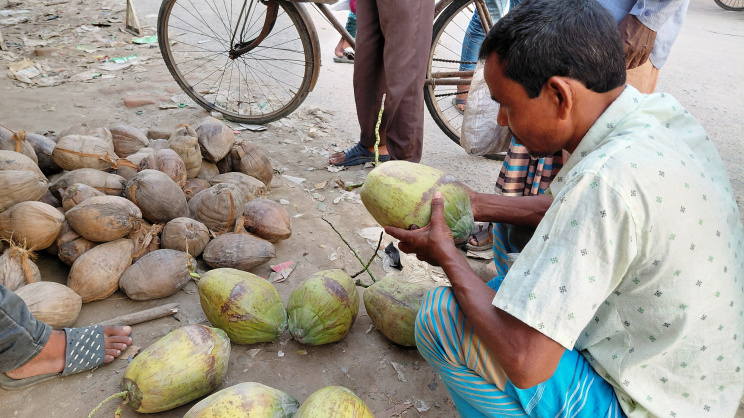
Community members said each mandap needs an average of 80-100 coconuts, with some requiring more. Families typically buy 10-50 coconuts each.
“Prices were lower even two weeks ago,” said Prabir, 65, of Barabari Haat in Lalmonirhat Sadar upazila.
“Traders have raised prices because of the increased demand during Durga Puja. Coconuts are used throughout the festival.”
Advocate Nirbala Roy, 40, of Nazirerhat in Rangpur city, said she was shocked by the prices when she went to buy.
“The prices are so high that ordinary people can hardly afford them. Since naru cannot be made without coconuts, we had to buy some, even if it meant purchasing fewer than usual,” she said.
Other puja essentials have also become more expensive, said Rajani Mohanta, 65, a farmer from Baidyer Bazar in Rajarhat upazila of Kurigram.
He alleged that traders were exploiting the festival rush.
“Although supplies in the market are adequate, traders are charging higher prices by creating an artificial shortage. This has increased the overall cost of the festival,” he said.
Traders, however, attributed the price hike to supply and transport costs.
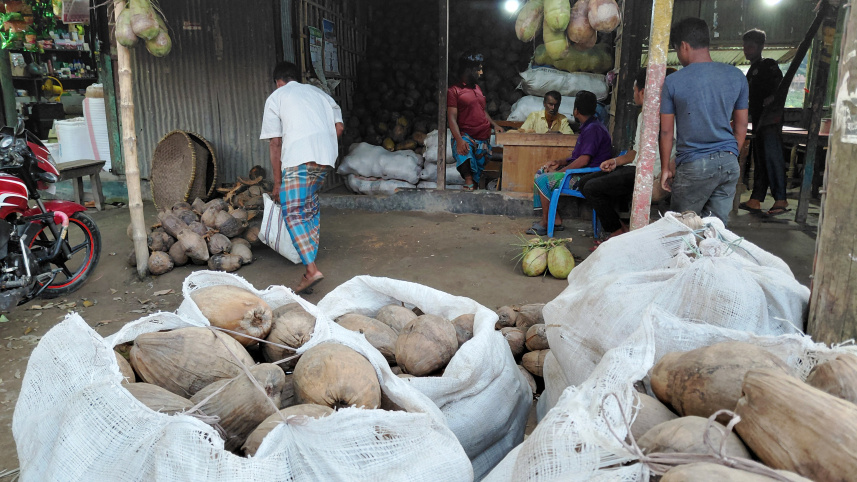
Mobarak Ali, a wholesale coconut trader at Barabari Haat in Lalmonirhat, said local production was limited, forcing traders to bring supplies from Bagerhat and Khulna.
Truck hire for transporting coconuts, which cost Tk 30,000-32,000 last year, has risen to Tk 40,000-45,000, he said.
“We make a profit of Tk 20-25 on each pair of coconuts. Some coconuts also turn out to be rotten. We have to sell at higher prices because we are buying them at higher prices,” he said.
 For all latest news, follow The Daily Star's Google News channel.
 The supply chain begins in the south.
Mozammel Haque, a fruit trader at City Bazar in Rangpur city, said he bought coconuts from Bagerhat, Khulna and Satkhira for Tk 180-200 a pair. Including transport and other expenses, each pair costs him Tk 190-210. He then sells them to retailers at a profit of Tk 10-15 a pair.
Retailers set their own selling prices at different haats and bazaars, he said.
“Locally grown coconuts were sold out in September. Every coconut on sale in the markets here has been brought from the south,” he said.
Mizanur Rahman, a trader at Jatrapur Haat in Kurigram, said customers were buying fewer coconuts because of the high prices.
“Sales are lower than last year,” he said.
Temples, however, have little scope to cut back. Ashok Sarkar, treasurer of the Durga Mandir at Guptapara in Rangpur city, said the temple needed 120 coconuts for the puja every year.
“This year, we bought them at Tk 300 a pair, compared with Tk 200 last year,” he said.
The cost has risen to Tk 18,000 from Tk 12,000.
While families can reduce their purchases to some extent, temples cannot cut back on the quantities needed for rituals, Ashok said.
“We had to buy the quantity required for the rituals at the temple.”
“Regardless of how much prices rise, we cannot compromise on religious rituals,” said Shankar Chandra Chakraborty, president and priest of the Durga and Kali Temple at Kalibari in Lalmonirhat town.
Hiralal Roy, president of the Lalmonirhat District Puja Udjapan Parishad, said coconut naru remained in high demand.
“Guests often ask for it as soon as they arrive. Prices are high this year, but people are still buying as many as they can afford,” he said.
Comments