


Subsidised food distribution falls, raising poverty concerns

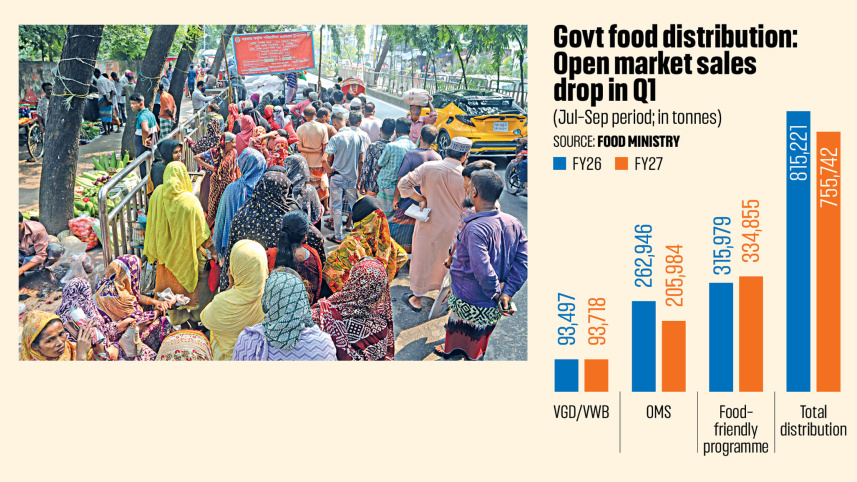
Foodgrain distribution at subsidised rates declined in the first quarter of the current fiscal year, mainly because of a fall in open market sales (OMS), raising concerns about the impact on poverty and food security.
Government agencies, including the Directorate General of Food, distributed 7.55 lakh tonnes of grains in the July-September period of fiscal year 2026-27, down 7 percent from the same period a year earlier, according to food ministry data.

The downturn comes at a time when inflation remains persistently high and wage growth continues to lag behind rising consumer prices, eroding purchasing power and increasing the risk of higher poverty.
Selim Raihan, executive director of the South Asian Network on Economic Modeling (SANEM), said the fall in public food distribution raises questions about Bangladesh’s policy priorities.
“With inflation still high and wage growth for unskilled workers lagging behind prices, households need stronger protection against falling purchasing power,” he said.
Bangladesh has been facing high inflation since fiscal year 2022-23. Consumer prices rose by 10 percent in FY25 before inflation eased to 8.7 percent in FY26, primarily because food inflation moderated.
In September, the 12-month average inflation rate stood at 8.65 percent, according to the Bangladesh Bureau of Statistics (BBS). Meanwhile, real wage growth for low-paid workers remained negative in FY26, according to the World Bank’s Bangladesh Development Update, released last week.
The multilateral lender warned that nearly 6.2 crore people in Bangladesh are currently living just one economic shock away from falling below the poverty line, as persistently high inflation and severe energy shortages are reversing years of hard-won economic gains.
The World Bank report estimated that national poverty would rise to 22.5 percent in 2026 from 18.7 percent in 2022, as a prolonged economic slowdown erodes household welfare through weak labour demand and persistent inflation.
Selim, also a professor of economics at Dhaka University, said cutting food distribution at such a time risks worsening food insecurity and indebtedness, while forcing households to spend less on health and education.
“With about half of the poorest households still outside social protection programmes, fiscal pressures should lead to better targeting, not weaker essential support,” he said.
Food ministry data showed that open market sales of rice and wheat flour at prices well below market rates fell 22 percent to 2.05 lakh tonnes in the July-September period of FY27.
However, grain distribution under the government’s Vulnerable Group Development (VGD), Vulnerable Women Benefit (VWB) and Food Friendly Programme (FFP) increased slightly, according to the ministry.
Nazneen Ahmed, executive director of the Centre for Policy Dialogue (CPD), said OMS sales provide significant support to vulnerable households that do not qualify as poor during periods of high inflation.
“In view of inflation, food distribution should have been increased. We see the opposite,” she said. “This is not a good sign. The decline in distribution amid falling real incomes will have an impact on poverty.”
Food Secretary Abu Taher Md Masud Rana could not be reached for comment by phone despite repeated attempts.
Early last month, the Food and Agriculture Organization (FAO) projected that about 1.81 crore people in Bangladesh would face high levels of acute food insecurity between September and December 2026, 18 percent more than the estimated number for May-August this year.
The increase was mainly attributed to constrained household purchasing power amid persistently high inflation, driven by elevated fuel and energy costs associated with disruptions in the Strait of Hormuz. Floods had also affected livelihoods in some areas, the FAO said.
 For all latest news, follow The Daily Star's Google News channel.
Comments