


Call grows for single regulator for LPG sector
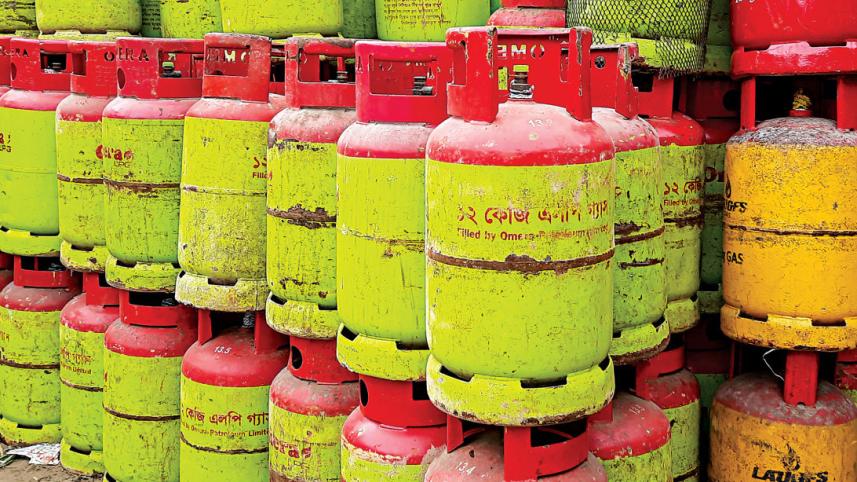
Industry leaders, energy experts, and policymakers have called for a single, centralised regulatory authority to manage Bangladesh’s fast-growing liquefied petroleum gas (LPG) sector.
With LPG consumption expected to more than double by 2030, stakeholders say a unified regulator is crucial to improve efficiency, ensure safety, and support sustainable growth for a sector serving over 1.5 crore households.
 For all latest news, follow The Daily Star's Google News channel.
 “Without a single, centralised regulator, the LPG sector’s rapid growth will not be sustainable, and Bangladesh’s energy security will remain at risk,” said M Tamim, vice-chancellor of Independent University, Bangladesh (IUB), while presenting the keynote at a roundtable on “Regulatory challenges in the LPG market.”
The event was organised by the LPG Operators Association of Bangladesh in cooperation with Energy and Power Magazine at the CIRDAP auditorium in Dhaka yesterday.
Tamim pointed out that LPG operators must obtain up to 26 separate licences and approvals from multiple entities, including the Bangladesh Energy Regulatory Commission (BERC), Bangladesh Petroleum Corporation, the Department of Environment, Bangladesh Standards and Testing Institution, Bangladesh Inland Water Transport Authority, and the Department of Explosives.
“This fragmented system causes overlapping inspections, unnecessary delays, and high compliance costs — over Tk 1.5 crore per year for some companies,” he said, adding that such challenges discourage new entrants and put strain on smaller operators.
He proposed consolidating all LPG-related regulatory functions under a single body, possibly under the BERC.
Licences could last five to 10 years with annual inspections, and the approval process should be fully digital to streamline operations, improve safety monitoring, and clarify accountability.
Jalal Ahmed, chairman of BERC, stressed the importance of urgent regulatory reforms and better coordination to tackle ongoing sector challenges, including supply disruptions.
LPG imports fell by 163,000 tonnes in October–December 2025 compared to the previous year, he said, citing international supply issues and a lack of reliable data as key concerns.
“Data gaps remain a serious problem. We now collect information directly from the NBR to ensure accuracy,” Ahmed said.
“This crisis is a learning moment. We must act quickly to avoid future disruptions,” he added, reaffirming BERC’s commitment to efficiency, monitoring, and public service.
Mohammad Amirul Haque, president of the LPG Operators Association, urged the government to establish a single, effective regulatory authority and allocate dedicated land for LPG infrastructure development.
Criticising delays caused by multiple regulatory bodies, he said, “We need clarity. One regulator must be assigned to this industry — not five. Otherwise, investment will stall.”
Haque also highlighted global sourcing challenges, noting that 97 percent of recent LPG cargoes went to Europe and China due to high demand. “We’re committed to ensuring supply, but Bangladesh must act faster. Credit-based imports on 270-day terms are not viable when global suppliers demand cash,” he added.
Political will needed for systemic reform
BNP central leader and former lawmaker Zahir Uddin Swapon stressed that real reform requires political will, not just bureaucratic action. “The current LPG crisis shows deeper problems in policy and governance. Either our policymakers lack clarity on the sector, or they have knowingly sustained anti-business regulatory approaches,” he said.
Swapon urged stakeholders to work toward a unified, citizen-friendly policy framework and cautioned that overregulation can reduce transparency. “More complexity in licensing or oversight often leads to less transparency, not more,” he added.
Ruhin Hossain Prince, former general secretary of the Communist Party of Bangladesh, called for stronger state control, prioritising public interest. “We’re told there’s a crisis, yet LPG is available if you can pay. This shows the problem lies in pricing and profiteering, not supply,” he said.
Prince stressed that state-owned enterprises must intervene if liberalisation leads to price hikes and market capture, while also highlighting underutilised domestic gas resources. “We produce only a fraction of what we consume. Why aren’t we prioritising exploration?” he asked.
AHM Shafiuzzaman, president of the Consumers Association of Bangladesh, urged the government to declare LPG an essential commodity due to its importance to over 1.5 crore households. He outlined 10 concerns, starting with formally recognising LPG under the 1956 Essential Commodities Act.
Shafiuzzaman called for transparent price-setting and better coordination among ministries and regulatory bodies, criticising discrepancies between government-fixed rates and market prices, pointing out that the declared Tk 1,306 per cylinder is rarely enforced.
The roundtable was moderated by Mollah Amzad, editor of Energy and Power Magazine. Other participants included Md Abul Hasan, chief inspector of the Department of Explosives; AKM Fazlul Haque, joint secretary at the Energy and Mineral Resources Division; Humayun Rashid, vice president of the LPG Operators Association; and Abdur Razzaq, founder and managing director of JMI Group.




Comments