


WTO conference kicks off with push to resist protectionism

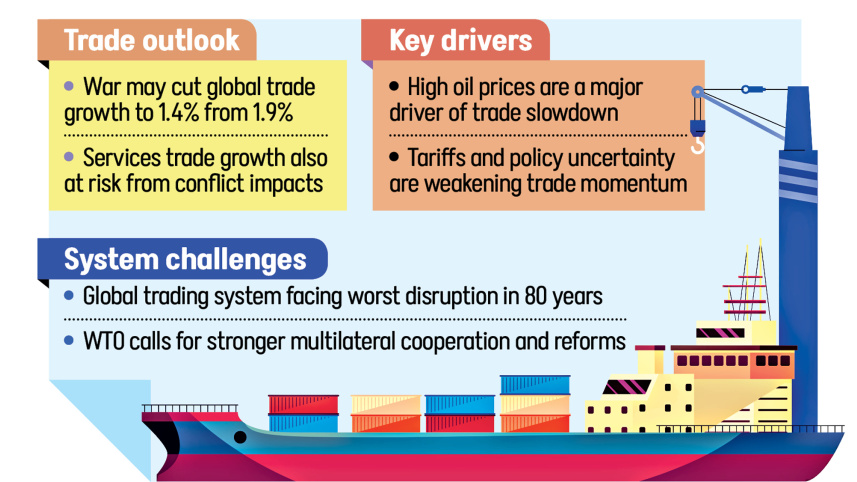
The 14th WTO Ministerial Conference began yesterday with a call to uphold the multilateral trading system, as rising trade protectionism poses challenges to the free flow of global trade.
At the event, which began in Yaoundé, Cameroon, World Trade Organization (WTO) Director-General Ngozi Okonjo-Iweala urged leaders of the 166 member countries to take necessary steps to reform the organisation, established in 1995, so that it can contribute more effectively to the global trading system.

Delivering the inaugural speech at the conference, she informed that prolonged high oil prices resulting from the Middle East conflict could lower the global trade growth by 0.5 percentage points, from 1.9 percent to 1.4 percent.
Economists are forecasting slower 1.9 percent growth for goods trade, with the impact of frontloading gone, previously postponed tariffs kicking in, and reflecting geopolitics, energy prices, and policy uncertainty.
However, she said, “I am full of hope for what we can achieve here for the WTO of the future -- to use this unique opportunity to lay the foundations for a reformed and reinvigorated institution.”
The WTO director-general said it is no secret that the world trading system is experiencing the worst disruptions in the past 80 years.
But these disruptions are a symptom of the wider disruptions shaking the international order created after the Second World War to prevent a repeat of the horrors of the first half of the 20th century, she said.
Okonjo-Iweala said some argue that we are in a rupture, a fundamental break with the past. Others counter that we are in more of a transition, as institutions and practices adjust to a world in which economic and geopolitical power are more widely distributed, and leadership is more diffuse.
She mentioned three important factors that have reshaped the multilateral trading system: first, the multilateral trading system changed the world; second, the world cannot go back; and third, looking to the future while keeping the multilateral trading system in mind.
Because open international trade has raised living standards and created wealth in both rich and poor countries, it has helped lift 1.5 billion people out of extreme poverty in recent decades.
However, she said these impacts were uneven: many poor countries, and poor people and regions within rich countries, were left behind.
There were job displacements. Nevertheless, it is indisputable that trade has been a major factor in raising living standards and in the unprecedented progress against poverty.
The volume of global trade today is more than 47 times higher than it was in 1950, while real global GDP has grown 15-fold over the same period.
“Now we are seeing resilience in the face of disruptions and crises as we speak. Our new trade outlook shows that last year, global goods trade grew by 4.6 percent in volume terms.
“Yes, tariffs and uncertainty had a dampening effect, but these were offset by import frontloading, the AI investment boom, and favourable macroeconomic conditions.
“The huge increase in trade in AI-related products like semiconductors and processors accounted for 42 percent of global trade growth last year. I want to note here that most of these goods were exempt from new tariffs, and that the bulk of global trade in just about everything that goes into a data centre faces low or zero tariffs under the WTO’s plurilateral Information Technology Agreement, to which 84 of you are participants,” the WTO DG also said.
Global trade was severely disrupted by the fallout from Covid-19, and due to a system of rules and norms that kept trade flowing, economies have shown remarkable resilience through many global crises, more recently the global financial and food crises from 2008 to 2010, and the Covid-19 pandemic.
Services trade is set to grow by 4.8 percent, though this too could fall to 4.1 percent if travel and transport are dragged down by the Middle East conflict. But there are also upside scenarios, such as if demand for AI-related products remains strong.
An important factor in trade’s resilience is that most economies have chosen to keep trading with each other on normal WTO terms that assure predictability, stability, and a good degree of openness.
The share of global goods trade conducted on most-favoured-nation (MFN) tariff terms has moved up and down in recent months -- it has been a bit volatile, but our latest analysis shows that it still remains around 72 percent -- nearly three-quarters of global goods trade.
 For all latest news, follow The Daily Star's Google News channel.
 WTO rules are still providing global trade with a stable core; however, much uncertainty is swirling around it.
She sought cooperation from WTO member countries to carry out reforms, as in the past thirty years since the Uruguay Round, not much has changed in the organisation’s rules and governance.
This was bound to lead to tensions within and between the organisation’s core functions.
These tensions are very much out in the open yesterday in this member-driven organisation, as one headline after another pronounces the organisation’s impending demise or irrelevance.
Advocating for a multilateral trading system, Luc Magloire Mbarga Atangana, minister of commerce of Cameroon and chair of the 14th WTO Ministerial Conference, called for strong unity and positivity for the rules-based trading system.
For instance, because of this strong unity and positivity, the adoption of the proposal on reducing fisheries subsidies by member countries was possible.
The multilateral trading system will offer a unique opportunity for member countries, he also said.
The summit will continue until March 29.
Comments