


Govt’s bank borrowing crosses annual target in nine months

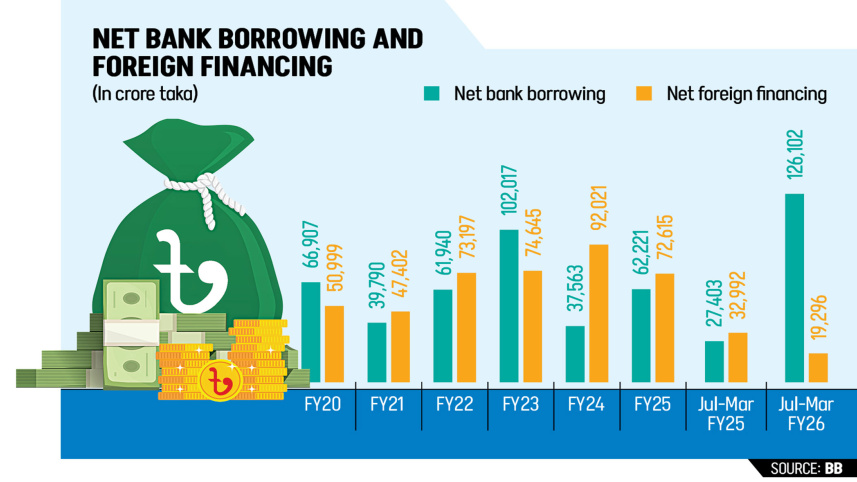
The government’s net borrowing from the banking sector in the first nine months of the current fiscal year has crossed the full-year target by more than Tk 22,000 crore, due mainly to weak revenue collection.
For fiscal year 2025-26, the government set a target of borrowing Tk 104,000 crore from banks. But between July 2025 and March 2026, it borrowed Tk 126,102 crore, according to Bangladesh Bank data.

The amount is nearly four times higher than the Tk 27,403 crore borrowed during the same period a year earlier.
Professor Mustafizur Rahman, a distinguished fellow at local think tank Centre for Policy Dialogue (CPD), said lower-than-expected revenue collection forced the government to rely more heavily on bank borrowing to meet expenditure needs.
“Government borrowing is linked to the revenue collection,” he said.
When the government borrows from banks, it reduces the amount of loanable funds available in the banking sector, creating a crowding-out effect for private sector borrowers.
Rahman said as the private sector showed lower demand for loans, government borrowing did not heavily crowd out private players. But continued borrowing would increase future debt servicing obligations.
“This is not a sustainable way,” he said.
Rahman added that the government should focus on revenue mobilisation, reduce leakages and expand the use of technology to improve tax collection.
According to provisional revenue data released yesterday, the tax authority collected Tk 3.27 lakh crore in the first 10 months of FY26, missing the July-April target by Tk 1.04 lakh crore.
Falling foreign financing also pushed the government to borrow more from banks to finance the budget deficit.
Central bank data showed that net foreign financing nearly halved to Tk 19,296 crore during July-March of FY26, down from Tk 32,992 crore in the same period of the previous fiscal year.
Total net deficit financing stood at Tk 144,109 crore during the nine-month period, compared with Tk 88,003 crore a year earlier.
Mohammad Abdur Razzaque, chairman of Research and Policy Integration for Development (RAPID), said the sharp rise in government borrowing is having a severe impact on the economy, including historically low private sector credit growth.
Private sector credit growth fell to a record low of 4.72 percent in March, according to Bangladesh Bank data.
Razzaque said banks were under pressure to reduce non-performing loans and narrow provisioning gaps, prompting them to lend more to the government because returns were higher and risks were lower.
“At the same time, the government was turning to banks because of inadequate revenue collection.”
According to the economist, it is creating a “most alarming vicious cycle” in the economy. He said that if the cycle cannot be broken, private sector-led growth will not be possible.
He said the interim government initially focused on controlling inflation through contractionary monetary policy and supportive fiscal measures, including lower public spending.
But he said the government now appeared to be shifting towards a growth-oriented approach with higher spending to solve economic issues.
 For all latest news, follow The Daily Star's Google News channel.
 “It is not a good sign for controlling inflation,” he said, adding that the government should be cautious about expenditure.
Razzaque suggested the government can seek foreign borrowing if favourable conditions are available.
Comments