


Middle class SQUEEZED


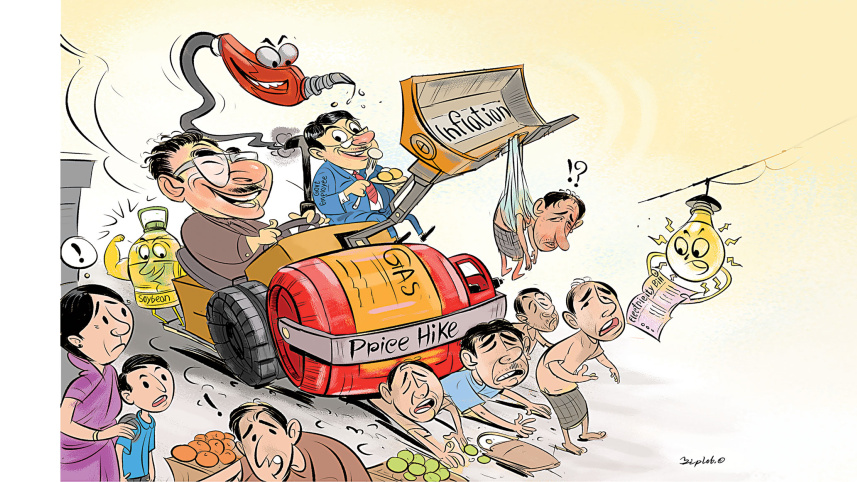
Delwar Hossain, a 52-year-old pickup driver in Dhaka, spent about 40 minutes in a queue yesterday to buy 4kg of flour at a subsidised government truck sale for Tk 110.
His wife, who used to focus solely on the household task, has started sewing clothes for neighbours, earning an additional Tk 5,000 a month on top of his Tk 20,000-25,000 income.

“Even with that extra income, we have to calculate every expense before spending because of the rising cost of living,” he told The Daily Star.
The couple’s predicament is increasingly common in Bangladesh, where most households are struggling to cope with mounting financial pressure.
A series of government-set price increases in electricity, fuel, transport, and cooking gas since June has driven up costs in ways that are not yet reflected in August’s inflation data, while wages are barely keeping pace with rising prices.
The inflation of 8.26 percent in August means prices are still rising, only more slowly. Food inflation was 7.02 percent. Both figures predate September’s fuel increase and this week’s LPG rise.
Bangladesh Bank warned on September 30 that inflation remained vulnerable to higher global energy prices, the fuel increase and the cost of a new public-sector pay scale.
Meanwhile, workers’ purchasing capacity is declining.
The Wage Rate Index rose 8.05 percent year on year in August, slightly below inflation, meaning real wages are falling. For households with little savings, the gap is closed by buying less, borrowing or both.
Of the 50 food items tracked by the Trading Corporation of Bangladesh, 33 were more expensive on October 4 than on February 17, when the BNP-led government took office. Twelve were cheaper and five unchanged. Eggs, flour, maida, soybean oil, sugar, potato, beef, and mutton were also dearer than a year ago.
Chickpea and several spices were also among the items that had become more expensive since February.
Talking to this newspaper, Nazneen Ahmed, executive director of the Centre for Policy Dialogue, a civil society think tank, said the main difficulty for households and businesses was unpredictability. “Prices are going up one after another, and we don’t see clear signs of them coming down.”
She cautioned against forecasting further hikes without adequate data, since such predictions could themselves fuel inflationary expectations.
BUYING LESS
For pickup driver Delwar, the squeeze is visible in the way his family shops.
“We cannot buy groceries in larger quantities anymore. We buy only what we need in small amounts,” he said.
At Karwan Bazar, retailer Mohammad Bablu said customers were purchasing smaller quantities. Someone who previously bought five litres of cooking oil might now take two, while a customer who bought one litre sometimes settles for half a litre.
At his shop, flour had risen from around Tk 50 a kg a month ago to Tk 65-Tk 70. “Income is low compared with the prices of goods. People are feeling the strain,” he said.
The strain is not limited to lower-income people, Bablu said.
BURDEN ON CONSUMERS
 For all latest news, follow The Daily Star's Google News channel.
 Ishaq Bin Sharif, who works for a private organisation in Banani and lives in Shewrapara, earns Tk 46,000 a month, up from Tk 42,000.
But his house rent has risen from Tk 7,000 to Tk 8,500, meaning Tk 1,500 of his Tk 4,000 pay rise is already going towards housing.
Ishaq said buses are often too crowded or difficult to catch when he needs to reach the office on time, forcing him on many days to take a motorcycle or CNG-run auto-rickshaw instead. Those trips have also become costlier, he said.
For Nadim Hossain, a private company employee from Munshiganj, the pressure has already pushed the household into debt.
“Prices and my salary are worlds apart. I have been in debt for about a year. I cannot make my income match the cost of living. If I buy one thing, I cannot buy another.”
Cooking gas has become a particular burden. Nadim said a cylinder that cost around Tk 1,837 recently was now difficult to find even for Tk 3,000 in his area.
Nadim’s experience comes against the backdrop of official price increases in recent months.
In June, the Bangladesh Energy Regulatory Commission raised power tariffs. After exempting the two lowest residential consumption slabs, the weighted average retail tariff stood at around Tk 10.40 per unit, up from Tk 9.11.
On September 21, diesel, petrol, octane, and kerosene prices were all raised by Tk 20 a litre. Diesel went from Tk 115 to Tk 135, while petrol rose from Tk 140 to Tk 160.
Transport fares followed. Long-distance bus fares have gone up from Tk 2.23 to Tk 2.40 per kilometre, while fares in Dhaka and Chattogram have increased from Tk 2.53 to Tk 2.70.
The latest increase came on Sunday, when BERC raised the regulated price of a 12kg LPG cylinder from Tk 1,585 to Tk 1,837.
Contacted, eight of 10 retailers in the capital had no cylinders, while the two that did were asking Tk 1,900 and Tk 2,250.
Talking to The Daily Star, AHM Shafiquzzaman, president of the Consumers Association of Bangladesh, said the successive increases were adding to pressure on households already grappling with high prices.
“People are already under severe pressure. Electricity prices have gone up, gas prices have gone up, and cylinder prices have increased. On top of high inflation, these increases are making people increasingly anxious about managing their daily expenses,” he said.
Restaurants are also seeing fewer customers as people struggle to cope with rising prices.
Bangladesh Restaurant Owners’ Association Secretary General Imran Hassan said restaurants were facing higher electricity, fuel, transport, LPG and raw-material costs.
“For many middle-class people, eating at a restaurant has now become a luxury,” he said, adding that customer numbers were down around 10-15 percent and sales about 30 percent at his restaurant.
“Earlier, a customer might have ordered meat but now chooses vegetables. Someone who used to have kebab and roti may now order just one Mughlai paratha,” Hassan said.
UNEVEN PAY RELIEF
Government employees are due to receive their October salary under the new national pay scale in the last week of this month, along with three months’ arrears from July. The revised basic pay is being introduced in phases and will be fully implemented by July 2027.
For most workers in the private and informal sectors, however, there is no comparable nationwide pay revision. Any salary adjustment depends largely on individual employers, leaving many workers to absorb higher living costs without an across-the-board increase in earnings.
CPD Executive Director Nazneen said policymakers should examine whether high import duties were contributing to price pressures. Bangladesh still depends on imports for many products, despite duties designed partly to protect domestic industries, she said.
Where domestic production has not expanded enough, she said, the government should consider whether maintaining high import duties was justified when those costs affect businesses and consumers.
Nazneen said stronger domestic industries and better income-tax collection could reduce dependence on import taxes for revenue.
Persistent high costs were also putting pressure on businesses, which could eventually affect investment and employment generation, she said.
Comments