


Rising inflation: Is the middle class the new poor?
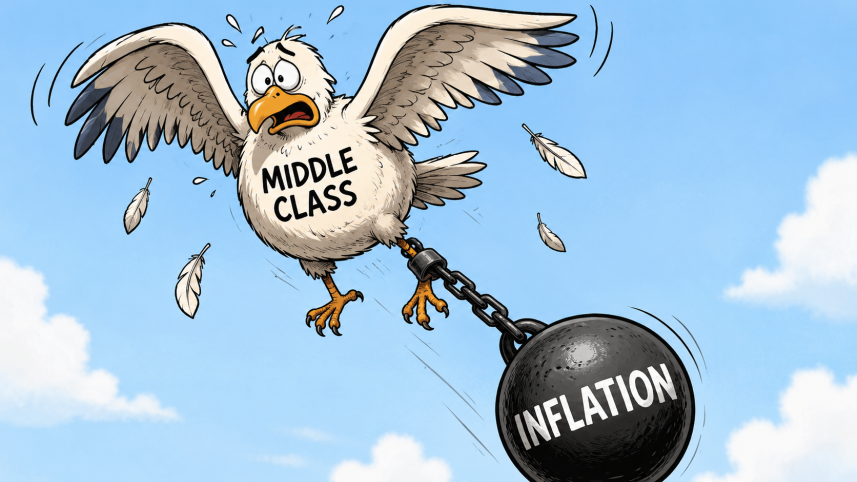
Inflation has taught me several useful life skills. I now know how long vegetables can remain edible in the refrigerator, which routes through Dhaka are technically walkable if one is sufficiently motivated, and how to stare at a restaurant menu for 10 minutes before announcing that I am “not actually that hungry”.
It has also made me much better at mental mathematics. A CNG ride in bad traffic is assessed with the seriousness of a small investment decision. Even grocery shopping now involves the kind of strategic thinking that should probably qualify for professional development points.

Such is the strange education of being middle class in Bangladesh today.
Against this backdrop comes the government’s decision to introduce a new pay scale for public-sector employees. Government employees have been working under the previous pay structure since 2015, so an adjustment after more than a decade of rising living costs is hardly unreasonable. They have faced the same expensive groceries, transport, housing and healthcare as everyone else.
The interesting question, however, is what happens to those outside that system. Inflation, after all, is wonderfully democratic. It does not ask whether I work for the government, a newspaper, a private company, or a school, before increasing the price of cooking oil. Salary revisions are apparently more selective.
The middle-class magic trick
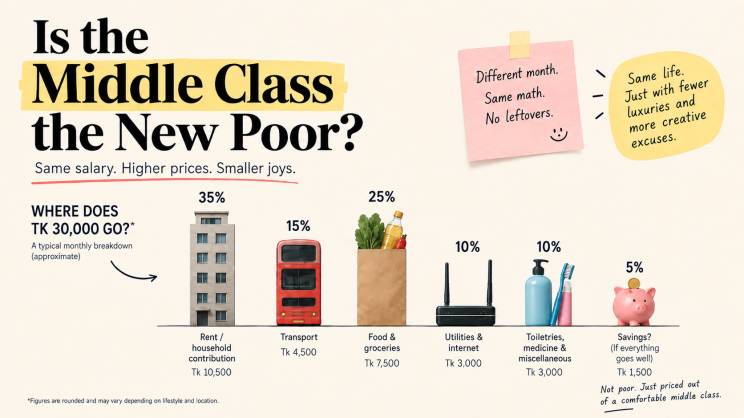
Consider Tk 30,000 as a simple reference point. It is the kind of monthly income that can still sound fairly respectable in casual conversation. Say “Tk 30,000” without context, and it seems like money with possibilities.
Then introduce it to Dhaka, and suddenly it becomes shy.
Rent or a contribution towards household expenses takes the first substantial bite. Transport arrives next, followed by food, electricity bill, internet, toiletries, medicine, and the endless parade of tiny expenses adulthood forgot to mention in the brochure.
There are still eggs, of course, although at around Tk 165 a dozen they are beginning to display the confidence of a luxury commodity. Bottled soybean oil costs more than Tk 200 a litre. Many everyday vegetables regularly wander into the Tk 80 to Tk 160 per kilogram range, while chicken and fish continue making their own contributions to national character building.
At this rate, the humble omelette is no longer breakfast. It is portfolio diversification.
The problem is not that every single item has become unaffordable. That would at least make the crisis obvious. Instead, everything has become slightly, irritatingly, persistently more expensive!
Inflation is much friendlier on paper
Official inflation rates usually arrive in percentages, which gives them an undeserved sense of calm.
Eight per cent. Nine per cent. Perhaps a little higher, perhaps a little lower. A percentage never looks at me apologetically while telling me that the same grocery list costs several hundred taka more than it used to.
Nobody walks through Karwan Bazar thinking, “Ah, I appear to be experiencing an inflationary environment!”
We think, “Tk 240 for tomatoes? What happened to them? Did they study abroad?”
This is why lived inflation feels different from the number published in economic reports. It accumulates through ordinary decisions. A slightly more expensive lunch, a higher ride-sharing fare, a more expensive packet of milk, another Tk 20 added somewhere that seems insignificant until the end of the month arrives and demands an explanation.
The middle class responds by becoming increasingly creative.
We downgrade without calling it a downgrade, and we postpone without calling it a sacrifice.
Perhaps I did not need that book. Perhaps forgetting about that weekend trip is an opportunity to reconnect with my city (sigh)! Frankly, financial distress sounds much healthier when rebranded as minimalism.
 For all latest news, follow The Daily Star's Google News channel.
 The advice is always to budget better
Eleven years is a very long time to remain tied to the same national pay scale while the value of money changes dramatically. The issue is not that government employees are getting an adjustment. The issue is that their adjustment highlights something the broader labour market often prefers not to discuss.
If a salary set years ago is no longer sufficient for government employees, why should we assume salaries elsewhere have somehow escaped the same economic reality?
Money has lost purchasing power regardless of who signs the employment contract.
Yet, in many private-sector jobs, annual increments can feel almost ceremonial. A few thousand taka is added, everyone politely congratulates one another, and inflation quietly takes it back. And sometimes it takes a little extra as a service charge.
Whenever the cost of living comes up, somebody inevitably recommends budgeting. This is sound advice. Cook at home and take public transport. Save 20 per cent of your income.
The only slight complication is that saving 20 per cent becomes challenging when approximately 117 per cent of the salary is already committed. Budgeting is enormously helpful when there is waste to cut. It becomes more philosophical when the spending categories are food, housing, transport and medicine.
I mean, one can only optimise toothpaste so far.
Still, we adapt, we walk more, and we wait for discounts. And now perhaps inflation has given us the ultimate survival strategy: intermittent fasting. Until recently, this belonged to the world of wellness. People voluntarily skipped meals to improve metabolic health and manage weight. In the new economy, it may simply be excellent financial planning.
I must say – if at this rate – food inflation continues, we may soon become one of the healthiest nations in the region purely through economic necessity. Until that happens, we will continue doing what the Bangladeshi middle class does remarkably well: adjust, recalculate, downgrade and somehow remain presentable.
Comments