


Elita Karim’s quiet journey through music, media, and resistance
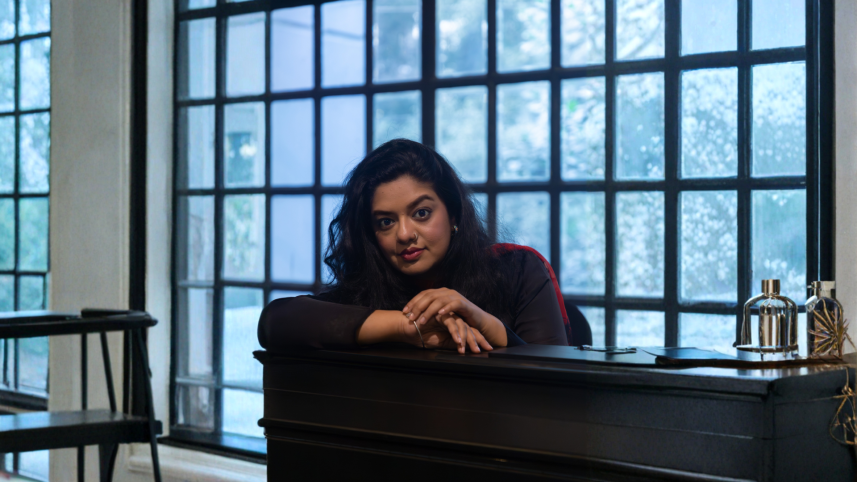
She has lived many public lives as a singer, journalist, editor, and researcher, but music has remained the quiet, constant thread running underneath them all.
"Music is something like breathing," Elita Karim says. "It's not really an activity. It's a part of your system… like how blood circulates inside your body." After more than two decades of working professionally in Bangladesh's music industry, Karim no longer tries to define what music means to her. It resists analysis because it precedes intention.

Her musical journey began in the early 2000s, evolving slowly and deliberately. Over the years, her work has earned countless formal recognitions. She was named Best Singer by Channel i, received the BACHSAS Award for Best Playback Singer, and later, a Red Cross International Best Article Award for a piece written after spending three nights in Benapole, reporting from the ground. The range of those acknowledgements mirrors the span of her practice: performance, observation, and engagement with lived reality.

The work behind the sound
Karim is careful not to romanticise being a professional musician. "The dreamy image collapses quickly under schedules, travel, fatigue, and expectation," she says.
What sustains her is not spectacle but exchange – the moment when sound becomes communication rather than display. Her discography reflects that restraint. She has allowed time to shape her output. Her solo album Elita arrived not as an announcement but as an accumulation of listening, waiting, and learning.
She is currently working on a new musical project led by artist Rashid Khan, alongside musicians from different generations, including Bappa Mazumder and Partha Barua. Karim speaks less about the scale of the project than its process.
"I will sing a song written and composed by him," she says. "The lyrics are very beautiful…very sweet."
Before recording, she listens again. She checks the key. She adjusts. Creation, for her, is incremental.

Learning, resistance, and knowing when to step back
Karim is currently pursuing a PhD in Mass Communication in the United States. Her research grew from lived observation, particularly during the July–August movement in Bangladesh.
"One idea kept returning to me: resistance," she recalls. Noticing how people, especially younger generations, responded creatively through street plays, protest songs, graffiti, reels, illustrations, and digital cartoons made her feel inspired.
"This is a form of resistance," she says. "These are ways people respond when power is uneven." Her research-in-progress explores what she calls "Resistance Publics," examining how art, music, and visual culture create alternative spaces of expression when conventional channels are restricted.
As a musician herself, she approaches this inquiry not as an outsider, but as someone who recognises these forms as interconnected ways of speaking.
"The research I am doing is also influenced by the artistic works produced during the 1971 Liberation War, for example, S.M. Sultan's paintings (which were created later but reflect the spirit of '71), the songs of Shadhin Bangla Betar Kendra and how they inspired people, and also the short radio plays on Bangladesh Betar or that witty segment called Charampatra," she elaborates.
That same attentiveness to boundaries has shaped her decisions in journalism. Karim has been associated with The Daily Star for a long time, gradually taking on editorial roles at Star Campus and later The Star Weekend Magazine, periods she remembers as productive and fulfilling.
The conflict of interest emerged only later, when she became editor of the daily Arts & Entertainment page, a section closely tied to the industry she herself belonged to. Editing coverage of a field one actively works in, she realised, demanded a separation she could not fully maintain.
"I can't just give up my music," she says. Stepping back from that role was not a retreat from journalism, but a decision grounded in clarity and integrity, allowing her to refocus on research, music, and longer-term inquiry.

An empty pitcher
When asked about creative fulfilment, Karim does not offer a resolution. Instead, she offers an image. "The pitcher is still empty," she says. No matter how much she learns, it feels as though it is not filling, but deepening. That emptiness is not lack; it is possibility. The day it fills, she believes, the work will stop.
 For all latest news, follow The Daily Star's Google News channel.
 For now, it hasn't. And perhaps that is the point.
Comments