


Dhaka’s energy crisis is turning everyday life into survival

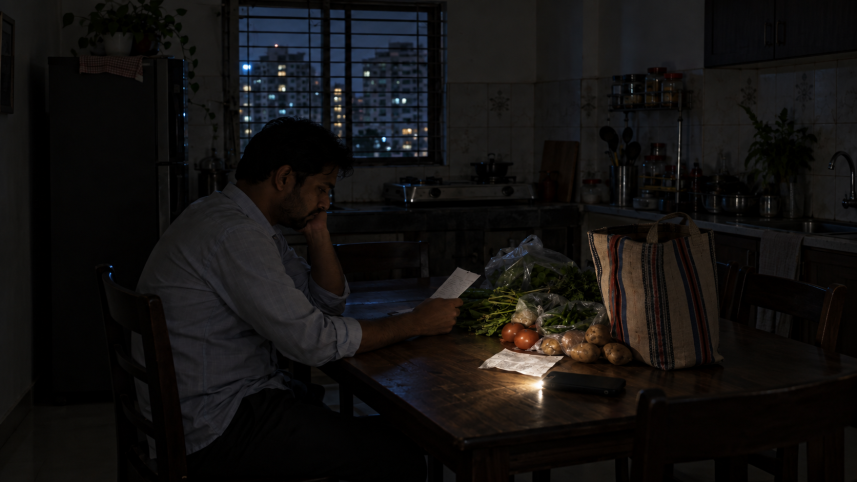
Everyday survival in Dhaka has quietly turned into an exhausting psychological tax. Between sudden blackouts, skyrocketing grocery bills, and endless queues, the emotional toll of constant adjustment is burning the city out.
I will not drag you through an 8th-grade composition on load shedding or inflation complete with standard causes, bleak effects, and a mandatory hopeful ending about Bangladesh’s bright future. Nobody needs that anymore. We are well past the point of needing a recap.

By now, the routine is practically muscle memory. We know the power will cut out, we know the grocery bill will sting a little harder every week, and we know fuel and gas have officially turned into daily endurance tests.
Naturally, we complain, we adjust, we complain again, and then, out of pure exhaustion, adjust some more.
Cooking around a gas shortage? Adjust. Sweating through a blackout because the generator cannot handle the AC? Adjust. Queuing for petrol? Adjust. Eyeing the price of tomatoes like a volatile stock market? You guessed it — adjust.
We are constantly adjusting!
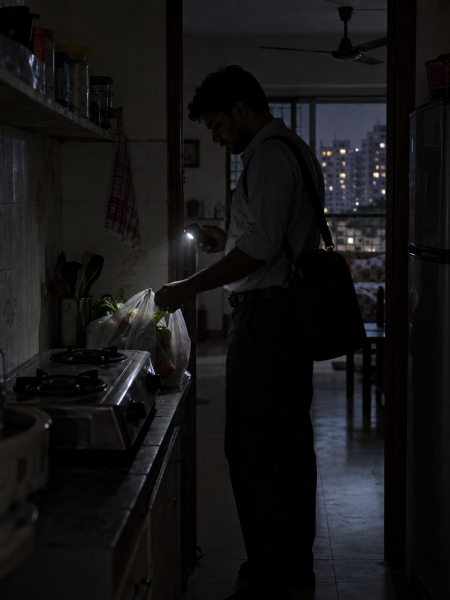
However, have we stopped to calculate what all this "adjusting" is costing us mentally? Let’s do the math!
Every day feels like we are playing roulette: Will the power stay on tonight? Will there be enough gas to cook when you get home? Will there be fuel at the pump tomorrow? Will the price of green chillies look like a typo next week?
I was reminded of this absurd mental tax recently while trying to get from Banani to Jigatola. It took me nearly two hours, four ride-hailing apps, and Tk 800 just to secure a car. And mind you, it was not even raining.
When a driver finally arrived, he politely asked if we could keep the AC off. Why? Because he was already running low on gas and terrified of getting stranded.
“There was a time when I could easily make eight or nine trips a day,” he said, adjusting his rearview mirror. “Now, I barely manage two or three. Half the day goes into waiting at the gas station. And when I finally go home to Mohammadpur, there’s no gas in the kitchen burner either.”
Suddenly, my own irritation felt foolish. His logic was airtight, and just like that, my private grievance turned into a strange, shared misery. I was drained from office stress, load-shedding, and the sheer financial violence of modern life, but so was he!
We were just two tired people sitting in an airless car in Dhaka traffic, silently performing our civic duty: "adjusting".
And this was not just the car driver. It’s pretty much the whole city, top to bottom, trapped in the same weary routine.
Take the rickshaw-pullers. Routes that used to be a quick, cheap fare have suddenly doubled. And if you dare to complain, the rickshaw puller will complain louder, and frankly, his list of arguments will be stronger.
“Look, sister, even the bare minimum like a cup of tea, a small bun, a single banana costs almost double now,” one rickshaw-puller told me, his voice sharp with pure exhaustion as he wiped sweat from his face. “Everything at the market has gone crazy. Vegetables, oil, rice -- you name it, it’s doubled. People get angry and yell at us when we ask for twenty extra taka for a ride. But do they think we eat air? That tea and bun is not some treat for us; it’s the only cheap thing keeping our knees from buckling while we pull them around all day! If we do not charge more, how do we eat?”
He paused, spat on the side of the road, and cursed under his breath. “Now we just cut back. I skip the boiled egg, I drink one cup less tea in a day, and I ask for taka 10-20 more just to survive.”
So, he too is adjusting. One less cup of tea. One less egg. One less green coconut for a sick parent.
Because apparently, there is a crisis for green coconuts as well. Whether driven by the endless seasonal heatwaves or the panic of another dengue outbreak, green coconuts — once the humble, roadside remedy- have soared to absurd prices.
 For all latest news, follow The Daily Star's Google News channel.
 And of course, it is not just coconuts. Good luck finding a single thing on your market list whose price has not climbed. Even local bus fare has joined the upward climb, thanks to the rising oil crisis!
However, the only things stubbornly refusing to rise are our salaries and our patience. Unless, of course, you work for the government, in which case at least one of those problems may have been solved. For the rest of us, our wallets are getting lighter, while our sanity seems to be shrinking at almost the same rate.
Even inside the cool, brightly lit aisles of a super shop, you can feel the anxiety, especially as a middle-class person, watching whatever little salary increment you received feel less like a raise and more like salt rubbed into an already open wound.
So, you stand there watching the numbers on the screen climb at the checkout, silently doing the math in your head. Because there is always that small, humiliating fear that you will have to turn to the cashier and say, “Actually, take this one out.” Maybe it’s a packet of milk, a tray of eggs, or the little treat you picked up for your child.
And of course, when we, the middle-class families, start cutting back, the pressure does not stop with us. It moves down the ladder, to the people who are already struggling the most. Domestic workers, for example, who keep our homes and daily lives running, are caught in an impossible situation. They ask for a small raise because the rent has gone up, groceries cost more, and the same salary simply does not stretch as far as it used to. But often, the answer they hear is, “We’re struggling too. If we have to pay you more, we may have to let you go.”
So, they stay.
And perhaps that is the saddest part of all: little by little, this crisis is asking everyone to surrender something — first a few comforts, then a few necessities, then a little dignity, and eventually, the small sense of peace we once took for granted.
Comments