


What every cadet college aspirant should know
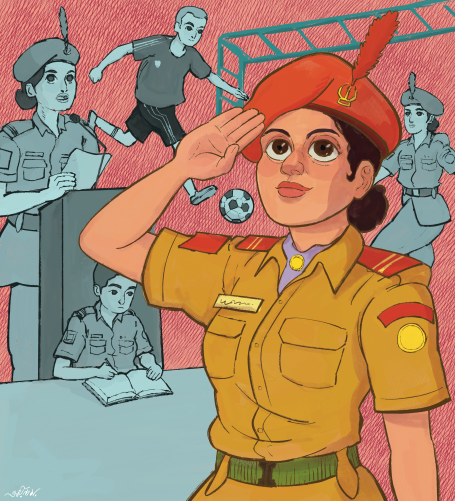
There’s a popular saying among ex-cadet college students: a cadet enters college crying and leaves six years later crying too.

Ask any teenager today to spend an entire day without their phone or an electronic device, and they might lose their mind. We did exactly that, every day, while sticking to a rigorous routine: waking up before sunrise for physical training (PT), standing through drill sessions under the blazing sun, running between the house, academic block, and dining hall, and getting thoroughly inspected by the staff, sometimes landing on the “extra drill” list for it.
The six years of my cadet life have shaped me into the person I am today, and many ex-cadets share the same sentiment.
Growing up away from home
Five minutes – that was all the time a cadet would get to talk to their parents for an entire week. For someone in grade seven, who is new to the cadet life, this can feel cruel.
At age 12 or 13, you are suddenly expected to live away from home for months. If you were upset, there was no running to your mother. If you were sick, there was no familiar bedroom to retreat to. If you had a terrible day, you only had your batchmates to comfort you.
As a cadet, you’re expected to keep track of your clothes and belongings, manage your studies, navigate friendships, deal with personal problems, and perhaps hardest of all, handle your emotions without your family around.
Of course, we missed home. We counted the days until the next holiday or parents’ day, waited for those five minutes of phone calls with our families, and looked forward to the moment we could finally return home.
Abdur Rahman Talha, an ex-cadet of Faujdarhat Cadet College, remembers these experiences vividly: “I still remember the first night away from home. I couldn’t sleep for a single moment. The phone calls were so short, as if the conversations were over before they could even start. Those experiences, however, shaped me into the person I am today.”
A sense of discipline
Cadet college requires you to stick to a strict, time-precise routine. But that’s not the discipline I am talking about. Once you graduate cadet college, you are probably not going to wake up at five in the morning or polish your shoes to a shine every single day. What stays is something quieter: an internal sense of discipline; the ability to decide what needs to be done, and figure out how to make time for it.
As Rehin Tazrian, an ex-cadet from Mymensingh Girls’ Cadet College, puts it, “In our university life, we have back-to-back deadlines, submissions, exams, and so on. For a lot of people, all these can feel overwhelming. For an ex-cadet, it’s nothing new.”
At cadet college, you will be constantly juggling academics, physical and extracurricular activities, inspections, and competitions amongst other things. And somehow, you have to fit all these into the same day.
Over the six years of cadet life, managing that chaos will become second nature. Even after leaving, you will find yourself carrying that habit of staying disciplined wherever you go and whatever you do. As a cadet, you will learn to organise your time, set priorities, and keep moving, even when there seems to be too much on your plate.
Learning to coexist
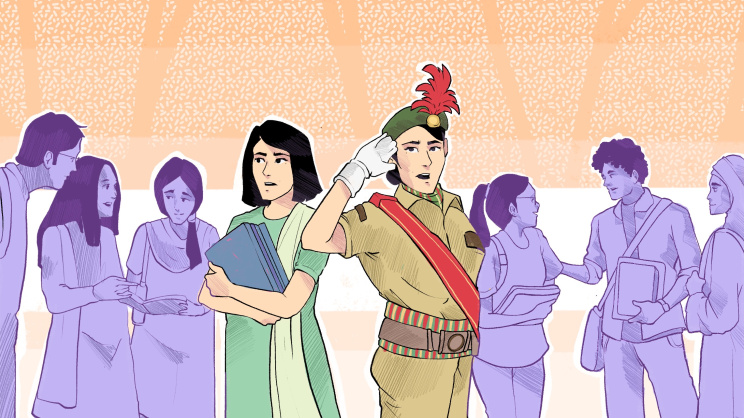
I still remember how, on the second day of entering cadet college, our adjutant visited our classroom. He told us, “For the next six years, this will not be your second home; it will be your first. At first, you will hate this place, then you will get used to it, and one day, you will realise that you can never really leave this behind.”
What made cadet college feel like home was never the place; it was the people.
Cadets come from all corners of the country. You will meet people from different backgrounds, families, and cultures. But once you enter the gates of cadet college, none of that matters. For six years, you will share rooms, meals, classrooms, study spaces, and almost every other part of your day with the same group of people.
One person’s mistake can sometimes mean the entire batch gets punished. At first, that can feel deeply unfair. Eventually, you begin to understand what it means to be part of a team. You look out for one another, hold each other accountable, and make a little home amongst yourselves. Six years of living that teaches you something a textbook never can: how to coexist.
 For all latest news, follow The Daily Star's Google News channel.
 Academics is about learning together
I still remember the night before our HSC physics exam, when the whole house was crowded into the room of our class topper, Jawad. He walked us through the hardest topics on the syllabus patiently while the rest of us listened. I have always cherished that memory.
That is what academics in cadet college really comes down to: efficiency and cooperation. Classes are divided into two sections of roughly 25 to 30 students. Teachers know your name and even your handwriting. There is a designated time for studying at night, and because time is limited, you learn to make the most of it. No tuition, no coaching, no excuses. Any outsider hearing this would probably ask, “How do they cope?”
That is where class toppers like Jawad come in. Perhaps the most remarkable thing about cadet college academics is not the teachers or the routine. It is that there is almost no academic rivalry among cadets. We passed around notes freely. If someone understood a topic better than the rest, they were expected to teach it to others.
Mahir Faysal Jadid, an ex-cadet of Sylhet Cadet College, remembers it the same way: “Before every exam, we used to crowd around the desk of our class topper. He would teach every topic patiently, and he did it without asking for anything in return. That is the kind of bond we had.”
In cadet college, doing well is never really about being better than the person beside you. It is about making sure the people beside you does well too.

Extracurriculars are just as important as academics
Before entering cadet college, I considered extracurricular activities (ECAs) a waste of time. Cadet college changed that completely.
Sports, indoor games, debate, public speaking, cultural activities and countless other extracurriculars are treated with the same seriousness as academics. Each college has three or four houses, a little like Hogwarts, and cadets will do almost anything to see their respective houses come out on top.
During my time as a cadet, I learnt to play football, volleyball, cricket, and indoor games. Along the way, I picked up painting, crafting, and writing from my seniors during different competitions.
Abdul Hasib Zehad, an ex-cadet of Faujdarhat Cadet College, reflects on his years: “I never imagined myself getting on stage. With the guidance from my seniors, during my cadet life, I won awards in debate, extempore, Model United Nations (MUN), and even went on to participate in an international olympiad. And I learnt and took part in all these while participating in different sports events.”
Participating in ECAs does not mean that cadets fall behind academically. It is just that we do not spend every waking hour buried in books, something that many people may think.
Adapting in every situation
I vividly remember the novice drill practice days. Physical training in the early morning, then after breakfast, drills under the blazing hot sun. No water, no rest; just constant left-right and the incessant shouting of the staff. By the end of a three-hour drill session, we had just twenty minutes to freshen up before we were already sitting in class, attending lectures. No one even had time to complain.
One of the finest things a cadet learns is to stay prepared for whatever comes next. In cadet college, the routine hardly changes, but as a cadet, you’ll keep getting challenged. You are expected to manage the rigorous schedule, academics, surprise inspections, continuous competitions, and countless spontaneous activities.
Amidst all that, there will always be room for a good laugh with your friends, even in the busiest of times.
Finding your own path
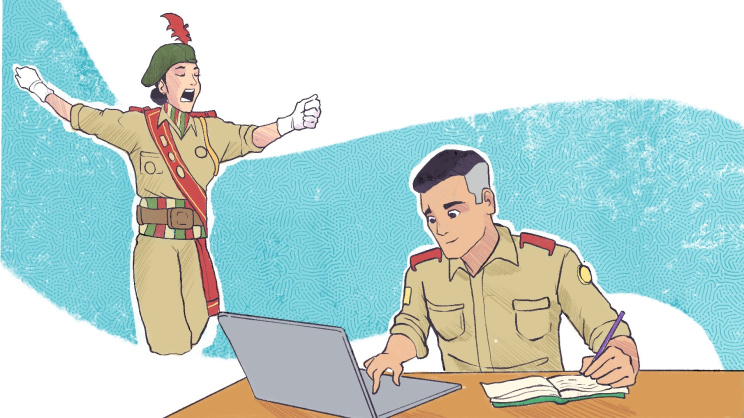
Contrary to popular belief, getting into cadet college does not automatically guarantee a successful career. But if you look at what ex-cadets go on to do, the range of paths is certainly worth noticing.
One of the biggest misconceptions is that being a cadet means you are guaranteed a “green card” at Inter Services Selection Board (ISSB) — an opportunity to undergo training in one of our military academies to become a defence officer. You do get to face the ISSB directly, but that does not guarantee selection.
Many cadets do join the military academy. As for the rest, they find their own paths.
From my batch, many cadets eventually joined the defence forces. Others went on to study medical or engineering, while some enrolled in reputed universities and institutions abroad.
Perhaps that is one of the most valuable lessons cadet college gave us: you keep moving and don’t stop simply because one path did not work out.
The camaraderie between batchmates
If there is one thing almost every ex-cadet will agree on, it is that the greatest gift of cadet life is your batchmates.
We entered the college as kids – an intake of more than 50 cadets thrown into the same place, following the same routine, and facing the same struggles. We cried together, laughed together, and fought with each other. Somewhere along the way, the people who were simply our batchmates became our close confidants.
Years have passed since we left cadet college. Yet, whenever we meet, it feels as though we are back there again. You can move to a new office, a new city, or even a new country, and still find an ex-cadet willing to help you whenever you need.
Cadet college will test you in ways few places can. You will, occasionally miss home and question whether you belong. But it will also teach you discipline that outlasts any routine, friendships that outlast any distance, and the confidence to adapt to anything.
If you are considering this path, go in with an open mind and a willingness to grow. You may enter crying, but you will leave ready for whatever comes next, carrying a family you never expected to find.
Irfan is an ex-cadet of Sylhet Cadet College. He spends his time writing, travelling, doomscrolling. Send him cat reels at: irfan.ink63@gmail.com.
Ramisha Arzuman, an ex-cadet of Mymensingh Girls’ Cadet, also contributed to this article.
Comments