


Amid narrowing choices, we need a credible economic strategy

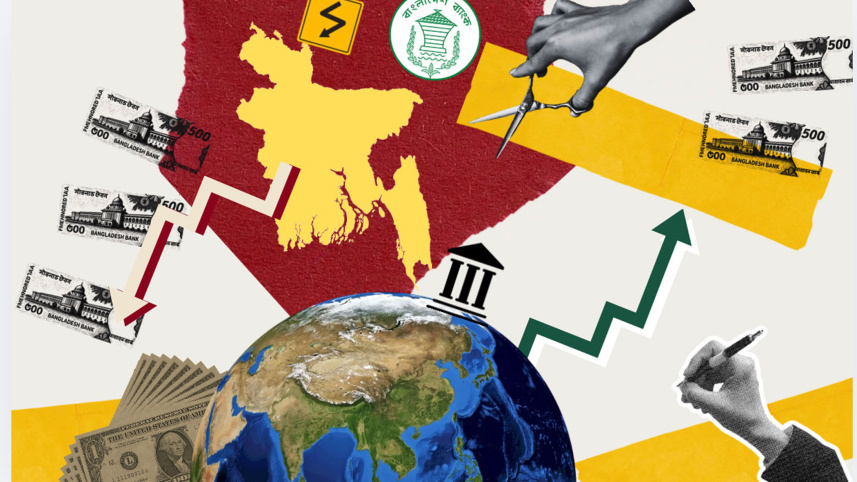
The three central banks responsible for setting the price of money globally recently took action in the same direction. The US Federal Reserve increased its target range to 3.75- 4 percent on September 16, its first increase since July 2023. The Bank of Japan, on September 18, increased its policy rate to around 1.25 percent. And on September 10, the European Central Bank increased its deposit rate to 2.5 percent. Though the Bank of England held, a third of its committee voted to tighten.
Earlier on July 30, the Bangladesh Bank announced that its repo rate would drop to 9.5 percent from August 2. This decline, a first in six years, came shortly after the central bank declared a contractionary monetary policy stance and kept the rate at 10 percent. Inflation was running at 8.26 percent in August, while non-food inflation had risen to 9.32 percent.

Such divergence is not automatically a mistake, but it must be justified.
A tightening cycle unlike the last one
Major central banks are raising interest rates not because their economies are experiencing excessive demand. Core US inflation was 2.4 percent in August and trending lower; the euro-area core inflation was 2.1 percent. The difference is the headline inflation rates, 3.4 percent in the US and 3.2 percent in Europe, and energy accounts for the difference. Brent crude oil prices were trading at around $104 per barrel last week, mainly due to disruptions to oil shipments through the Strait of Hormuz.
This tightening is intended to prevent an expected price response to the relative price changes resulting from the oil supply shocks. Kristalina Georgieva of the International Monetary Fund (IMF) put the question plainly: how restrictive should policy be when the shock originates beyond its reach? Coordination of policy actions across the major economies can lead to a synchronised tightening policy, given that exchange rates among the reserve currencies tend to remain stable when multiple major economies take similar policy actions. Those outside this group face pressure from multiple directions simultaneously, so the interactions among these pressures matter more than each pressure’s size.
The bill arrives in dollars
First, consider the import bills. Spot liquefied natural gas (LNG) in Asia has traded at levels close to $28 per million British thermal units (MMBtu) versus $2.8 at Henry Hub in the US, a tenfold gap indicating how differently an energy shock impacts a producer versus a spot market importer. Bangladesh’s imports totalled $71.1 billion in FY2025-26, while trade deficit hit a three-year high of $27.3 billion.
Next, consider the cost of money. The US 10-year Treasury yield recently touched 5 percent, highest in two decades. When the risk-free benchmark increases, so does every other asset whose value is based on it, including government borrowing costs and project finance costs for the power plants needed to reduce Bangladesh’s reliance on imported spot LNG.
Finally, consider the exchange rate. Higher returns on investments denominated in dollars, euros and yen draw capital towards reserve currencies. And yet, the taka has remained strong, at around 122.86 per US dollar, and gross reserves stand at more than $36 billion, about $31.5 billion under the IMF’s BPM6, covering 4.8 months’ worth of imports, financed by record remittances totalling $35.6 billion.
That represents a remarkable accomplishment. Unfortunately, that accomplishment occurred in a world that has just experienced significant change: namely, the Fed’s projection implies no interest rate cuts through 2027. Depreciation is not a viable option when input prices, financing costs and tariffs on garment exports (at over 25 percent) are all increasing.
Remittances provide double-edged benefits. On the one hand, higher oil revenues help fund jobs in the Gulf states employing many Bangladeshi workers, thereby supporting remittance flows. Tighter monetary conditions strengthen the dollar, widening the gap between official and curb rates and encouraging funds to move into informal channels. Monthly remittance flows have fallen below $3 billion for three consecutive months. Maintaining formal remittance flow channels is reserve management policy, not welfare policy.
Why the banks make this harder
Classified loans stand at close to Tk 6.07 lakh crore as of June, a new record, representing 32.78 percent of outstanding loans disbursed, with more than 72 percent of it in 10 banks. Twenty-one of 61 banks suffered from a capital shortfall of Tk 2.94 lakh crore as of March; the system-wide capital adequacy ratio fell to minus 3.17 percent against a 12.5 percent requirement.
The banking sector’s problems are not separate from current events happening elsewhere. A central bank overseeing an undercapitalised banking system cannot raise interest rates to protect its currency as every increase causes more loans to become classified and more banks to fall below thresholds. Our trilemma is smaller than what textbooks suggest because fragility has eliminated our ability to use interest rates as an economic tool. The August cut was justified on growth considerations. It is also what a central bank does when its banks cannot afford alternative options.
Fiscal policy also offers little room for manoeuvring. Interest payments on Bangladesh’s public debt consume Tk 21.10 of every Tk 100 targeted by the National Board of Revenue (NBR). To meet its FY2026-27 target, NBR forecasts annual revenue growth of 46 percent, far above recent growth of about 12 percent. Therefore, any budget shortfalls will need to be funded by the same banks that are being asked to recapitalise themselves.
There are differences between the country’s situation today and those it faced in 2013 and again in 2022-23, specifically that today it faces some $26 billion of external debt repayment obligations due by FY2029-30, an undercapitalised banking sector, and no IMF programme agreement since May to stabilise market expectations.
What should be done now
The government should close negotiations with the IMF, not because the IMF’s judgement is superior but because its endorsement allows other parts of the external funding architecture to function properly.
It should also publish gross reserves accurately and let the exchange rate adjust to reflect that burden, not through intervention, which converts a currency adjustment into a reserve crisis.
 For all latest news, follow The Daily Star's Google News channel.
 In addition, the government should use hedging agreements (term contracts), storage and efficiency to manage risks related to energy consumption rather than relying on spot purchases, shift from universal subsidies towards targeted transfers, and formally price formal remittance channels so that they compete with informal alternatives. It should also accelerate loan recognition and conditionally recapitalise banks on the basis of governance reform. Capital invested into an unreformed board refinances original losses; until measured capital is restored, the policy rate stays hostage to the banks.
The instruments available to Bangladesh are narrower than theory would suggest. Interest rates are limited by bank capital, forex markets are limited by reserve adequacy, and fiscal policy is limited by a revenue base of less than 7 percent of GDP. But what still exists is sequence and credibility: complete IMF programme negotiations, and stop issuing policy statements that contradict the following month’s decision. None of these actions requires resources the country doesn’t have; all they require is willingness to be believed.
Dr M Kabir Hassan is professor of finance and the Moffett chair in the Department of Economics and Finance at LSU-New Orleans in the US, and a member of the AAOIFI Ethics and Governance Board and chairman of its Education Board.
Views expressed in this article are the author's own.
Follow The Daily Star Opinion on Facebook for the latest opinions, commentaries, and analyses by experts and professionals. To contribute your article or letter to The Daily Star Opinion, see our guidelines for submission.
Comments