


Recognise women’s labour that run the economy
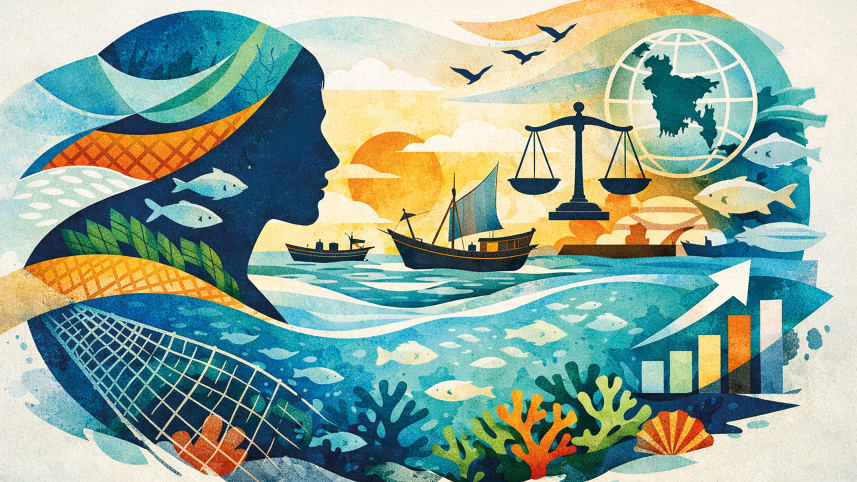
Women across the world begin their labour way before the formal workday starts, performing countless tasks that sustain both national economies and private households. They engage in paid and unpaid work, from agricultural production and small-scale trade to caregiving. Despite these, much of women’s work remains invisible, undervalued, and entirely excluded from formal recognition. Women are often underrepresented in ownership rights, financial resources, policy-making spaces, and leadership positions that shape the economic systems. This persistent gap highlights how historically male-dominated structures continue to influence economic governance, constraining women’s equal recognition, authority, and equitable access to opportunities and resources. In this piece, I discuss a specific sector, namely ocean governance, where women’s labour falls through the cracks.
In Bangladesh, women dominate the pre- and post-harvest sectors, including drying fish, processing, marketing, aquaculture, and, increasingly, seaweed cultivation. Despite their significant labour, they frequently lack recognition in fisheries regulations and miss out on subsidies as well as cash assistance provided to “registered fishers” during fishing bans. They also face occupational hazards in unsafe drying yards and processing sheds and are absent from co-management bodies that determine fisheries rules in Marine Protected Areas.

Women are often underrepresented in ownership rights, financial resources, policy-making spaces, and leadership positions that shape the economic systems. This persistent gap highlights how historically male-dominated structures continue to influence economic governance, constraining women’s equal recognition, authority, and equitable access to opportunities and resources.
It is unfortunate that their voice is not represented in governance, and this has undermined gender justice and sustainability because women’s silent contributions get subsumed as informal labour. In contrast, the Sustainable Development Goals (SDGs) include SDG 14, which proposes a sustainable use of the marine life, and SDG 5, which requires equal involvement of all genders. There is no way to achieve one without the other.
Furthermore, Bangladesh has obligations and good faith commitments to incorporate gender in ocean management under various international instruments. For instance, the FAO Small-Scale Fisheries Guidelines 2014 urge states to acknowledge women in value chains and engage them in decision-making arrangements. Moreover, fisheries techniques that are socially responsible are promoted in the FAO Code of Conduct for Responsible Fisheries and Post-Harvest Practices and Trade 1995, where post-harvest activities take the centre stage and women are mostly engaged.
Similarly, the ILO Convention No 190 of 2019 is concerned with violence and harassment in the workplace, which is applicable to women working in these sectors as well. Similarly, the Convention on the Elimination of all forms of Discrimination against Women 1979 acknowledges the right of rural women to access resources and participatory development, and its General Recommendations iterate state obligations to realise gender responsive governance. Similarly, the Sendai Framework Disaster Risk Reduction (2015-2030) focuses on inclusive policies for disaster preparedness, which is crucial for coastal workforce, particularly women.
Unfortunately, in our law, the legal definition of fishing is narrow, and it leaves out women involved in the important aspects of the value chain like fish processing, aquaculture and post-harvest activities, thus depriving them of identification, subsidies, and other social support programs. Moreover, representation gaps are also crucial, and women do not have an opportunity to engage effectively in fisheries co-management councils and other decision-making bodies due to a lack of mandatory quotas. The gender-specific prism is also missing even in the occupational standards of the sector, as the requirements of personal protective equipment (PPE), toilets, and even a childcare space are seldom provided, exposing women to hazardous and unfair working conditions. The challenges are compounded by financial exclusion, in which women still experience limited access to credit, insurance, and collateral-free loans, and are not able to invest and expand their marine based livelihoods.
To empower women in fisheries, we need a holistic approach at the policy-legal level recognising women across all levels of marine governance and coastal development. First, the definition of ‘fishing’ under the Marine Fisheries Act needs to be extended to explicitly recognise women across the value chain, i.e., catching, processing and marketing, and in aquaculture. This will potentially qualify them to receive formal identification, subsidies, and compensation in the event of a fishing ban or natural calamity. In addition, institutional representation should be ensured to make sure women are mandatorily represented in the fisheries co-management councils and different decision-making committees. Also, the Delta Plan and National Adaptation Plan should be made gender-responsive to facilitate women-managed coastal livelihoods, including seaweed and shellfish aquaculture, eco-tourism, and mangrove-based enterprises. Furthermore, our labour standards require urgent convergence with the global norms; hence, fisheries labour regulations need to be aligned with the ILO Convention 188 to ensure the written contracts, occupational safety and health standards, the use of personal protective equipment, access to sanitation provisions, etc. In order to further guarantee a safe working environment, protocols on ILO Convention 190 against harassment should be enforced stringently on landing sites, fish markets, as well as processing sheds.
The blue economy discourse in Bangladesh often revolves around industrial fishing, shipping and offshore energy. But it is equally important that the invisible hand of women in fish-drying yards, shrimp-processing plants, and seaweed farming is recognised. This is the bare minimum they deserve for the immense contribution they make.
The writer is apprentice lawyer at the Dhaka judge court.
 For all latest news, follow The Daily Star's Google News channel.
Comments