


Illegal bamboo felling rampant in Moulvibazar

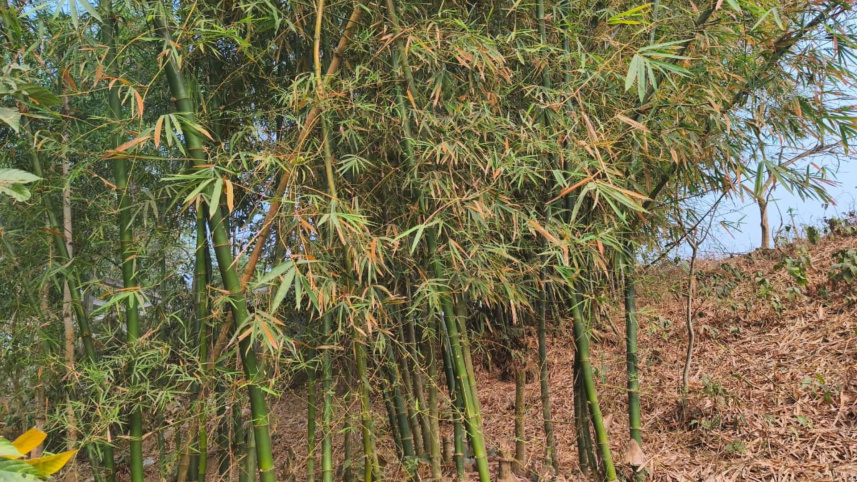
Once a major source of government revenue and a key component of forest biodiversity, bamboo forests in Moulvibazar under Sylhet division are facing widespread illegal felling amid the absence of legal leases and effective monitoring.
All 23 bamboo mahals across four forest ranges in the district are currently without leases, creating opportunities for organised groups to cut bamboo illegally, both at night and in broad daylight, according to locals and environmentalists.

Despite repeated tender invitations by the Department of Forest, no registered leaseholders have come forward.
As a result, although the mahals are officially vacant, bamboo worth crores of taka is being extracted and sold illegally, causing significant revenue losses.
According to the Forest Department, the district has 23 bamboo mahals covering about 40,055 acres of forest land. Of these, seven are located in the Rajkandi range, seven in the Juri range, four in the Barlekha range, and five in the Kulaura range.
The Sylhet Forest Department floated tenders to lease the bamboo mahals for the 2025-26 fiscal year on April 20 this year, but received no bids.
A recent visit to several bamboo mahals in the Rajkandi range revealed extensive signs of illegal harvesting.
A Forest Department official, speaking on condition of anonymity, said bamboo clumps in many areas had been completely cleared, leaving behind stumps, scattered remains and, in some places, fire-damaged patches.
Former leaseholders said government-set lease prices are no longer economically viable.
“The tender prices are higher than the market selling price of bamboo. Instead of profit, losses are inevitable. That’s why no one is interested anymore,” said a former leaseholder, requesting anonymity.
Local bamboo traders also acknowledged the existence of an illegal supply chain.
Sadiq Ali, a bamboo trader from the Sagardighi area of Srimangal, said bamboo sold in markets is no longer sourced legally.
“For a long time, we haven’t been able to buy bamboo from authorised mahals. Smugglers are cutting bamboo at night due to weak surveillance,” he said.
Environmentalists warned that indiscriminate bamboo extraction could have serious ecological consequences.
“Bamboo should not be viewed merely as a revenue source. It is an integral part of forest ecology,” said ASM Saleh Sohel, a national council member of Bangladesh Paribesh Andolon, adding that “if such cutting continues, wildlife habitats and ecological balance will be severely affected.”
Responding to the allegations, Mohammad Nazmul Alam, assistant conservator of forests of the Sylhet Forest Department, rejected claims that high lease prices discouraged bidders.
Regarding illegal felling, he said regular drives were being conducted to curb cutting and smuggling, but monitoring remained difficult as most bamboo mahals are located in remote areas and the department faces a manpower shortage.
He added that field teams are currently assessing bamboo stock in each mahal, and tenders will be invited where leasing is deemed feasible.
 For all latest news, follow The Daily Star's Google News channel.
Comments