


Why coastal communities don’t get enough milk and vegetables

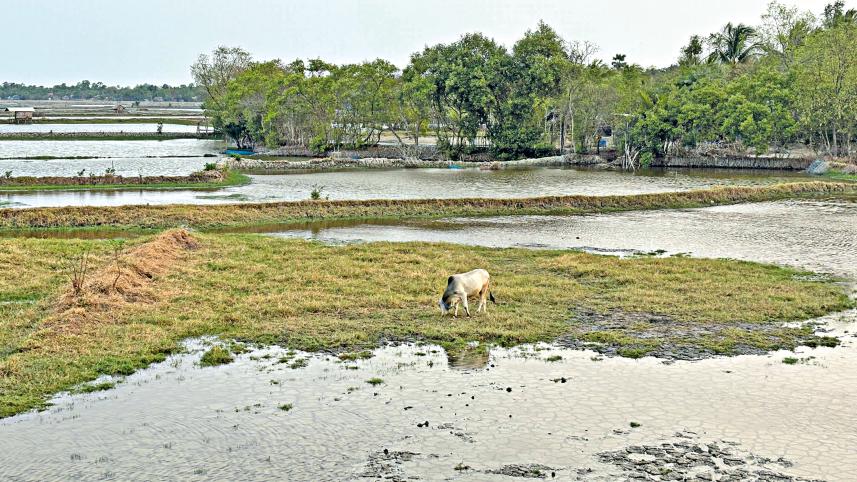
The Ashtomashi Badh, or eight-month embankment, historically shaped the southwest coast of Bangladesh into an ek fosholer desh—a single-crop landscape—where peasants cultivated rice once a year using fresh water. Within these low-lying, embankment-protected deltaic areas, everyday life evolved around an integrated ecological system linking agriculture, fishing, and cattle rearing through shared grazing spaces. These grazing lands typically consisted of uncultivated khas jomi, charland, and fallow paddy fields. Situated alongside rice fields, this grazing landscape sustained a form of embedded food sovereignty, combining large-scale rice cultivation with household-level cow milk production, and supporting the ideal of a largely "self-sufficient" rural household.
Before the climate-resilience adaptation regime took hold in the 1980s, everyday survival in the delta rested on a diversified subsistence economy. Households relied on domestic milk production and consumption, the cultivation of vegetables and rice, and fishing in shared waterbodies to meet their basic needs. These practices were guided by an agricultural ethic of subsistence embedded within relatively egalitarian social relations across the deltaic landscape. Household formation itself was closely tied to agricultural food sovereignty, providing a stable foundation for domestic nutrition and livelihood security.

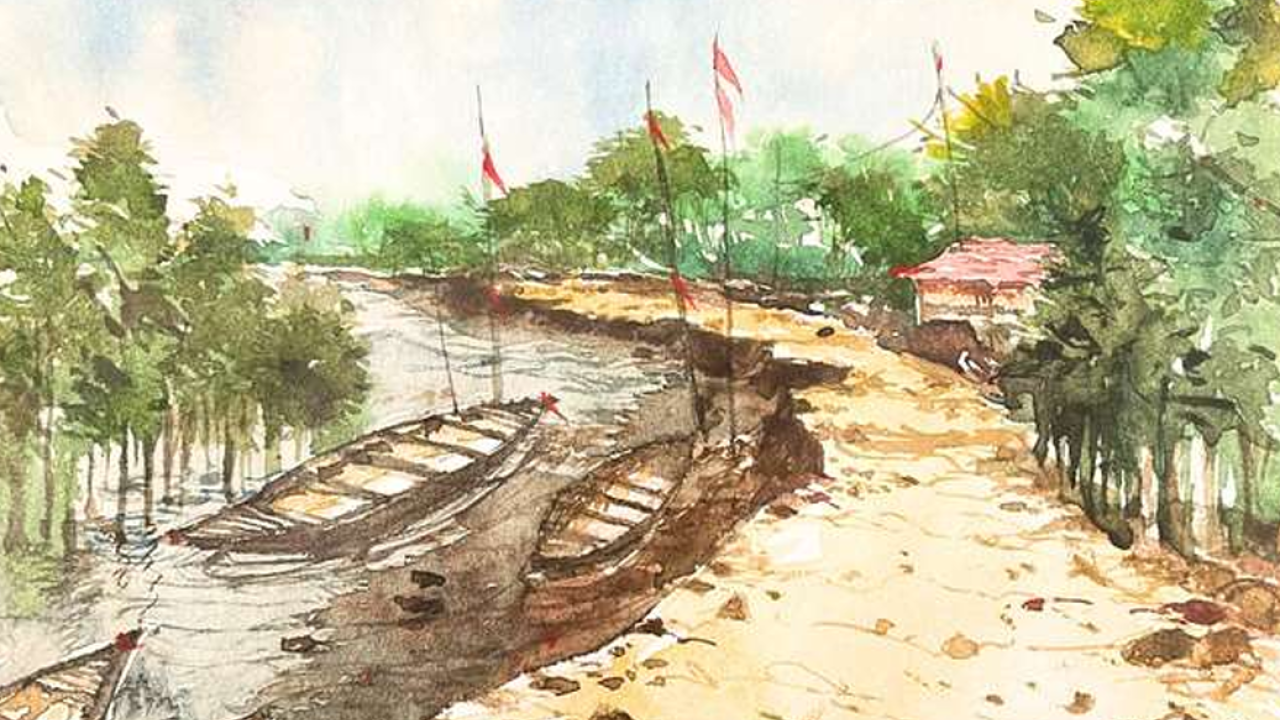
From the 1970s and 1980s onwards, however, state and non-state actors increasingly framed the future of the delta through scientific and technical narratives that forecast widespread submergence under saline water. Over time, Bangladesh's southwest coast came to be designated as the country's "most vulnerable" region and a climate "hotspot", a dystopian framing that justified the introduction of large-scale sustainable development programmes. As this narrative gained traction, governing the climate hotspot in ways that could ensure long-term sustenance and survival emerged as a pressing political and policy challenge.
Within climate-resilience development frameworks, development brokers increasingly argued that saline-water intrusion into embankment-protected areas was inevitable, driven by recurring sea-level rise and embankment erosion. On this basis, they promoted a shift away from freshwater rice cultivation towards the expanded use of brackish-water species. During the 1980s and 1990s, major international donors actively prescribed and supported tiger-prawn aquaculture through a series of development projects in designated climate hotspots and highly vulnerable regions. These interventions particularly targeted low-lying deltaic communities portrayed as facing unavoidable saline intrusion due to climate change.
Consequently, from the late 1970s onwards, shrimp cultivation began to replace existing paddy fields across coastal Bangladesh. This transition was largely driven by local and external elites who possessed the financial capacity to invest in capital-intensive aquaculture operations. Under donor guidance, the Bangladesh government not only endorsed this shift but also provided administrative and institutional support to those establishing brackish-water aquaculture, promoting it as a sustainable and climate-resilient development pathway.
Yet the expansion of shrimp cultivation was neither smooth nor consensual. A substantial body of scholarship documents how land acquisition for shrimp farming frequently involved coercion and violence. Local villagers often resisted attempts by powerful actors to convert freshwater paddy lands into saline aquaculture zones, leading to prolonged conflicts and bloodshed. Throughout the 1970s and 1980s, violence became a defining feature of land grabbing for shrimp cultivation in the Bengal Delta.
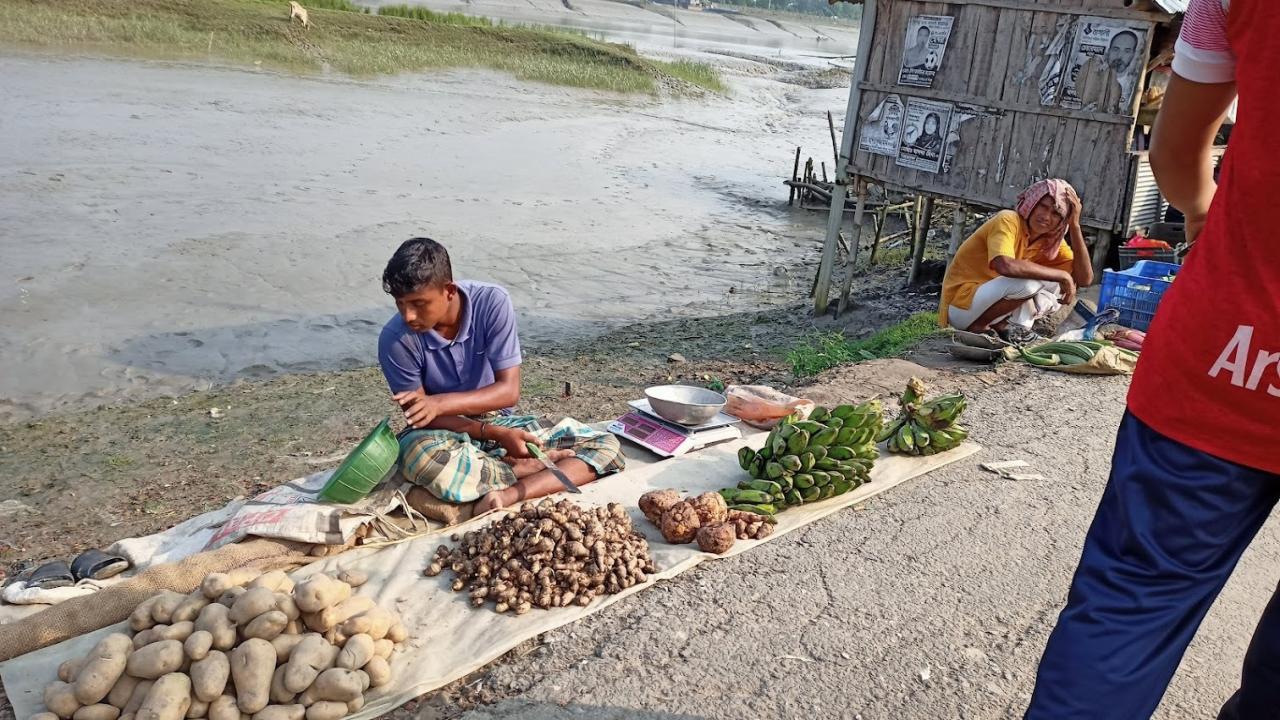
Scholars have commonly identified the primary agents behind these forceful land appropriations as the so-called "shrimp mafia". This raises a critical question: what legitimised the violent transformation of fertile agricultural land into saline aquaculture ponds? The answer lies in the climate-adaptive regimes and climate-resilient livelihood models imposed during this period. A class of shrimp cultivators consolidated power in the delta under the justification of climate adaptation, aided by donor-backed development programmes and direct state support.
Since the 1970s and 1980s, deltaic communities have found themselves caught within what is widely described as a climate-adaptive regime—one that structurally reorganises land and livelihoods around export-oriented brackish-water aquaculture, primarily shellfish. Development brokers frame this "blue revolution" as a rational response to climate change, arguing that saline intrusion into embankment-protected habitats, paddy fields, and grazing lands is unavoidable. In practice, this process has de-peasantised the area, concentrating land ownership, displacing subsistence-based livelihoods, and preparing coastal territories for integration into global supply chains.
Saline intrusion, promoted as a climate-resilience strategy, has had devastating consequences for both local agriculture and common grazing lands. As the commons disappeared, domestic cattle rearing and household-level cow milk production for local consumption sharply declined.
In saline-affected areas such as Munshiganj Union, weekly markets continue to operate, yet networks of local producers and consumers trading domestically produced cow's milk have virtually vanished. The limited domestic milk that is still produced often reflects declining quality, a visible indicator of the wider impacts of salinity on livestock and fodder.
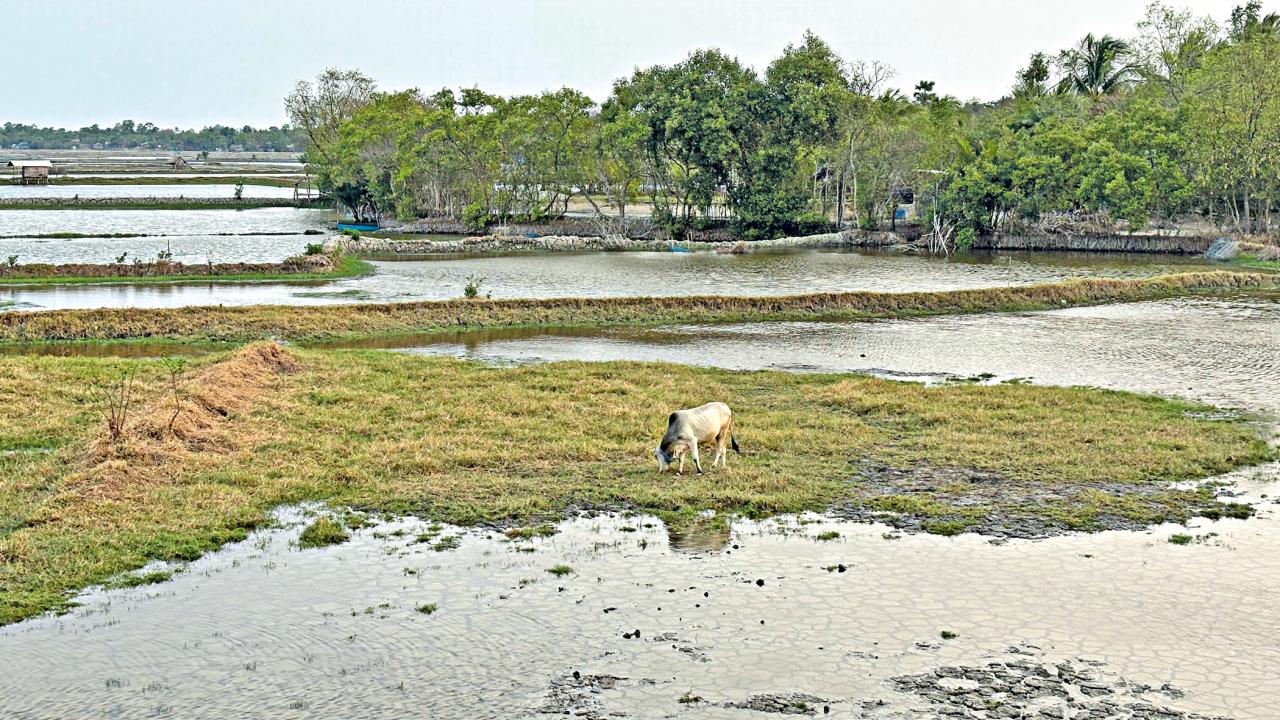
Similarly, in village markets near forest-adjacent zones, most vegetables are now transported from the mature delta. Local vegetable-growing lands, paddy fields, and grazing areas have been degraded by saline intrusion, leaving households without kitchen gardens or the capacity for large-scale cultivation. Soil degradation—driven by climate-adaptation pressures and routinely justified as an unavoidable response to climate change—has pushed food production out of local control. As a result, vegetable prices in the southwest coast are significantly higher than in the mature delta.
Across coastal Bangladesh, brackish-water aquaculture is steadily dismantling agro-based household economies and eroding food sovereignty. Communities are losing access to grazing lands, domestic milk production, and the social practices that once sustained household-making. What is presented as climate resilience has, in reality, transformed everyday survival into a struggle against dispossession.
Md Raihan Raju is a journalist at The Daily Star and can be contacted at raihanraju29@gmail.com
Send your articles for Slow Reads to slowreads@thedailystar.net. Check out our submission guidelines for details.
 For all latest news, follow The Daily Star's Google News channel.
Comments