


Chandra Bhattacharjee’s Art of Survival
Chandra Bhattacharjee’s journey is one of hardship, and his philosophy is grounded in lived experience. One of India’s most talented contemporary artists, he carries a suave personality shaped by struggle and survival, with scars surfacing in muted tones.
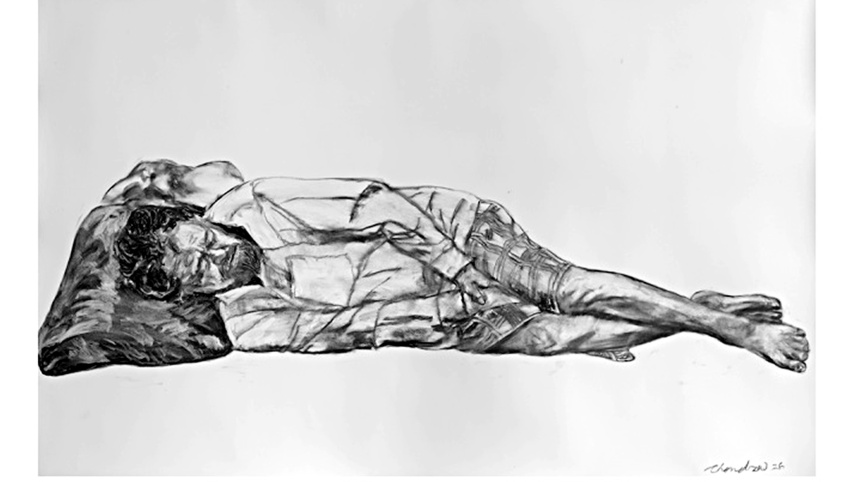
Dhaka audiences can now experience his vision firsthand through his first solo exhibition at Galleri Kaya, Between Witness and Imagination, running from July 10 to 21. Monumental canvases compel viewers to acknowledge the shadow citizens -- beggars and abandoned people -- painted on eight-and-a-half-foot-tall surfaces that force viewers to lift their heads and confront the echoes of their existence.

His canvases balance intimacy with monumentality while registering the subtle consequences of human intervention and its impact on the fragility of both humans and nature. Rooted in personal observation, they speak of experiences that resonate across borders: the transformation of landscapes, the erosion of ecological balance, and the search for freedom within an increasingly regulated world.
The muted visual language that defines his canvases stems from an emotional connection forged during his days painting film banners. While painting 40-foot portraits of stars like Amitabh Bachchan, he noticed how society looked down on labourers like him. The tendency to render the downtrodden invisible drew him to study the neglected.
Born in Burdwan, Bhattacharjee arrived in Kolkata without family support and began painting film banners. He lived above a vegetable market, sharing cramped quarters with drums of kerosene and enamel paint. Days were spent on scaffolding, and nights at art college. He recalls scrubbing enamel paint off his hands with kerosene and washing at roadside taps before heading to class.
He insists that he does not glorify himself as marginalised; he only acknowledges his deep relationship with marginalised people, one that has endured through sketching, photographing, and keeping mental notes for his canvases.
Charcoal became his medium of choice for its speed and simplicity. “I didn’t want their lives to become still life. Charcoal is minimal, simple, like their lives.” He experimented with stencils, watercolour, and mixed media, but the subject always dictated the technique.
Poverty may be conveyed by a broken bowl -- enough to suggest hunger and deprivation. A spark of light may be a firefly, or it may ignite a forest. The loss of the jungles and gardens of his childhood is a scar he carries, expressed subtly through metaphor rather than crude imagery. “Forests burning, rivers drying -- these are not landscapes but wounds,” he feels.
“Muted tones of burnt sienna, umber, sap green, ochre, blue, white, and black become characters here, not just a colour spectrum,” he explains, adding that his restraint echoed the colours of the Santal villages he frequented in Birbhum, where walls were painted with natural pigments.
His academic years were shaped by an institution where theory was absent and art history was never taught. Success meant anatomical perfection, drawing that closely resembled photography. Many peers never moved beyond this, producing decorative work driven more by emotion than calculation.
Today, by contrast, students emerge steeped in theory, more calculative and inclined to follow rules. Unlike earlier generations, who painted directly from imagination, metaphor and abstraction now dominate.
Contemporary art matters to him because it reflects the incidents of its time. Yet he believes the poetic, fluid quality of drawing is being compromised, even though the relationship between the individual and the forces shaping modern existence remains at its centre.
He is equally aware of the art market. Buyers once were few; now even modest earners purchase small works. Wealthy collectors may invest for status or profit, but he sees value in this too. “If forty buy without understanding, and four are true connoisseurs, what harm is there? Exposure matters. A child growing up in a home with paintings may later become a genuine collector.”
His ongoing exhibition in Dhaka ranges from monumental canvases to intimate watercolours, though he notes that mixing series can obscure the process. Yet, somewhere in the palette and in the thoughts, there is a connection, he reflects, inviting viewers to engage with the works through their own understanding.
Within his images lies a spiritual, meditative quality anchored in truth and observation. His art is a meditation on lived reality, guided by a philosophy that insists colour itself can become character, and that the language of painting must speak directly to the soul.
Bhattacharjee remains a minimalist, humanist, and an artist deeply connected to the lives he paints. His art is born from struggle and speaks of scars, empathy, and survival. “I don’t shout in the streets; I paint. That’s my way of speaking.”
 For all latest news, follow The Daily Star's Google News channel.
Comments