


The sleeping giant
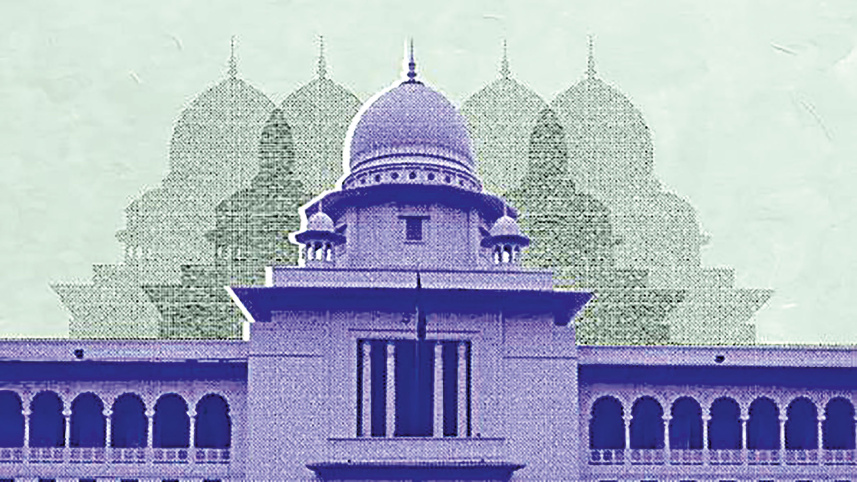
In the corridors of the Supreme Court of Bangladesh, a quiet jurisprudential revolution is unfolding- one rewriting the rules of comparative constitutional democracy. While international attention remains fixed on the country’s macroeconomic indicators and political transitions, its apex court has developed a sophisticated doctrine that legal scholars are already calling ‘prospective dormancy’- an idea so elegantly crafted that it deserves attention from anyone who believes a constitution must live, breathe, and adapt without breaking.

Historically a consumer of Western legal frameworks, Bangladesh is now ready to export a genuinely original contribution to comparative constitutionalism. The notion that a constitutional provision can rest like a sleeping giant within the supreme law, waiting for its precise democratic awakening, is Bangladesh’s unique gift to the world.
The doctrine addresses a foundational dilemma in constitutional theory: what happens when a court invalidates an amendment that dismantled democratic safeguards? The conventional answer is binary. Either the court applies the ruling retroactively, instantly resurrecting the old text and potentially invalidating years of governance, or it applies the decision prospectively, leaving a constitutional void in the interim. Both options carry severe costs. Retroactivity can punish good-faith governance and destabilise institutions; prospectivity leaves the unconstitutional framework in operation until a future date.
Bangladesh’s courts have found a third way. The groundwork was laid by the High Court Division (HCD) in Dr Badiul Alam Majumdar v Bangladesh. Here, the HCD struck down portions of the Constitution (Fifteenth Amendment) Act 2011, which had abolished the non-party caretaker government system- an interim mechanism designed to ensure free and fair elections by transferring executive power to a neutral technocratic administration during electoral periods. In invalidating the amendment, it revived the caretaker framework but limited its immediate operation to future electoral cycles. Past state actions were preserved under the doctrine of condonation and prospective invalidity.
The doctrine reached its apex refinement when the Appellate Division (AD), presided over by the former Chief Justice Syed Refaat Ahmed, adjudicated civil review petitions in Abdul Mannan Khan v Bangladesh. Following the July 2024 uprising and dissolution of the Twelfth Parliament, the AD confronted a practical paradox. If the caretaker provisions revived with full retroactive force, their operational triggers- predicated on the orderly dissolution of an active Parliament- could not interface with the ongoing extraordinary interim governance phase. A mechanical application of the resurrected text would create an operational impasse: constitutionally valid, yet functionally un-executable.
The AD’s response was intellectually courageous and pragmatically wise. It ruled that the restored provisions would lie dormant until the precise enabling circumstances specified in the text itself came into play. The non-party caretaker framework was reinstated into the supreme law, but its operational apparatus remains static- bridging the gap between the extraordinary dissolution of the Twelfth Parliament and the transition to the Thirteenth. By planting this constitutional ideal firmly in the soil of the next formal electoral cycle, the AD vindicated the Constitution’s basic structure- encompassing democracy, free elections, and the people’s constituent power- without detonating the existing transitional framework. That delicate balance between principle and practicality is the hallmark of mature constitutionalism.
This is what prospective dormancy means: the original or old text returns to the Constitution, valid and intact, but remains operationally quiescent until specific, textually defined conditions trigger its awakening. It is neither retroactive nor merely prospective. It is a deliberate temporal suspension of a living constitutional provision- textually alive but politically asleep, waiting for its precise democratic moment.
This doctrinal innovation must be distinguished from standard procedural tools. In Mohammad Saddam Hossen v Bangladesh, the HCD struck down executive-led modifications to Article 116, reviving the original 1972 text that vested control of the subordinate judiciary within the Supreme Court. Although the AD subsequently passed a stay order pending the final resolution of the state’s appeal, this procedural mechanism is fundamentally different from prospective dormancy. A stay order merely preserves the status quo during litigation; prospective dormancy is a final, substantive determination that treats a validated constitutional provision as capable of deliberate temporal suspension. One is a pause button; the other is a sleep timer.
Comparatively, Bangladesh now occupies unique territory in global constitutionalism. American jurisprudence has largely resisted prospective rulings, treating them as exceptions. The Indian Supreme Court, by contrast, pioneered prospective overruling to shield past transactions from the destabilising effect of new interpretations. Apex courts in Pakistan and Bangladesh have deployed the separate doctrine of condonation to validate past de facto governance when striking down unconstitutional regimes. These tools either protect reliance interests by delaying a ruling’s impact or sanitise past illegality without reviving the original constitutional text. The doctrine of prospective dormancy does neither: it revives the historic text immediately but regulates its temporal velocity, demonstrating that a constitutional provision can sleep within the supreme law until its precise democratic awakening.
Critics steeped in strict legal positivism may protest that a law is either valid or it is not; to declare a provision revived but dormant is, to them, rewriting rather than interpreting. Yet inflexible formalism borders on constitutional utopianism, remaining blind to the messy reality of political life. Prospective dormancy accepts that constitutions are not algorithms; they are compacts between generations requiring judicial mechanisms that respect both the text and the rhythm of the polity.
For Bangladesh, this innovation arrives at a pivotal moment. Our democracy has been tested by institutional conflict and executive overreach. The doctrine offers a constitutional roadmap that is principled without being destructive. It tells us we can correct past errors without burning the house down, proving that restoration can be patient, surgical, and wise.
Historically a consumer of Western legal frameworks, Bangladesh is now ready to export a genuinely original contribution to comparative constitutionalism. The notion that a constitutional provision can rest like a sleeping giant within the supreme law, waiting for its precise democratic awakening, is Bangladesh’s unique gift to the world. When Parliament eventually dissolves and circumstances align, the caretaker provisions will wake—not with the violence of retroactive upheaval, but with the quiet authority of a text that never truly left. That is the genius of prospective dormancy. Timing is everything.
The writer is Associate Professor of Law and Chair in the Department of Law at ZH Sikder University of Science and Technology.
 For all latest news, follow The Daily Star's Google News channel.
Comments