


Ethical use of animals in biomedical research in Bangladesh
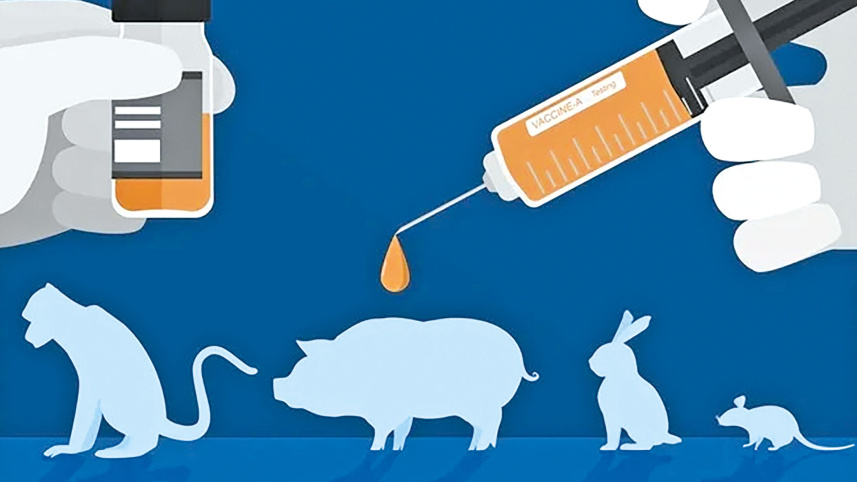
Using animals for biomedical research purposes has been a significant part of scientific studies for a long time. Animal models provide crucial information about human diseases, treatments, and potential preventive measures. Certain diseases and health conditions can only be examined through living organisms based on their anatomy, environmental conditions, and metabolism.
Over the last few decades, Bangladesh has advanced quite well in pharmaceuticals and healthcare services, leading to substantial development in its biomedical research sector. While science accelerated, the regulations governing the ethical use and humane procedures of animal testing in biomedical research remained underdeveloped. This write-up examines this legal gap and discusses the need to formulate an accountability mechanism dedicated to the ethical use of animals in biomedical research.

Bangladesh does not have any specific legal provisions addressing the use of animals in biomedical research. However, there are some laws that focus on the humane treatment of animals. The Animal Welfare Act 2019 replaced the Cruelty to Animals Act, 1920. Although the new act amended several outdated provisions but did not provide strong protection to animals used in research sectors. Section 6 of this Act prohibits actions that are unnecessarily cruel but section 6(4)(e) makes an exception for cruelty committed by government-approved educational and research institutions for education or research.
There is an acute lack of structured training programs to help researchers handle animals ethically. Many research facilities do not have sufficient funds, which makes it hard for them to develop new research methods and substitutes for animal models.
Another animal welfare law, the Wild Animals (Conservation and Security) Act 2026, focuses on protection and conservation of wild animals and biodiversity in Bangladesh. Section 26 of the Act makes it mandatory to seek permission from the warden or authorised officer for conducting research on wild animals in their habitat. A person may seek a permit for collecting and transporting animal organs or flesh for educational purpose, scientific research or management purposes under the Act. But due to its limited scope, this law only applies to wild animals.
As there is no specific national legislation, many research institutions (particularly in the biomedical and pharmaceutical sectors) and universities in Bangladesh follow internationally recognised guidelines such as the ICLAS guideline, Office of Laboratory Animal Welfare (OLAW) guidelines. For example, the International Centre for Diarrhoeal Disease Research, Bangladesh (icddr,b) established the Animal Resources Facility (ARF) in 1962 to supply laboratory animals in Bangladesh. The ARF is governed by the Animal Experimentation Ethics Committee, which has been registered with the OLAW since 2001. It oversees ethical treatment of animals in research and provides periodic review reports of scientific studies.
The Bangladesh Medical Research Council (BMRC) emphasises on humane treatment of animals in experiments and encourages minimising animal use. According to the Bangladesh Journal of Pharmacology, the principle of animal care in experimentation should follow the guidelines provided by the National Institute of Health (NIH), European Council Directive or any other comparable organisation.
Some institutions form Institutional Animal Care and Use Committees or/and adopt the 3Rs principle. The 3Rs principle is the worldwide gold standard for humane treatment of animals in research. This idea was originally proposed by William Russell and Rex Burch in the book The Principles of Humane Experimental Technique in 1959. The 3Rs of this principle represent- Replacement, Reduction, and Refinement.
“Replacement” focuses on avoiding animal use in research wherever possible and using a non-animal method instead, such as cell cultures, computer simulations, multi-organ chips, etc. “Reduction” refers to techniques that gather the same amount of information using fewer animals in the tests. The “Refinement” principle means modifying the experimental methods to minimise pain and distress for the animals involved. A few examples of refinement are better housing, use of anaesthetics and analgesics, humane animal handling, etc.
In comparison to Bangladesh, the international community has a significantly richer legislative framework for animal care in the biomedical sectors. Several international organisations set standards for animal welfare and health, such as the World Organisation for Animal Health (WOAH), the International Council for Laboratory Animal Science (ICLAS), etc. United Nations Convention on Animal Health and Protection (UNCAHP) is a global framework which has prohibited inhuman treatment of animals. Although it does not specifically address research animals.
Depending on cultural, ethical differences and scientific priorities, animal care laws differ across the globe. Some countries have comprehensive legislation strictly regulating the use of animals in research. Others have minimal or no specific legal frameworks. The United States, Canada, European Union, United Kingdom, Australia, Japan, India and many other countries have enacted specific laws and established observation committees to ensure ethical treatment of lab animals.
Unlike international communities and different other countries, Bangladesh’s current legislative framework in this area is rather neglected. Despite the existence of several institutional guidelines and ethical committees, the applicability of these rules and accountability mechanisms is still vague. Additionally, there is an acute lack of structured training programs to help researchers handle animals ethically. Many research facilities do not have sufficient funds, which makes it hard for them to develop new research methods and substitutes for animal models. Even professionals working in this field are not familiar with internationally recognised standards.
Bangladesh still relies on outdated laws and limited resources in this modern age of science. To fill this gap, we need new laws in the light of internationally recognised standards of animal care. Instating a centralised monitoring system can improve the oversight mechanism of animal use in research. It is also crucial to train researchers and lab professionals. Finally, the government should incentivise alternative techniques in order to replace animal models in experiments. Researchers, veterinarians, activists, and animal welfare organisations can give valuable suggestions to the government and work together to make an important difference. The country must strike a balance between the continuous growth of scientific research and the ethical use of animals in biomedical research.
The writer is law graduate from the University of Dhaka.
 For all latest news, follow The Daily Star's Google News channel.
Comments