MF Husain: The barefoot modernist who painted a civilisation in motion

Gods and goddesses, the eternal feminine, galloping horses, matinee idols -- these were less the subjects of Maqbool Fida Husain's canvases than fragments of a civilisation perpetually adjudicating between memory and modernity.
So, to call him merely a painter, then, is to mispresent the persona. He was a barefoot cultural nomad who turned visual imagination into a private, unmistakable dialect, and in doing so held up a mirror to the shifting society.

Born in Pandharpur, Maharashtra, on September 17, 1915, Husain's was an apprenticeship written in hardship long before it was written in paint.
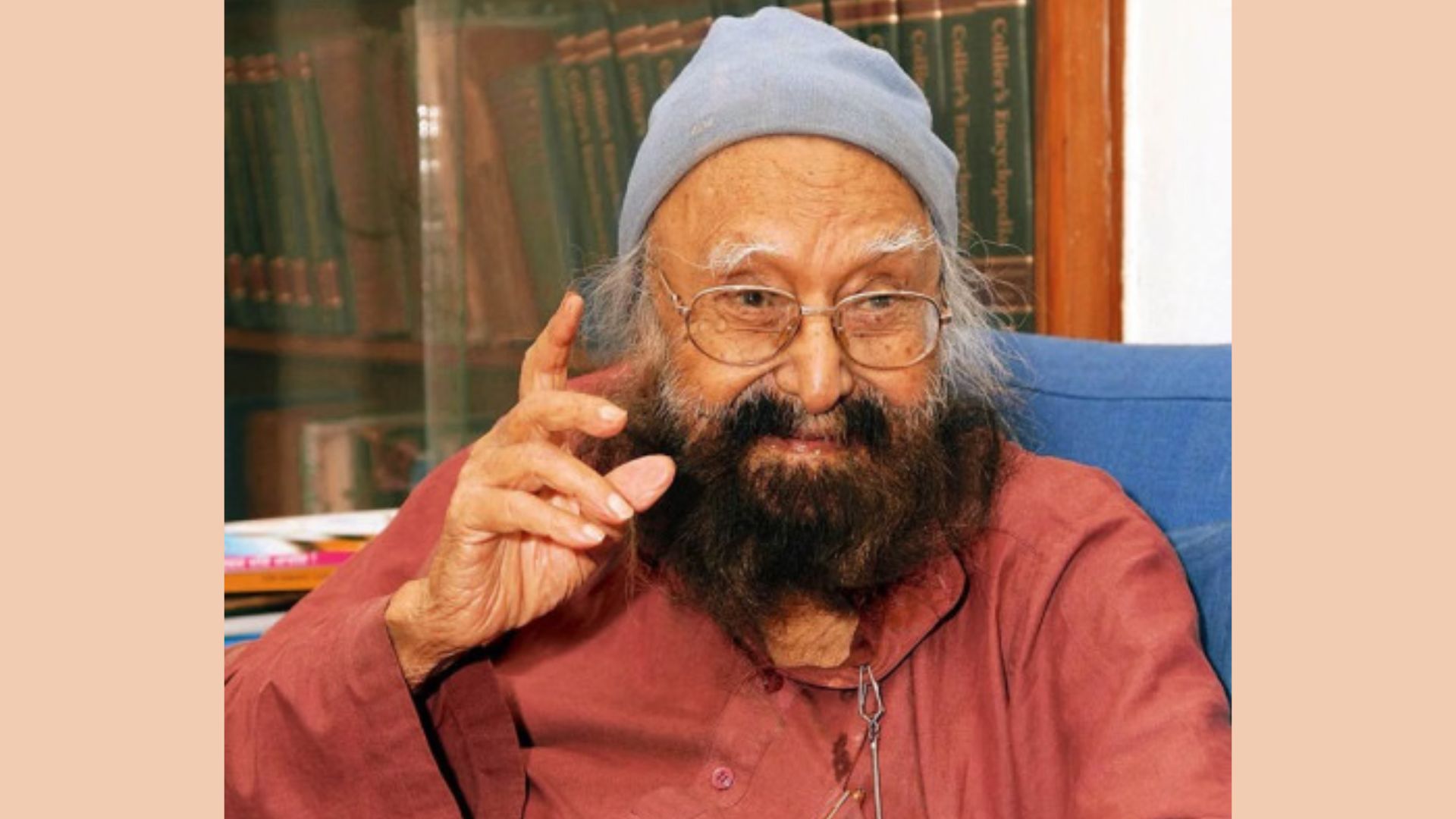
He lost his mother in infancy, a loss that would deeply shape his life and work. That early bereavement arguably influenced his recurring portrayal of women. He often depicted the feminine through bold abstraction and with an almost devotional intensity, presenting women as both creators and destroyers.
Raised thereafter by extended family, steeped early in Islamic calligraphy and the traditions of Indian folk art, he absorbed influences that would later fuse, unlikely and magnificent, with the imported vocabulary of European modernism.
He enrolled at Bombay's JJ School of Art in the 1930s to study classical technique, but it was the sidewalks of the city, not its studios, that truly forged him.
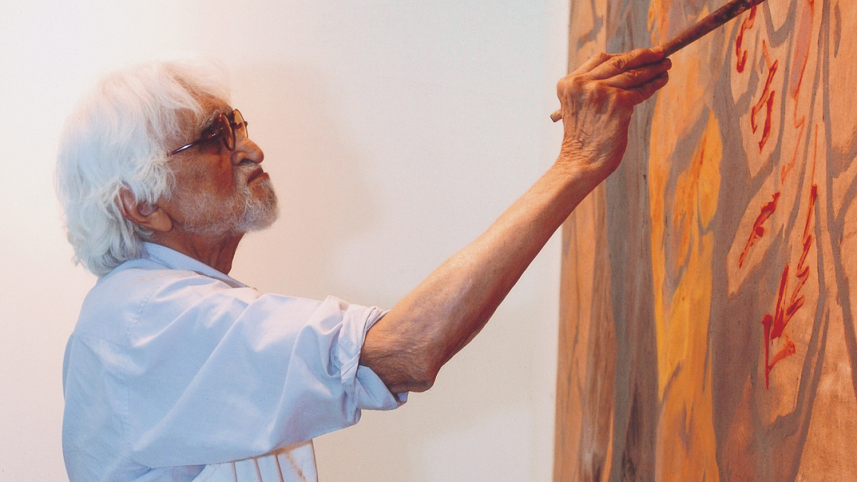
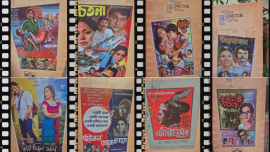
Struggling to straddle between earning and ambition, Husain painted cinema hoardings for a living -- an unlikely academy that taught him the audacity of speed and the confidence of scale.
Painting at a clip fast enough to catch the city's fleeting chaos gave Husain his signature idiom -- unrestrained, kinetic brushwork, saturated colour, and an instinct for movement.
By the 1940s he had become a founding figure of the Progressive Artists’ Group, a collective that sought to forge an authentically ethnocentric avant-garde by making Cubism and other European modernisms converse with, rather than supplant, indigenous myth, folk tradition, and the rhythms of everyday life.
European abstraction wedded to the rich iconography of temple art and the epics of the Indian subcontinent, was his particular genius -- not superficiality but synthesis.
At the heart of his oeuvre stood two recurring obsessions.
His horses, all angular muscle and arrested motion, were never merely animals. They became metaphors for raw, untamed energy -- the surge of aspiration in a newly independent nation and, perhaps, a reflection of Husain’s own restless, elemental temperament.
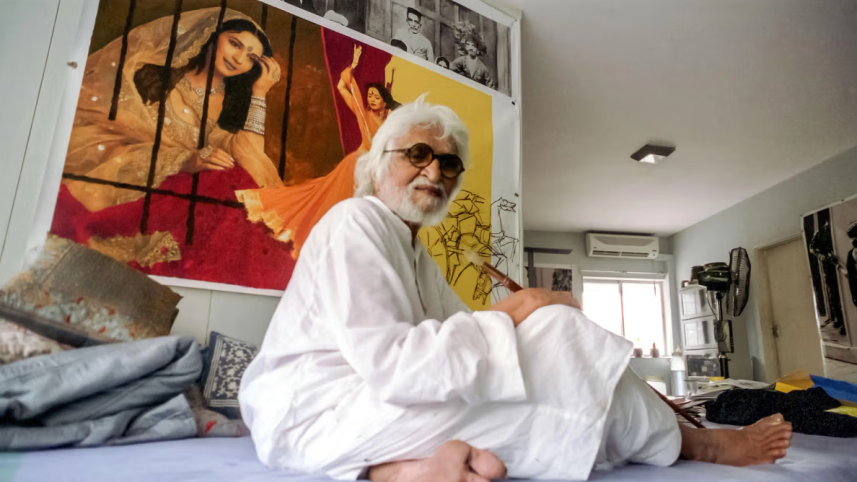
Meanwhile, the womanhood he painted -- rendered sometimes as public figures like Mother Teresa and sometimes as nameless goddesses -- carried the weight of both creation and destruction, the twin poles of his understanding of spirituality.
He painted the divine feminine not with the hushed reverence of miniature tradition but through a modernist's audacious abstraction, a choice that many read as celebration and others, fatefully, read as sacrilege.
In 1964, the highly admired poet Gajanan Madhav Muktibodh passed away. Husain was deeply shaken that such a brilliant literary mind had died in poverty, without ever seeing his own poems compiled and published as a book.
On his way back from Muktibodh's funeral in the scorching Delhi summer heat, Husain removed his shoes. He wanted to physically feel the searing pain and sorrow of his friend's tragic, unacknowledged life. He decided right then to never wear shoes again and maintained this signature barefoot look for the rest of his life as a personal philosophy, once stating it kept him connected to the earth and rejected the idea that footwear should dictate a person's social status.
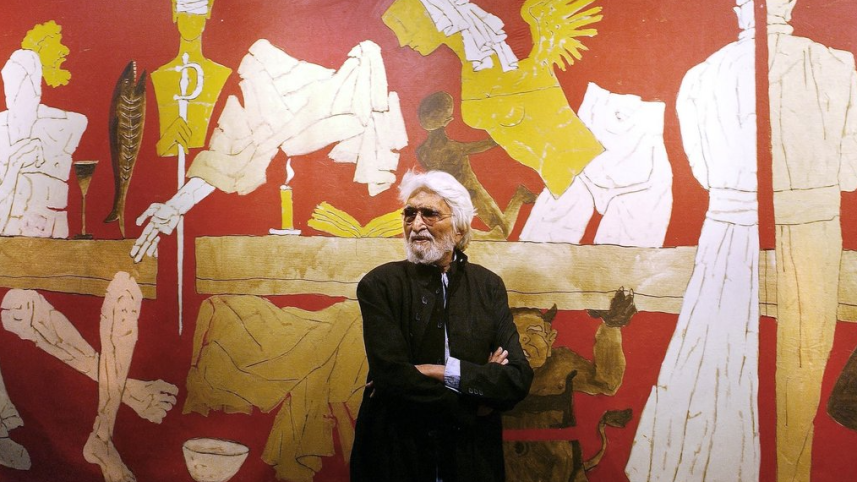
The only exception he ever made was wearing heavy boots during freezing European and New York winters to prevent frostbite.
Something close to a Renaissance figure, Husain was a painter, filmmaker, set designer, photographer, theatre-maker, a polymath for whom art was inseparable from the act of living itself.
 For all latest news, follow The Daily Star's Google News channel.
 His 1967 film Through the Eyes of a Painter carried the same restless visual grammar as his canvases and won him the Golden Bear at the Berlin International Film Festival; decades later, his experimental feature Gaja Gamini -- starring Madhuri Dixit, the muse who haunted much of his late work, with a special appearance by Shah Rukh Khan -- extended that same cinematic infatuation into the new millennium.
His fascination with Bollywood, Madhuri Dixit not least among his muses, found its way into both canvas and celluloid, further blurring a line he never much respected in the first place.
The friendship with Shah Rukh Khan, in fact, outlived the film itself, ripening into one of Indian art's more improbable and affectionate collaborations.
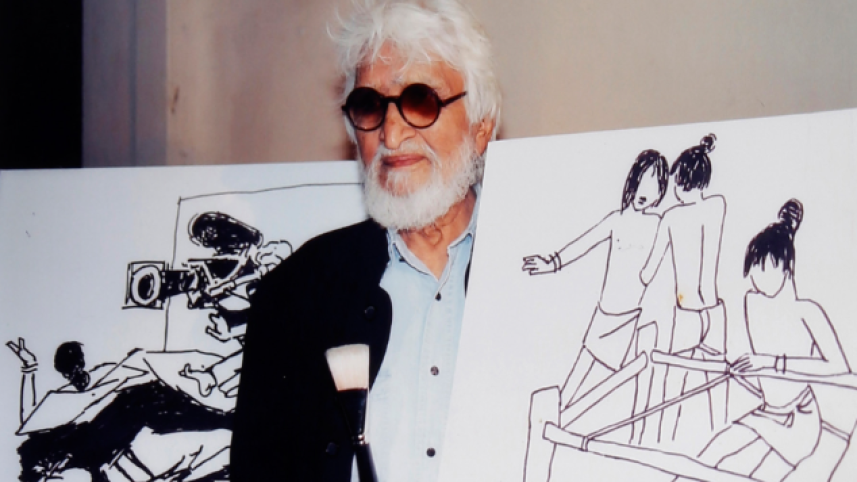
In 2001, Husain sketched a striking black-and-white tribute to Khan's performance in Asoka. In 2007, the two shared a canvas quite literally, painting together live at a Tehelka summit at London's Royal Society of Arts -- Husain rendering Khan against a scene from Mughal-E-Azam in a joint work titled "Art for Freedom".
When Husain died, Khan spoke of him with unguarded grief, a self-declared admirer whose home walls, he said, bore several of the master's paintings.
Yet that very expansiveness eventually narrowed, cruelly, into confinement.
The polymath who had once moved fluidly between street and salon, cinema and canvas, found his final years reduced to something closer to a recluse -- not by choice, but by circumstance.
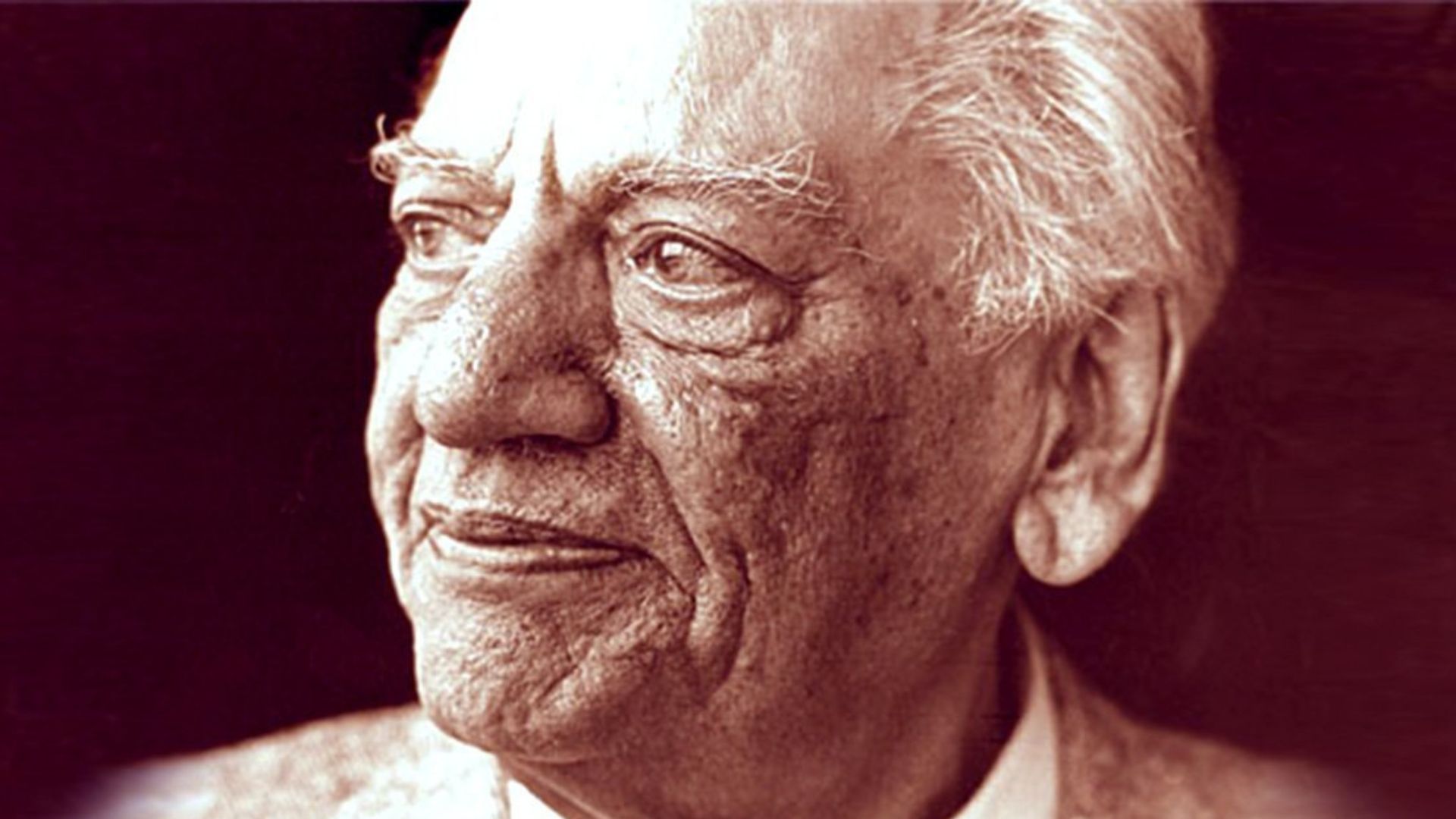
It was a bitter irony -- an artist whose entire imaginative universe was entangled with India's plurality was compelled to paint that plurality from abroad. He acquired Qatari citizenship in 2010 and died in London in 2011, an uncomfortable footnote to a story that should, by rights, have ended at home.
After a long life devoted to artistic expression, Husain remains, in the end, a cartographer of colour in a divided world. His work reflects an understanding that civilisations survive not only through their monuments and manuscripts, but also through their images -- and the debates those images provoke.
He was an iconoclast who never quite fit the frame others tried to build around him -- too devout for the secularists, too irreverent for the orthodox, too cosmopolitan for the nativists, too rooted to ever fully belong elsewhere.

Ed Sheeran and the ‘apolitical’ hypocrisy against ‘free Palestine’
‘Café de Volte’ set for two Friday shows

How cricket led Emon to cinema

Hritmancha’s ‘Happy Days’ to stage four shows at Dhaka University


Madonna to open VMAs with first live performance in 23 years
Rubaiyat’s ‘The Difficult Bride’ heads to Chicago after Venice and Toronto
‘I miss Bangladesh every single day’: Aparna Ghose
Timeless film posters displayed across BFDC on ‘Film Directors’ Day’